
3-Tab vs Architectural Shingles: Which Is Right for a Louisiana Home in 2026?
Architectural shingles cost about 25-40% more than 3-tab and last almost twice as long, with wind ratings nearly double (110-130 mph vs 60-70 mph). For Louisiana's hurricane exposure and current insurance market, architectural is the right answer for any primary residence the homeowner plans to keep for more than 5-7 years. 3-tab still makes sense for rental properties, garages and outbuildings, or homes selling within 3-5 years.
Walk into any Louisiana hardware store, and the asphalt shingle aisle shows two main categories side by side: 3-tab on the lower shelf, architectural on the higher one. The price tags are different. The marketing copy is similar. Most Louisiana homeowners replacing a primary residence roof in 2026 face a binary choice between the two.
The decision deserves more than the kitchen-table moment most homeowners give it. The cost difference is real but small. The lifespan difference is large. The wind rating difference is significant in hurricane country. And the insurance market reaction to the two categories has shifted enough in the past five years that the math on 3-tab in Louisiana looks different in 2026 than it did in 2018.
The Side-by-Side Comparison
| Factor | 3-Tab Asphalt | Architectural (Dimensional) |
|---|---|---|
| Materials cost / square (2026) | $90-$130 | $110-$170 (standard) / $150-$220 (premium) |
| Installed cost / sq ft | $3.50-$5.00 | $4.50-$7.00 (standard) / $5.50-$8.50 (Class 4) |
| Lifespan (real Louisiana climate) | 12-18 years | 22-28 years |
| Manufacturer warranty | 20-25 years | 30 years or "lifetime" |
| Wind rating | 60-70 mph | 110-130 mph |
| Layers | Single layer | Multi-layer laminated |
| Weight per square | ~200 lbs | ~250-340 lbs |
| Aesthetic | Flat, uniform appearance | Dimensional, shake-like appearance |
| FORTIFIED Roof eligible | No | Yes (with Class 4 IR rating) |
| Insurance discount eligible (LA R.S. 22:1483) | No | Yes (Class 4) |
Cost Difference — Smaller Than Most Homeowners Think
On a typical 2,500 sq ft Northshore home (25-30 squares of roof surface), the installed cost difference between 3-tab and standard architectural is meaningful but not dramatic:
| Material | 25-Square Roof | 30-Square Roof |
|---|---|---|
| 3-tab asphalt | $8,750-$12,500 | $10,500-$15,000 |
| Standard architectural | $11,250-$17,500 | $13,500-$21,000 |
| Class 4 architectural | $13,750-$21,250 | $16,500-$25,500 |
Architectural shingles run roughly $2,500-$5,000 more than 3-tab on a typical Northshore replacement. The gap closes further when comparing cost-per-year-of-roof-life: 3-tab at $11,000 over 15 years = $733/year. Architectural at $14,500 over 25 years = $580/year. The more expensive option is the cheaper option amortized over realistic lifespan.
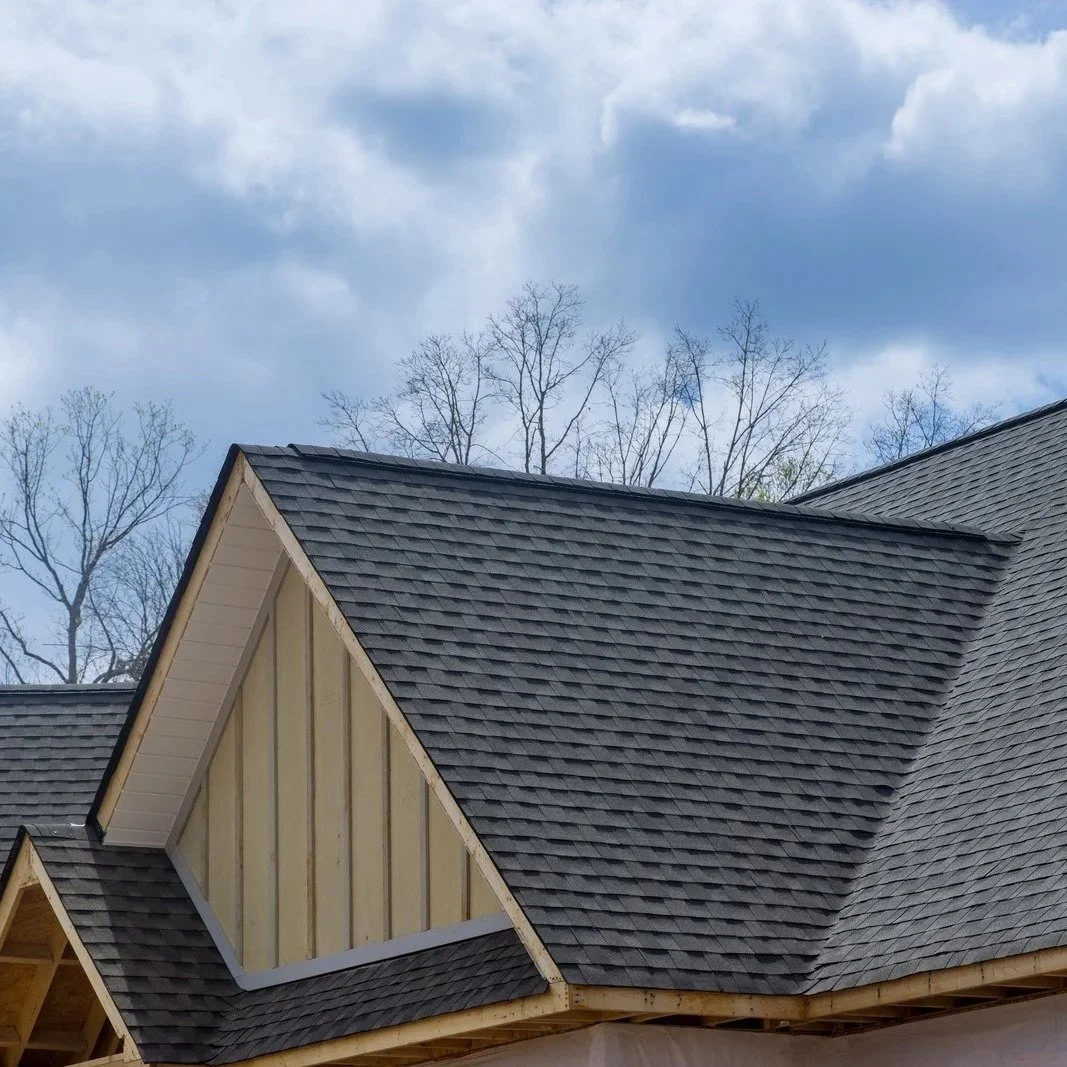
Architectural shingles provide Louisiana homes stronger wind resistance, longer lifespan, and better hurricane protection than traditional 3-tab roofing systems.
Lifespan — Where the Real Money Difference Sits
The manufacturer-stated lifespan and the real Louisiana lifespan differ for both products. Heat, humidity, UV intensity, and hurricane stress all shorten Gulf Coast roofing lifespan vs. national averages.
3-tab real Louisiana lifespan: 12-18 years
Manufacturer warranty: 20-25 years. Real Northshore experience: 12-18 years on a properly installed and maintained roof. The single-layer construction has less material to weather through, shingles become brittle from UV faster, and the adhesive seal between rows fails earlier than on multi-layer architectural.
Architectural real Louisiana lifespan: 22-28 years
Manufacturer warranty: 30 years or "lifetime." Real Northshore experience: 22-28 years on properly installed and maintained architectural. The thicker, multi-layer construction handles UV and humidity better, holds wind seal longer, and resists hail damage more effectively than 3-tab.
Real-world implication: a homeowner installing 3-tab in 2026 should plan for replacement around 2040-2044. Architectural installed in 2026 typically runs to 2048-2054. The 5-10 year lifespan difference is real money over a long ownership horizon.
Wind Rating — Why It Matters More in Louisiana
Manufacturer wind ratings represent laboratory-tested wind uplift resistance. The numbers reflect what the shingle can survive when properly installed.
3-tab wind rating: 60-70 mph typical. This is below Category 1 hurricane sustained winds (74+ mph). Direct hurricane landfall on the Northshore puts 3-tab roofs at high failure risk even in Cat 1 conditions. Hurricane Ida (2021), at Cat 4 landfall in nearby Lafourche Parish, produced widespread 3-tab failures across the broader Louisiana region.
Architectural wind rating: 110-130 mph typical. This handles Cat 1 and Cat 2 sustained winds and most Cat 3 sustained-wind exposure on the Northshore (where storms typically weaken to TS or Cat 1 by the time they reach St. Tammany Parish from southern landfall points). Class 4 architectural at the top of the wind-rating range (130 mph) is the practical Northshore standard.
What does proper installation add to the wind rating
Wind ratings assume manufacturer-spec installation: correct nail pattern, proper edge components, sealed deck where required. Improperly installed 3-tab fails at 50 mph; properly installed 3-tab hits the manufacturer’s rating. The same logic applies to architectural — the FORTIFIED Roof installation protocol (sealed deck, ring-shank nails, 6-nail high-wind pattern) pushes architectural shingle performance toward the upper end of the manufacturer-rated range.
The Louisiana Insurance Market Reality on 3-Tab
The largest single change in Louisiana roofing economics over the past five years is what insurance carriers have done with 3-tab roofs. The shift has been substantial enough that the upfront cost comparison is no longer the relevant decision driver.
Carriers limiting renewal on 3-tab past age 12-15
Most Louisiana admitted insurance carriers now limit or decline renewal on 3-tab roofs past age 12-15. Some refuse new policies on homes with 3-tab roofs at all. The cheaper-upfront math collapses when the insurance market refuses to renew the policy at year 13.
FORTIFIED Roof program ineligibility
FORTIFIED Roof certification under IBHS standards requires architectural shingles, a minimum. 3-tab roofs cannot qualify for the Louisiana Fortify Homes Program (Roof Strong) grant or the FORTIFIED state income tax credit, regardless of installation quality. The Louisiana FORTIFIED incentive value (up to $10,000 from either the Roof Strong grant OR the FORTIFIED tax credit, plus the recurring wind/hail insurance discount) is not available to 3-tab roofs.
Mandatory wind/hail discount ineligibility
La R.S. 22:1483 requires an actuarially justified wind/hail discount on FORTIFIED-designated roofs (carrier filings in 2026 typically produce discounts in the ~9-25% range) and on Class 4 impact-resistant shingles. 3-tab is neither, so the recurring premium discount is not available. On a typical Northshore home with a $4,000-$7,000 annual premium, the missed discount runs $750-$1,500 per year.
A new 3-tab roof in Louisiana 2026 saves roughly $3,000-$5,000 upfront vs Class 4 architectural — and gives up access to the FORTIFIED grant ($10,000), FORTIFIED tax credit ($10,000), recurring wind/hail discount ($750-$1,500/year), and most insurance carriers' willingness to renew the policy past year 13. The upfront savings are dwarfed by the foregone benefits within 2-3 years of installation.
Where 3-Tab Still Makes Sense
Three Louisiana scenarios where 3-tab remains a reasonable choice:
Scenario 1 — Rental properties or investment housing
Rental property economics often favor the lowest-upfront roofing cost. Investor calculations weigh capital expenditure against rental yield, and the absence of a primary-residence insurance discount for rental properties removes most of the architectural benefit. Many Louisiana rental property owners default to 3-tab on rental stock for this reason.
Scenario 2 — Garages, sheds, and outbuildings
Detached structures on residential properties — garages, sheds, carports, workshops — typically use 3-tab. The structures are not covered by primary-dwelling insurance discounts; the wind exposure is similar to the main house, but the consequences of failure are lower, and the upfront savings translate directly into ownership costs.
Scenario 3 — Selling within 3-5 years on a constrained budget
When the homeowner plans to sell within a short horizon, and the primary residence currently has 3-tab in good condition, replacing it with 3-tab maintains the existing roofing category at the lowest cost. Architectural would produce slightly higher resale value, but the premium vs. resale uplift math rarely favors the upgrade for short ownership.
Where 3-tab does NOT make sense
Primary residence the homeowner plans to keep 5+ years. Any home where insurance carrier renewal is at risk past year 12-15. Any home pursuing FORTIFIED designation. Any home where the homeowner wants the recurring wind/hail discount. In these scenarios — which describe most Northshore primary residences — architectural with a Class 4 rating is the right answer.
When Architectural Class 4 Specifically Wins Over Standard Architectural
Among architectural shingles, the choice between standard architectural and Class 4 impact-resistant is also worth running:
Class 4 wins for hurricane-zone primary residences
Class 4 unlocks the actuarially justified wind/hail discount under La R.S. 22:1483 (15-25% on the wind/hail portion of the premium). On typical Northshore premiums, the discount ($750-$1,500/year) pays back the $500-$1,500 Class 4 upgrade premium in 1-2 years.
Class 4 wins for FORTIFIED Roof projects
FORTIFIED Roof Hail Supplement requires Class 4 shingles. Most Louisiana insurance carriers also require Class 4 to grant the wind/hail discount even on the baseline FORTIFIED Roof (Bronze) designation, even though IBHS does not technically require Class 4 for the baseline.
Standard architectural wins for budget-tight, low-premium policies
Homeowners with annual premiums under $2,000 in less hurricane-exposed parishes see a smaller dollar discount on Class 4. The $500-$1,500 upgrade premium recovers more slowly. Standard architectural with proper FORTIFIED-grade installation is the smart-money compromise.
Real-World Performance Data from Recent Storm
Hurricane Ida (2021) and Hurricane Francine (2024) provided real-world performance data on both shingle categories across Louisiana. Three observations from post-storm Northshore inspections:
3-tab roofs over 12 years old failed disproportionately under Francine's tropical-storm-force Northshore winds — even where architectural roofs of similar age came through with minimal damage.
Class 4 architectural with FORTIFIED-grade installation produced the lowest claim incidence rate of any roof category. Insurance carriers cite this performance data when justifying ongoing wind/hail discount renewals.
Standard architectural without FORTIFIED installation performed better than 3-tab but worse than Class 4 FORTIFIED. The differential under non-major-hurricane sustained winds is largely about installation quality, not just shingle category.
Where This Doesn't Apply
Specialty roofs (designer, luxury, synthetic)
Designer asphalt shingles (Presidential Shake, Camelot II, Grand Sequoia, Berkshire) and synthetic composite shingles are separate categories from standard architectural — covered in the broader shingle types guide. The 3-tab vs architectural binary applies only to mainstream asphalt categories.
Metal, tile, slate
Non-asphalt roofing systems use entirely different materials, lifespans, and installation methods. Asphalt vs. asphalt comparison does not transfer.
Repair-only scope
Repairs use the same shingle category as the existing roof, not the upgraded category. A 3-tab roof being repaired uses 3-tab shingles; replacement is the only opportunity to upgrade categories.
Frequently Asked Questions
12-18 years in real Louisiana climate vs. 20-25-year manufacturer warranty. UV intensity and humidity shorten lifespan by 15-25% below national averages. Maintenance discipline (annual inspection, boot replacements, valley cleaning) pushes toward the longer end of the range.
For primary residences kept 5+ years, almost always yes. The lower annualized cost (longer lifespan), higher wind rating (hurricane exposure), and insurance market preference (carriers limit renewal on 3-tab past age 12-15) all favor architectural. Class 4 architectural further unlocks the FORTIFIED program and recurring wind/hail discount.
Louisiana code allows up to two layers of asphalt shingles before requiring a tear-off to the bare deck. Overlay (3-tab over 3-tab) is technically permissible but voids most manufacturer warranties, hides decking damage, and produces a shorter overall lifespan. Most reputable Northshore contractors do not recommend overlays.
Lower wind ratings, higher claim frequency in hurricane events, and shorter lifespans all contribute to higher loss ratios on 3-tab roofs. As Louisiana's insurance market tightened post-Hurricane Ida (2021), carriers increasingly limited or excluded 3-tab from new policies and renewal continuation. The trend is unlikely to reverse.
Technically, yes, within Louisiana's two-layer rule, but rarely advisable. The aesthetic mismatch (architectural shingles installed over the flat profile of 3-tab) often produces visible irregularity. Manufacturer warranties are typically void on overlay installations. Tear-off to bare deck and proper architectural installation are the standard recommendations.
For Most Louisiana Primary Residences, Architectural Is the Right Answer
The cost gap between 3-tab and architectural was a meaningful consideration ten years ago. In 2026, with Louisiana's tightened insurance market, the FORTIFIED program structure, and the actuarially justified wind/hail discount under La R.S. 22:1483, the math consistently favors architectural — specifically Class 4 architectural — for any Northshore primary residence kept more than 5-7 years. 3-tab still has narrow legitimate use cases (rentals, outbuildings, very-short-horizon ownership), but the default for primary-residence replacement should no longer be 3-tab regardless of upfront budget. The five-year ownership horizon is where the math tips. Above that, architectural wins.
