
Signs It’s Time to Replace Aging Siding, Not Repair It
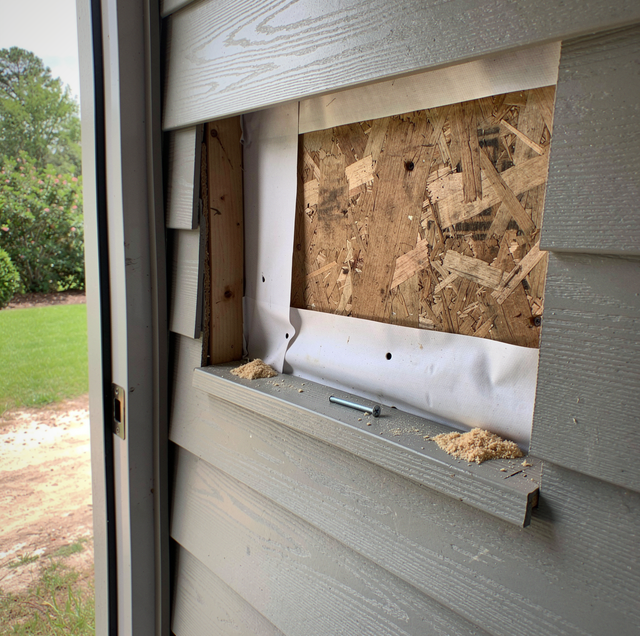
A cracked panel under the kitchen window. A corner where two runs no longer meet cleanly. A stretch of wall that sounds hollow and gives when you push on it. Every one of those has a fix. A siding crew can pull the damaged course, set a new piece, and leave a wall that sheds water for another decade.
That is what makes the decision hard. Siding almost never shows a defect that cannot be repaired in isolation. The question is not whether the bad piece can be swapped, but whether the wall around and behind it still works. Five conditions decide that, and each has a repairable version and a version that ends the conversation.
One Failed Board Is a Repair, a Repeating Pattern Is Not
Start with where the damage is, not how much there is. A single split panel with a clean impact point, a gouge at ladder height, a piece knocked loose by a branch: those are events. The wall around them is intact, and cutting in a new piece ends the problem.
A pattern changes the answer. When the same defect appears on more than one wall, or repeats along a line rather than at a spot, the cause is not something that happened to the siding. It is something the siding is doing. Splits along a nail line across a full run point at the fastening. Soft, swollen edges in the lowest two courses on several walls point at splash and grade. Buckled panels in a narrow vertical band point at a stud line and the water tracking down it.
Extent has a mechanical edge too. Removing one course of lap siding means unfastening the course above it, so every single-piece repair is a two-course operation, and ten scattered repairs mean handling most of a wall twice. Frequency counts as extent as well. Caulking the same joints every spring, or repainting on a shortening cycle, says the material has stopped holding a finish, a whole-wall condition rather than a spot.
The Water Barrier Behind the Panel Decides Most Replacements
Siding is a shedding layer, not a waterproof one. Wind-driven rain gets behind panels at butt joints, corner posts, and window heads, and the assembly is built on the assumption that it will. What keeps that water off the framing is the weather-resistive barrier fastened to the sheathing, the flashing at each opening and penetration, and a drainage path that lets it run back out at the base.
So a missing panel is not an emergency and a torn barrier is. A wall with intact housewrap, lapped so each upper piece runs over the one below and flashed at the window heads, can lose a panel in a storm and stay dry underneath. A wall where the barrier is brittle, split at the fastener lines, or lapped backward has been wetting its sheathing every time it rains.
None of it shows while the siding is up, which is why an honest answer arrives after a panel comes off. What a crew looks for behind it is dark staining, oriented strand board with swollen, crumbling edges, plywood with separating plies, framing that gives under a probe, and fastener heads pulled through. The inside of the house sometimes shows it first: paint blistering on the room side of an exterior wall, wallpaper lifting at a seam, soft drywall near a window, or a musty smell in a closet on an outside wall. The line is crossed when the barrier fails over an area rather than at a point, or when the sheathing has lost strength. Neither can be judged from the ground, and neither can be corrected from outside with the panels in place.
Fasteners and Attachment Integrity Set the Patching Limit
Vinyl is not nailed tight to a wall. It hangs. Each panel locks into the one below and is fastened through elongated slots in a nailing hem along the top, with the nail left slightly loose so the panel can slide as it heats and cools. A twelve-foot panel changes length by roughly half an inch across the temperature swing a wall sees in a year, and the rest of the system assumes it.
Years of movement and wind load widen the slots until the nail no longer holds its position. The hem tears through at the slot, the head pulls free, and panels slip out of alignment or drop out of the course below, leaving open seams that admit insects into the cavity as readily as water. Once a run has torn hems, there is no re-hanging it: a nail driven outside the original slot pins the panel, and a pinned panel buckles on the first hot afternoon.
Fiber cement and engineered wood fail differently in attachment. Both are blind-nailed through the top edge into studs or rated sheathing, with the next course hiding the fasteners. When that edge has crumbled, or the framing behind the nail line has decayed, a new plank has nothing to bite, and face-nailing it opens a water path at every head. It stops being a repair when the fastening surface is gone along a run.
Every Siding Material Ends Its Life in Its Own Way
Age alone condemns nothing. Every material has its own end-of-life behavior, though, and knowing which is on the wall tells you whether a defect is local or the start of a whole-surface failure.
Vinyl is PVC blended with impact modifiers and ultraviolet stabilizers. Sunlight breaks down that stabilizer package: the surface chalks, color fades unevenly, with sun-facing walls going first, and the material loses its ability to flex. Old vinyl that is also cold does not dent; it cracks. When panels break during ordinary handling, the wall can no longer be worked on.
Fiber cement is cement, sand, and cellulose fiber pressed into board. It handles weather well on its face and badly at a raw edge. Every cut made on site leaves unsealed board unless someone primes it, and water wicking into that edge swells the fiber and separates the layers. Delaminating bottom edges and crumbling around fastener heads are the material coming apart, not a coating problem.
Cutting fiber cement releases respirable crystalline silica. Score-and-snap tools, shears, wet cutting, or a saw fitted with vacuum dust collection keep the dust down. Dry cutting with an ordinary circular saw does not, and the exposure is invisible.
Wood and engineered wood both fail from the lower edge and end grain upward, and both hide it. On cedar or pine, the paint film sits on the face while decay works through the back and the underside, so a board can look freshly painted and still crush under thumb pressure. Engineered siding is wood strands bound with resin and wax, and once water enters at a cut end or a fastener penetration, the substrate swells and does not go back.
Aluminum is the outlier. It neither rots nor embrittles. It dents permanently, because the metal deforms rather than springing back, and its finish chalks as the binder oxidizes.
| Material | How It Ends Its Service Life | Past the Line When |
|---|---|---|
| Vinyl | UV depletes the stabilizer package; surface chalks and panels embrittle | Panels crack on removal, or nailing hems tear along a run |
| Fiber cement | Water wicks into unsealed cut ends; layers swell and separate | Delamination at edges and fastener heads on several walls |
| Wood | Decay from lower edges and end grain, hidden behind intact paint | Soft boards behind sound paint across a whole course |
| Engineered wood | Substrate swells at cut ends and fastener penetrations, permanently | Swollen edges with cracked factory finish repeat along a run |
| Aluminum | Dents permanently; finish chalks as the binder oxidizes | Denting is widespread, or panels are torn at seams |
A Repair Only Holds if Matching Material Still Exists
The last threshold has nothing to do with condition. Profiles and colors are discontinued, and a repair requires stock that matches the geometry and appearance of what is already up.
Geometry comes first. A vinyl wall may be double four-inch, double five-inch, dutch lap, or board and batten, and a plank wall may be a width the manufacturer stopped making. The replacement has to lock into the courses above and below and sit in the same plane, or the patch leaves a step and a different shadow line mid-wall.
Color is the harder half. Vinyl carries its color in the material rather than in a field-applied coating, so matching a single patch panel by painting it is not a real option: a painted panel reads differently in raking light and weathers on a different schedule than the wall around it. Even a current color carrying the same name will not match, because the wall beside it has been fading for fifteen years.
One move remains: harvest sound panels from a back elevation to patch a visible wall, and put the new stock where nobody looks. That buys time until the donor walls run out. The repair option closes when the profile is gone or when salvageable matching stock runs low.
What Does Not Push a Wall Past the Line
Plenty of siding gets replaced for reasons that do not hold up, and faded color leads the list. A wall gone dull and uneven still locks together, still sheds water, and still protects the barrier behind it. Appearance and performance are separate measures, so a color complaint is a paint question, not evidence that the assembly has failed.
Paint on a house built before 1978 is presumed to contain lead. Scraping, sanding, or power washing it during siding work spreads chips and dust across the yard, so containment, careful cleanup, and a lead-safe certified crew are standard practice.
Isolated impact damage stays a repair. One panel cracked by a thrown rock, a dented run at mower height, a section pulled loose by a gust: the wall around it is intact, and the fix is local. Repeated wind and hail exposure warrants a look at every wall, since the damage often hits the elevation nobody walks past. Record each wall before material comes off.
The five thresholds determine it: how far the defect extends, what the barrier and sheathing behind it are doing, whether anything remains to fasten to, whether the material has reached end of life, and whether matching stock still exists. One crossing is enough.
Frequently Asked Questions
Often yes, and on vinyl the removal decides. A panel is freed with a zip tool, the hooked blade that reaches under the butt lock of the course above and releases it while the nails below are pulled. Past roughly twenty years, that flex is gone, so the course above snaps and a one-panel job becomes a three-panel job.
Not from outside. A pin-type moisture meter with insulated pins reads sheathing at depth, and wood held above roughly twenty percent moisture content supports decay fungi rather than drying. A blunt probe that sinks past about a quarter inch under light pressure has found material that will not hold a fastener. Both need the siding open.
On fiber cement, it matters more than almost anything installers skip. Field-cut edges need to be sealed or primed before the plank goes up, with clearance at the base, commonly six inches above finished grade and one to two inches above a roof surface or flashing. A plank set tight to a deck ledger wicks there whatever the face coating.
Vinyl can be painted, with one constraint: the new color must be no darker than the original unless the product is rated vinyl-safe, because a dark coating absorbs more heat and warps panels engineered to expand at a lighter reflectance. A 100% acrylic rated for vinyl is the usual choice. Aluminum is easier: wipe it with a dark cloth, and if chalk transfers, it needs washing and a bonding primer.
Shoot each wall whole from a distance, then close-ups of each defect with a coin or tape measure in frame for scale, and note the date the damage was found. Keep one removed panel rather than sending everything to the dumpster, since the back usually carries the manufacturer and profile stamp identifying the wall. Matching questions vary by policy and adjuster, so raise those with your insurer.
On a full replacement, that is the part worth watching, because it is the only time the wall is open. A new weather-resistive barrier goes on in courses from the base upward so each sheet laps over the one below, commonly six inches at vertical seams and two inches at horizontal ones, and it ties into flashing above the windows and a pan under each sill. A patch repair delivers none of that.
Schedule a siding inspection — get a clear answer on whether your wall is a repair or a replacement. Epic Roofing LLC serves Mandeville, Covington, and Baton Rouge. Call (225) 819-3742.
