
The Anatomy of a Roof: Every Layer Explained (and Why Each One Matters in Louisiana)
A residential roof is not one thing. It is nine engineered layers (plus the attic ventilation system that affects all of them) that have to work together to keep water out and stay attached in hurricane wind. The layer most homeowners do not know exists — the underlayment — fails before the visible shingles do, and is the reason a 25-year-rated roof in Louisiana often needs replacement at year 18.
Most Louisiana homeowners walk into a roofing conversation knowing the word "shingle" and not much else. The contractor talks about decking, underlayment, ice and water shield, drip edge, ridge cap — and the conversation either becomes useful or becomes a pricing fight. The difference is whether the homeowner understands what each component actually does.
What follows is the layer-by-layer anatomy of a Northshore residential roof, from the framing up to the visible surface. Each layer's job, what fails first in Louisiana's climate, what an honest replacement scope addresses, and why some line items matter more here than they do in dry-climate national articles.
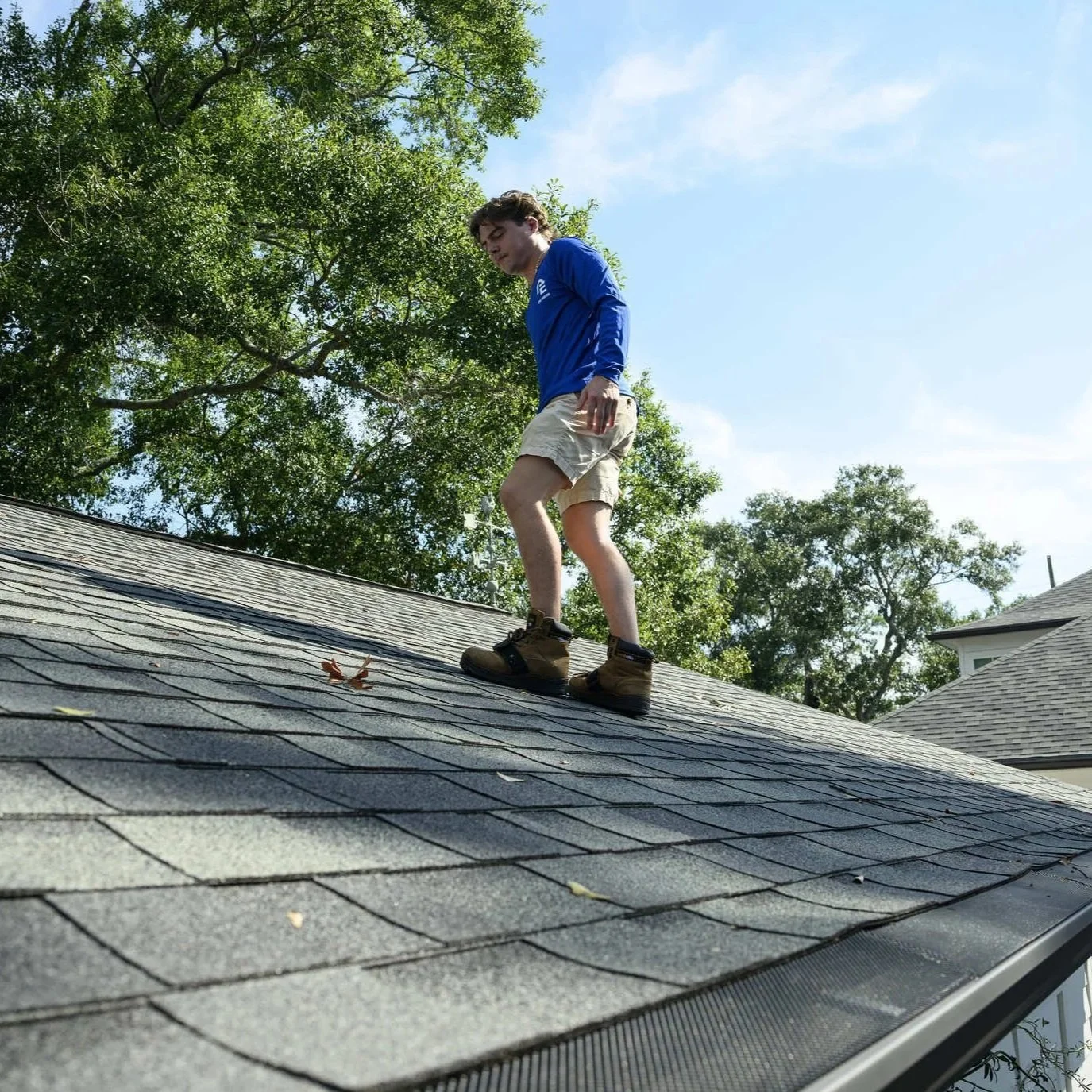
Roof inspector examining architectural shingles during Louisiana roofing assessment to identify storm damage, ventilation issues, and installation quality concerns.
The 9 Layers of a Residential Roof — Plus the Ventilation System That Supports Them
Layer 1 — Rafters or trusses (the structural skeleton)
Wood framing members spaced 16 or 24 inches on center that span from the wall plates to the ridge. Rafters are individual sloped members; trusses are factory-built, triangulated assemblies. Both carry the dead load of the roof itself plus live loads from wind, rain, and the occasional roofer.
What fails in Louisiana: Water-damaged rafter tails at the eaves from years of clogged gutter overflow, and uplift damage at the ridge from hurricane-force winds. Rafter or truss damage is rarely addressed in a standard re-roof scope — when discovered, it triggers a structural repair conversation separate from the roofing project.
Layer 2 — Roof decking (the structural sheathing)
OSB (oriented strand board) or plywood sheathing nailed across the rafters. Modern Louisiana decking is typically 7/16-inch OSB or 1/2-inch CDX plywood. The decking provides a continuous nailing surface for the underlayment and shingles, plus structural diaphragm stiffness for the framing.
What fails in Louisiana: small leaks above failed flashing or pipe boots create wet zones that delaminate OSB and rot plywood. By the time the contractor tears off the old roof, most Northshore homes 20+ years old need 2-8 sheets of decking replaced. Severe cases need 20+ sheets. Replacement runs $80-$120 per sheet installed in 2026.
Honest scope detail: the estimate should include a decking allowance (typically 4-6 sheets) plus a per-sheet rate for additional sheets. Estimates that say "decking included" without a count or rate are the estimates that surprise the homeowner with mid-project add-ons.
Layer 3 — Underlayment (the secondary water barrier)
Continuous sheet material installed over the decking before shingles. Felt paper (15# or 30# asphalt-saturated paper) is the traditional product; synthetic underlayment (polypropylene-based products like GAF Tiger Paw, CertainTeed RoofRunner, Owens Corning ProArmor) is the modern standard.
Why this layer matters more in Louisiana: when shingles get lifted by hurricane wind, the underlayment becomes the only thing keeping water out of the deck. Felt paper tears under sustained wind. Synthetic underlayment holds. The cost difference is $200-$400 per project; the lifespan difference is 10-15 years. Quality contractors specify synthetic underlayment as a standard line item.
Layer 4 — Ice and water shield (the secondary barrier in vulnerable zones)
Self-adhering membrane installed in roof zones where wind-driven rain and water backup are most likely: along eaves, in valleys, around all roof penetrations (chimneys, skylights, plumbing vents), and along sidewalls. While baseline IRC R905.1.2 requires ice and water shield only in cold climates where ice forms at eaves, Louisiana FORTIFIED Roof standards, many parish jurisdictions, and most insurance carriers require or expect it on Louisiana residential roofs as best practice.
What ice and water shield does that underlayment cannot: when shingles fail in a specific area, the self-adhering membrane creates a watertight seal around fastener penetrations. Standard underlayment only resists water; it does not seal. Ice and water shield is what prevents one shingle failure from becoming a six-figure interior water damage event.
Honest scope detail: The estimate should specify how many feet of ice and water shield are being installed. A typical Northshore home needs 2-4 rolls (one roll covers about 200 sq ft).
Layer 5 — Drip edge (the perimeter metal trim)
L-shaped or T-shaped metal flashing installed along eaves and rakes before underlayment (at eaves) or after underlayment (at rakes). Drip edge directs water off the roof and away from the fascia, preventing the rot pattern that destroys eave framing.
Why drip edge matters in Louisiana: gutter overflow during heavy rain pushes water back under the shingle edge. Drip edge intercepts the water and routes it to the gutter or beyond. Roofs without a proper drip edge develop fascia rot within 5-7 years. The 2021 IRC requires a drip edge on all Louisiana residential roofs.
Honest scope detail: drip edge should specify gauge (0.019-inch minimum), color, and linear feet. Aluminum drip edge is standard; galvanized steel is also acceptable. Plastic drip edge is non-compliant with most Louisiana code adoptions.
Layer 6 — Starter strip (the first shingle row)
Specialized shingle product installed at eaves and rakes before the field shingles. The starter strip provides the adhesive bond that the first row of field shingles seals to. Without a starter strip, the first row of shingles has nothing to bond to and lifts in the wind.
Why starter strip matters in Louisiana: hurricane uplift forces concentrate at roof edges and pull shingles off in clusters. A proper starter strip with manufacturer-matched product creates the wind-rated edge seal that prevents this failure pattern. Field-cut three-tab shingles used as a starter (a cost-cutting shortcut) defeat the wind rating of the entire roof.
Layer 7 — Field shingles (the visible roof surface)
The shingle layer that gets all the homeowner's attention. Architectural asphalt is the Northshore standard ($4.50-$7.00 per square foot installed); Class 4 impact-resistant adds $500-$1,500; designer or synthetic options sit higher. Wind ratings range from 60-70 mph (3-tab) to 110-150 mph (Class 4 architectural and synthetic composite).
What homeowners do not know about field shingles: the visible shingle is the third or fourth most-failure-prone layer in the system. Underlayment, flashing, and pipe boots fail first in Louisiana. The shingle is replacing the LAST line of defense, not the first.
Layer 8 — Flashing (the seam protectors)
Metal sheets that protect every roof transition where water might enter: chimney sides (step flashing + counter flashing), sidewalls where roof meets wall (step flashing), valleys where two roof planes meet (valley flashing), and around plumbing vents (pipe boots). Flashing is geometry, not sealant — properly installed flashing sheds water through overlap, with sealant as a secondary barrier only.
Why flashing fails in Louisiana: the most common single source of roof leaks on Northshore homes 5-10 years old is failed pipe boot flashing — the rubber collar around plumbing vents that cracks from UV exposure in 5-10 years. Step flashing on chimneys is the second most common failure point. Honest scope replaces these during any re-roof; cheap scope reuses old flashing and creates the next leak.
Layer 9 — Ridge cap (the peak finish)
Specialized shingle product installed along the ridge (peak) of the roof. Ridge cap covers the joint between the two slopes that meet at the ridge and integrates with ridge venting if the roof has it. Standard architectural shingle systems use a manufacturer-matched ridge cap that carries the same wind rating as the field shingles.
Why the ridge cap matters in Louisiana: the ridge is one of the highest-uplift zones during hurricane winds. Improperly attached ridge cap lifts off in clusters, opens the ridge to water entry, and frequently triggers full roof failure starting at the peak.
Bonus Layer — Attic Ventilation
Not technically a roof layer, but the attic ventilation system directly affects shingle lifespan. Properly vented attics maintain temperatures within 10-15 degrees of outdoor ambient; under-vented attics in Louisiana summer can reach 140-160°F. The heat cooks the underside of the shingles and can shorten the lifespan by 5-10 years.
Two main components: intake vents at the soffit (eaves) and exhaust vents at the ridge. The IRC requires 1 sq ft of net free vent area per 150 sq ft of attic space (1:150 ratio), or 1:300 with a vapor barrier. Most Northshore homes need 8-15 sq ft of total ventilation, depending on attic size.
Ventilation is the cheapest single upgrade during a re-roof. Adding or upgrading ridge vent runs $400-$800 on a typical Northshore project — and extends shingle life enough to pay back through delayed replacement easily.
Why the Layer-by-Layer View Changes the Cost Conversation
Two contractors quoting the same roof can produce $5,000 different total prices because they are quoting different layer scopes. Reading both quotes layer by layer reveals where the money is going and what each contractor is actually replacing.
| Layer | Cheap-Scope Pattern | Honest-Scope Pattern |
|---|---|---|
| Decking | 0-1 sheet allowance | 4-6 sheet allowance + per-sheet rate |
| Underlayment | 15# felt paper | Synthetic underlayment by name |
| Ice & water shield | Eaves only or omitted | Eaves + valleys + all penetrations + sidewalls |
| Drip edge | Reuse existing or omitted | New 0.019" aluminum, full perimeter |
| Starter strip | Field-cut 3-tab | Manufacturer-matched starter product |
| Flashing | Reuse existing flashing | New step + counter + valley + pipe boots |
| Ridge cap | Field-cut 3-tab | Manufacturer-matched ridge cap |
| Ventilation | Existing preserved (no audit) | Net free vent area calculated, ridge vent if needed |
The cheap-scope pattern produces apparent savings of $1,500-$3,500 on the contract. Within 2-5 years, the homeowner pays back the savings through premature failures: underlayment lifespan cut in half, leaks at flashing details, fascia rot from missing drip edge, and shingle blow-offs starting at the edges. The cheap scope is almost never the cheap outcome.
An estimate that does not specify each of the nine layers for each line item is one the homeowner cannot evaluate. The contractor who walks through the layer-by-layer breakdown during the inspection conversation is the contractor who has thought through the project. Vague estimates produce surprise add-ons.
Where This Doesn't Apply
Flat commercial roofs
Commercial flat-roof systems use a different layer architecture: deck → insulation board → cover board → membrane (TPO/EPDM/modified bitumen). The components and installation methods are completely different from sloped residential.
Standing seam metal roofs
Metal roofs replace shingles + starter + ridge cap with metal panels and ridge closures. Underlayment, decking, drip edge, and flashing concepts still apply. Metal-specific installation details are outside this guide's scope.
Frequently Asked Questions
Underlayment and flashing are the two most failure-prone layers. Both fail before the visible shingles in Louisiana’s climate. The shingle gets all the attention; the underlayment and flashing do most of the actual waterproofing work.
Layers 2-9 typically get inspected and replaced as needed during a full re-roof. Decking is replaced where damaged. Underlayment and ice and water shield are always replaced. Drip edge, starter, ridge cap, and shingles are always replaced. Flashing is replaced where damaged or worn. Layer 1 (rafters/trusses) is structural and outside the standard re-roof scope.
Decking: 30+ years if no leaks. Synthetic underlayment: 25-30 years. Felt underlayment: 12-15 years. Ice and water shield: lifespan of the roof. Drip edge (aluminum): 30+ years. Architectural asphalt shingles: 22-28 years. Pipe boots: 5-10 years. Step flashing (aluminum or galvanized): 25-40 years.
Yes — overlay roofing installs new shingles over existing shingles. Louisiana code allows up to two layers. Overlays save tear-off labor but hide decking damage, void most manufacturer warranties, add weight that stresses framing, and produce a shorter overall lifespan. Most reputable Northshore contractors will not quote overlays because the long-term math works against the homeowner.
Underlayment is a continuous water-resistant sheet that covers the entire roof deck. Ice and water shield is a self-adhering membrane installed in specific high-vulnerability zones (eaves, valleys, around penetrations) that seals around fastener penetrations. Both are installed; ice and water shield is the upgrade for the zones where leaks are most likely.
The Roof Is the Sum of Its Layers
A roof works because nine layers do their specific jobs together. When the conversation about a replacement project gets specific about each layer, the homeowner can evaluate the contract. When the conversation stays at "new shingles, $15,000," the homeowner has no way to know whether the project will last 10 years or 25. The anatomy is what makes the financial decision a real one, not just a sticker price.
