
What Causes Roof Leaks Around the Chimney? A Flashing Breakdown
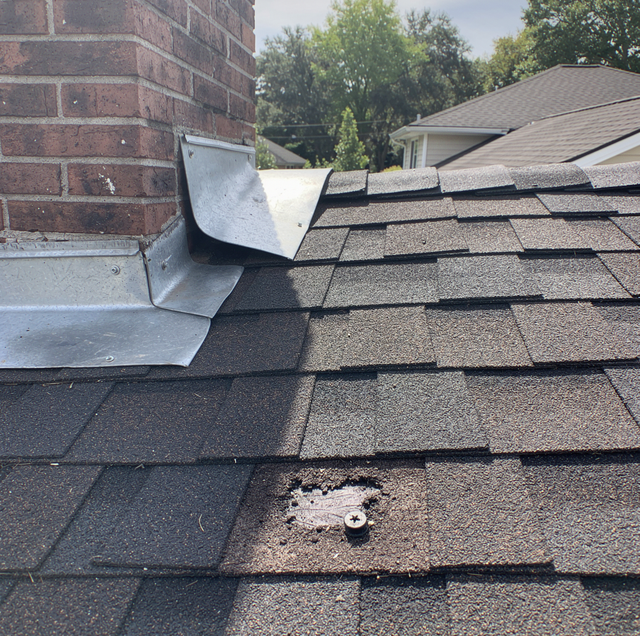
A water stain on the ceiling near the fireplace rarely means the chimney itself is failing. Brick and mortar hold up fine against rain on their own. The leak almost always starts at the joint where the chimney meets the roof plane, a spot made of several distinct materials that must work together to shed water. When one of those pieces slips, corrodes, or opens even a small gap, water finds its way in during the next heavy rain and keeps finding that same path until someone fixes the actual point of entry.
Understanding what's happening at that joint makes it much easier to explain a leak to a roofer, catch a problem early, or know what questions to ask during an inspection. Below are the main mechanisms behind chimney leaks, starting with the flashing system itself.
Step Flashing Is Built To Move With The Roof
Step flashing is the small, individual pieces of metal woven into the shingle courses along the side of a chimney, one piece per shingle row, each overlapping the one below it like fish scales. That layered design lets water run down the roof slope, hit a piece of flashing, and get redirected onto the shingle surface instead of soaking into the roof deck.
The system depends on every piece staying in the right position and overlapping correctly. If a roofer installs step flashing with gaps between pieces, uses too few pieces for the number of shingle courses, or lets nails or fasteners puncture a flashing piece in the wrong spot, water gets a straight path through. Step flashing can also work loose over years of roof expansion and contraction, freeze-thaw cycles, and foot traffic from chimney sweeps or repair crews walking near the chimney base. Once a single step flashing piece shifts out of line, the whole shingled overlap above it stops doing its job, and water starts tracking sideways into the roof deck rather than draining down and off.
Counter-Flashing Has To Seal Against The Chimney Itself
Step flashing handles water moving down the roof, but it doesn't attach directly to the chimney. That's the job of counter-flashing, a second layer of metal set into a groove cut in the mortar joints and bent down to overlap the top edge of the step flashing below it. Counter-flashing prevents water running down the brick face from getting behind the step flashing and into the roof structure.
This is where a surprising number of leaks originate, because counter-flashing relies on two separate connections holding tight at the same time: the metal-to-mortar seal at the top and the metal-to-metal overlap at the bottom. If the counter-flashing was set too shallow into the mortar joint, or the mortar around it starts to crack and pull away, water works its way behind the metal from above. If the overlap with the step flashing beneath it is too short, or has spread apart over time as the roof and chimney settle at slightly different rates, water bypasses the flashing system entirely at the overlap. Either failure point produces the same visible result: dampness that seems to come from the chimney but is really coming from a gap most homeowners can't see from the ground.
Sealant And Caulk Break Down Faster Than People Expect
Some chimney flashing details rely in part on sealant or roofing cement to seal small gaps, particularly around corners, fastener heads, and areas where achieving a perfect metal fit isn't practical. Sealant is meant to be a secondary defense, not the main barrier, but it's also the piece most likely to fail first because it's exposed directly to sun and weather.
UV exposure dries out and cracks most exterior sealants within a handful of years, even higher-grade products. Once a bead of sealant develops hairline cracks, it stops being watertight, but it often still looks intact from a quick glance at ground level, which is why sealant failure is one of the more commonly missed causes of a chimney leak. Temperature swings make it worse: sealant expands and contracts at a different rate than the metal or mortar around it, and repeated cycles pull tiny cracks open wider each season. When a roof was built or repaired using sealant as the only water barrier around a flashing detail, rather than as backup to a properly lapped metal joint, that spot tends to leak again within a few years no matter how many times it gets recaulked, because the underlying joint design was never doing the real work.
Wide Chimneys Need A Cricket To Move Water Around Them
Any chimney wider than roughly 30 inches, measured across the high side facing up-slope, creates a problem that flashing and sealant alone can't solve. Water running down the roof hits the back of the chimney and has nowhere to go, so it pools against the brick instead of draining around it. Over time, that standing water finds every small gap in the flashing and mortar at that spot, because it's sitting there under pressure rather than running past quickly.
The fix is a cricket, sometimes called a saddle, a small peaked structure built behind the chimney that splits water into two channels and directs it around both sides. A cricket is a shaped piece of roof framing and sheathing, not just an extra flashing detail, and it needs its own underlayment and flashing tied properly into the surrounding roof. When a chimney was built without a cricket, or the original cricket was undersized for how wide the chimney actually is, that back corner becomes the spot where leaks show up again and again, usually worse after long or heavy rain events when water has more time to sit and search for a gap. Homeowners sometimes assume the flashing itself is bad in this scenario, and it may need replacing too, but the water pooling behind an undersized chimney is often the root cause driving repeat failures even after flashing gets redone.
Mortar Cracks Let Water Get Behind The Flashing From Above
Counter-flashing depends on a tight seal at the metal-mortar joint. Mortar is porous by nature, and it ages; over years of freeze-thaw cycles, general weathering, and simple time, hairline cracks develop in the mortar joints around a chimney. Those cracks don't just affect the brick itself; they open a path for water to travel behind the counter-flashing that's supposed to be sealed into that exact spot.
This failure mode is sneaky because the flashing can be in good condition and still let water through, since the leak point is technically in the masonry rather than the metal. Water gets into a cracked mortar joint, travels a short distance inside the wall, and reaches the back of the counter-flashing, entering the system from a spot the flashing was never designed to block from that direction. Chimneys with deteriorating mortar joints, sometimes visible as crumbling or missing mortar between bricks, are a common source of leaks that keep coming back even after a roofer replaces the flashing itself, because the mortar was the actual gap and it never got repointed.
Reading The Signs Before The Damage Spreads
A few patterns tend to point toward one mechanism over another. A leak that shows up only after long, steady rain rather than quick storms often points to a cricket problem or water pooling behind a wide chimney, since it takes time for standing water to find a gap. A leak that appears after almost any rain, even light rain, more often indicates a simple flashing gap or a sealant crack near the surface. Water stains that run along one side of the chimney rather than centered behind it can indicate a step flashing piece that shifted out of alignment on that particular course.
Because several of these mechanisms can be occurring simultaneously on an older roof, a reliable diagnosis usually requires getting eyes on the actual flashing, mortar joints, and roof deck around the chimney rather than guessing from the shape of a ceiling stain. Once the actual gap is identified, addressing that specific point, whether it's an undersized cricket, cracked mortar, a shifted flashing piece, or dried-out sealant, tends to solve the leak permanently instead of just papering over the surface with more caulk.
Frequently Asked Questions
Look at where the stain first appears relative to the chimney. Stains centered along the sides usually trace to step or counter-flashing, while stains at the very top of a ceiling below a wide chimney's back side often point to a cricket or pooling issue. A close inspection of the actual flashing and mortar is the only way to confirm which mechanism is at fault.
Rarely, and only when the leak was truly just a small gap in sealant to begin with. Sealant is meant as a secondary barrier over a properly lapped flashing joint, not the primary defense, so recaulking without addressing the flashing or mortar underneath tends to buy a season or two before the same leak returns.
That pattern usually means water is pooling somewhere rather than draining quickly, which points toward a missing or undersized cricket behind a wide chimney, or a flashing overlap that's just barely adequate under light rain but gets overwhelmed once water has more time and volume to find a gap.
Yes. Counter-flashing is set directly into mortar joints, and once those joints crack or crumble, water can travel behind the flashing from above without the metal itself failing at all. This is one of the more overlooked causes because the visible flashing can look completely intact.
Step flashing pieces are fastened to the roof deck, not to each other and not directly through into the chimney, and each piece needs to stay free to shift slightly as the roof expands and contracts. Improper fastening, missing pieces, or gaps between overlapping sections are common causes of leaks even when the metal itself hasn't corroded.
An annual look, ideally before the rainy season builds up and again afterward, catches most developing problems while they're still small. Sealant cracks, loose flashing, and early mortar deterioration are all much easier to address before a full season of standing water has had a chance to work a small gap into a larger leak.
Schedule a Chimney Flashing Inspection — Get a free roof inspection to check step flashing, counter-flashing, mortar joints, and cricket drainage around your chimney before small gaps turn into ceiling damage. Epic Roofing LLC serves Mandeville, Covington, and Baton Rouge. Call (225) 819-3742.
