
Top Roofing Companies on the Northshore: What Actually Separates a Quality Contractor
There is no single "top roofing company" on the Northshore — the right contractor depends on the project, location, and specific needs. What separates quality contractors from the rest is objective and measurable: active LSLBC license, current insurance coverage, manufacturer certifications at the highest tier, FORTIFIED-approved status, written workmanship warranty, and documented Louisiana tenure. Homeowners who run candidates against those filters reliably find quality without depending on marketing.
Search "top roofing companies Mandeville," and the results are a mix of paid directories, contractor self-listings, and review-aggregator pages with limited verification. None of them tells the homeowner what actually matters about a Northshore roofing contractor. The objective signals exist — they are just not on the page-one results.
What follows is the framework for evaluating any Northshore roofing contractor against the criteria that predict project outcome. The framework works whether the contractor came from a Google search, a neighbor's referral, or a door-knock after a storm. Run the candidate against six specific filters; the ones that pass are the ones to consider seriously.
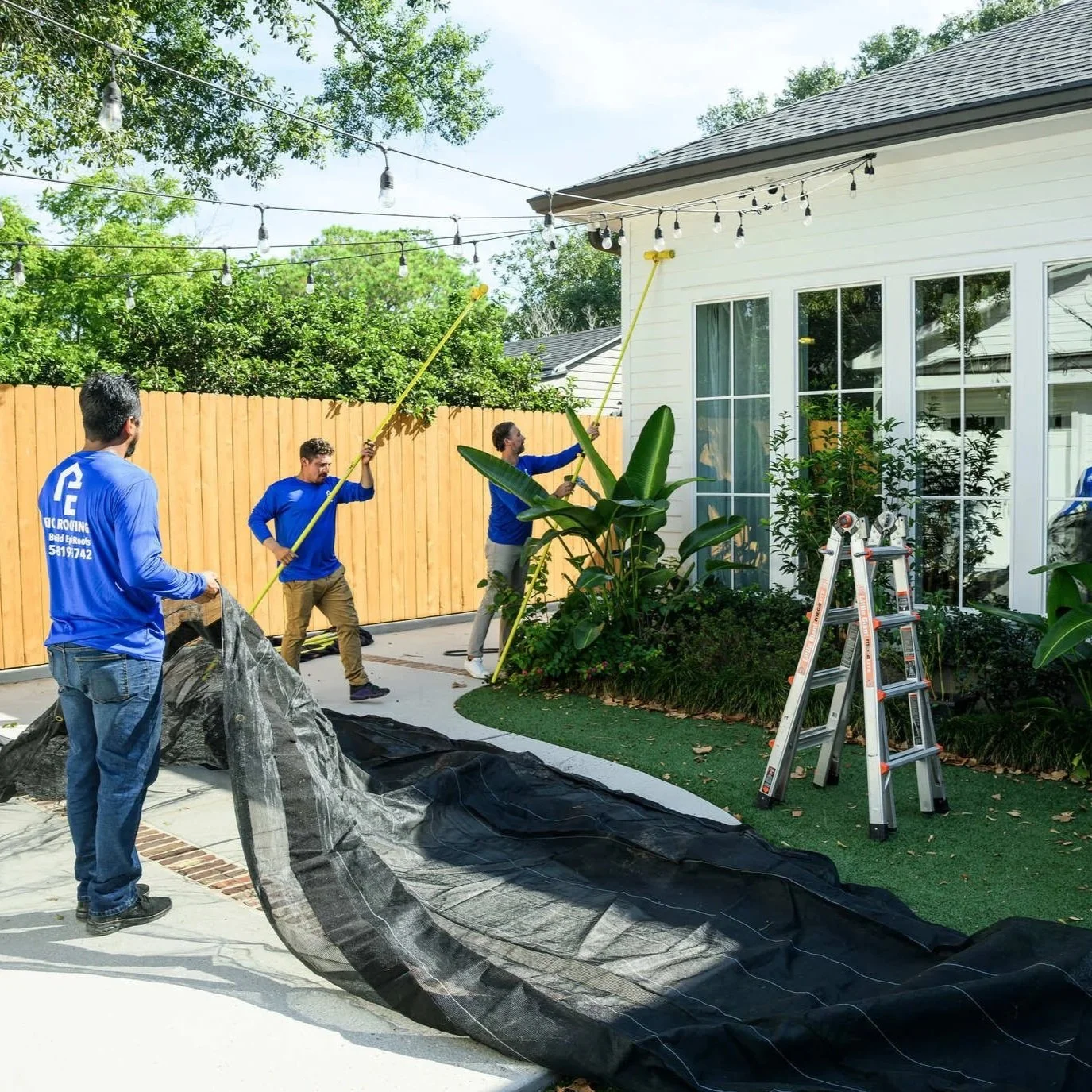
Professional Northshore roofing contractors preparing residential property for roof installation while following safety standards and storm-resistant roofing practices.
The 6 Filters That Separate Quality Northshore Contractors
Filter 1 — Active LSLBC license with residential roofing classification
Louisiana State Licensing Board for Contractors (LSLBC) requires any residential roofing contractor performing work valued at $7,500 or more to hold an active state license. The license must include classification for residential roofing — not just general contracting. Verification at lslbc.louisiana.gov takes 30 seconds by company name or license number.
What disqualifies a candidate: no LSLBC record, expired license, license without residential roofing classification, or out-of-state license without Louisiana reciprocity. After major Northshore storms, unlicensed out-of-state contractors flood the area — LSLBC verification is the first filter that separates them from the legitimate Louisiana roofers.
Filter 2 — Current general liability and workers' comp insurance
Two insurance policies the contractor should provide before any work begins: general liability (typically $1M minimum) and workers' compensation. The contractor should provide a certificate of insurance (COI) listing the homeowner as additional insured for the project, issued directly by the insurance carrier — not a photo of a year-old certificate.
Why both matter: General liability protects against property damage during the project. Workers' comp protects the homeowner from liability if a roofer is injured on the property. Louisiana law allows uninsured-worker injury claims to attach to the homeowner — meaning the cheapest contractor without workers' comp becomes the most expensive contractor when a fall occurs from a Northshore two-story eave.
Filter 3 — Top-tier manufacturer certifications
Major shingle manufacturers operate multi-tier contractor certification programs. The top tiers represent measurable training, installation auditing, and the ability to issue extended warranty terms that homeowners cannot obtain elsewhere. Top tier by manufacturer:
CertainTeed — Shingle Master / 5-Star Master Shingle Applicator. Unlocks SureStart PLUS warranty (50-year materials, 25-year workmanship coverage).
GAF — Master Elite (top 3% of GAF contractors nationally). Unlocks Golden Pledge warranty (50-year materials, 25-year workmanship coverage).
Owens Corning — Platinum Preferred Contractor. Unlocks Platinum Protection Limited Warranty (50-year materials).
IKO — ROOFPRO Premium. Unlocks ROOFPRO 4 Plus Plus Premium warranty.
Malarkey — Emerald Pro+. Unlocks Emerald Premium warranty.
Verification: Each manufacturer maintains a contractor locator on their website. Search by zip code or by contractor name. Real certified contractors appear in the locator; claimed but unverified certifications do not.
Filter 4 — FORTIFIED-approved status
The Louisiana Department of Insurance (LDI) maintains a list of FORTIFIED-approved contractors at ldi.la.gov. Contractors on the list can install FORTIFIED Roof retrofits that qualify for the Louisiana Fortify Homes Program (Roof Strong) grant — up to $10,000 reimbursement per project.
FORTIFIED-approved status indicates the contractor has invested in the training and credentialing required to install to IBHS FORTIFIED standards. Even when the homeowner is not pursuing FORTIFIED, this credential signals the contractor has invested in best-practice installation training.
Critical detail for FORTIFIED projects: the lead installer on the specific job needs a FORTIFIED Roofer credential, not just the company. Verify the actual installer credentials during contract negotiation.
Filter 5 — Written workmanship warranty (separately stated)
Two separate warranties matter on a roofing project: the manufacturer's warranty (covers shingle defects, typically 25-50 years or lifetime) and the workmanship warranty (covers installation defects, varies by contractor). The contract should state both separately.
Quality Northshore contractors offer 5-15 year written workmanship warranties on standard installations. Manufacturer-certified top-tier contractors often offer longer terms (25-year workmanship as part of GAF Golden Pledge or CertainTeed SureStart PLUS). Verbal warranties or "satisfaction guaranteed" without written terms are not warranties — they are marketing.
Filter 6 — Documented Louisiana tenure under one company name
How long has the contractor been operating in Louisiana under the same name? Companies that change names every 2-3 years often do so to escape complaint history. Tenure of 5+ years under the same name in the same Louisiana market is a positive signal. The longer the tenure, the more likely the contractor will still be there for warranty service in 5-10 years.
Verification: LSLBC license history shows the company's licensed operating history. Louisiana Secretary of State business filings show registration history. Both are public-record searches that reveal whether a contractor's marketing claims about tenure are accurate.
What Online Reviews Actually Tell a Homeowner
Star ratings are useful but easily gamed. The patterns inside reviews — and the contractor's responses to them — reveal more than the average rating.
Read the negative reviews carefully
The 1-star and 2-star reviews surface patterns. Look for consistent complaints across multiple reviews: scheduling problems, cleanup issues, pricing changes mid-project, and unresponsiveness after installation. One angry review might be an outlier. Five reviews with the same complaint in different words is a pattern worth taking seriously.
Check how the contractor responds
Professional contractors respond to negative reviews — explaining context, offering resolution, and taking ownership where appropriate. Contractors who never respond, or respond defensively and combatively, reveal how complaints actually get handled. The review thread is a small sample of customer-service behavior.
Filter for Northshore-specific reviews
A contractor with great Houston reviews but no Mandeville reviews is not a known quantity here. Storm-chasers often have legitimate reviews from a different state but limited or no local Louisiana track record. Filter to recent Northshore projects when evaluating a candidate.
Look at review distribution and volume
A 4.9-star contractor with 312 reviews and a normal star distribution is more credible than a 5.0-star contractor with 12 reviews all posted within the same week. Review volume and time distribution matter as much as the average rating.
Red Flags That Separate Storm Chasers from Real Local Contractors
Five red flags signal storm-chaser patterns the homeowner should walk away from immediately: (1) unsolicited door-knock within 72 hours of a named storm, (2) pressure to sign an Assignment of Benefits document on the spot, (3) no local Louisiana physical address (P.O. Box only), (4) price dramatically below other bids, (5) refusal to provide LSLBC license number for verification. Any single red flag justifies caution; multiple red flags together justify walking away, regardless of how compelling the pitch sounds.
What an Initial Conversation Should Cover
Before signing any contract, the homeowner should be able to walk through these specific points with the candidate contractor:
LSLBC license number provided and verifiable on lslbc.louisiana.gov.
Certificate of insurance commitment in writing before work begins.
Manufacturer certification tier confirmed and verifiable on the manufacturer's contractor locator.
FORTIFIED-approved status if relevant, plus lead-installer FORTIFIED Roofer credential confirmation for FORTIFIED projects.
Written workmanship warranty terms — duration, transferability, what is covered, what is excluded.
Three Northshore project references from the past 12 months.
Permit pulling commitment — contractor pulls the St. Tammany Parish or Mandeville city permit in their name.
Decking allowance and per-sheet rate for additional sheets if more decking damage is discovered.
Quality contractors handle this conversation in 15-30 minutes without deflection. Contractors who deflect, change the subject, or claim items are confidential are revealing patterns the homeowner should pay attention to.
The Insurance-Claim-Specific Vetting
When the project is being filed through a homeowner’s insurance claim, the contractor's experience with Louisiana insurance carriers matters more than usual. Specific things to ask:
Experience with Xactimate-format estimates that match adjuster scope language.
Track record of supplemental approvals on past Louisiana claims (getting carriers to authorize additional payment for items the adjuster initially missed).
Willingness to work directly with the adjuster on scope discussions during the inspection.
Refusal to sign the Assignment of Benefits — the contractor should explicitly NOT request AOB.
Any Northshore contractor who proposes Assignment of Benefits as part of an insurance claim project is moving the homeowner toward loss of claim control. Refuse to sign AOB regardless of how the contractor frames it. The settlement check should go to the homeowner, who pays the contractor after work is inspected and approved.
Where the Standard Vetting Framework Doesn't Apply
Emergency post-storm tarping
When active leaks are happening, and a tarp needs to go up within 24-48 hours, the full vetting framework compresses. Minimum non-negotiables: LSLBC license verification (30 seconds) and certificate of insurance proof. Skip those even in emergencies, and the homeowner is exposed to both quality risk and liability.
Repair-only projects under $7,500
LSLBC licensing is technically not required for residential roofing work valued under $7,500. The licensing filter still matters as an indicator of professionalism, but smaller repair projects from non-licensed contractors sometimes work out fine. Insurance and manufacturer certification matter less on small repairs since no extended warranty is being unlocked.
Specialty material projects (metal, tile, slate)
Standard asphalt-shingle vetting framework applies, but specialty-material expertise becomes additionally important. Standing seam metal, tile, and slate require trade knowledge that most general asphalt contractors do not have. Verify specialty-material experience specifically, rather than assuming general roofing tenure transfers.
Frequently Asked Questions
Roughly 200-300 LSLBC-licensed residential roofing contractors are active in St. Tammany, Tangipahoa, and surrounding parishes. Most are small (1-3 crews) and serve specific subsets of the Northshore market. Established companies with 5+ year tenure represent maybe 30-40% of the licensed pool.
Not always. Review volume correlates with marketing investment as much as quality. A contractor with 50 reviews and consistent quality patterns is often a better choice than a contractor with 300 reviews, where quality patterns are mixed. Read distribution and recent reviews, not just totals.
Usually, yes, for full replacements. The extended manufacturer warranty unlocked by certified-installer status (25-year workmanship coverage from GAF Golden Pledge or CertainTeed SureStart PLUS) is meaningful insurance that non-certified contractors cannot offer. The premium for certified installation is typically 5-10%.
Smaller licensed contractors and one- to two-crew operations handle most Northshore residential repair work efficiently. Larger manufacturer-certified contractors sometimes decline small repair jobs. The LSLBC contractor search on lslbc.louisiana.gov produces a complete list of licensed Northshore residential roofers; filter by Northshore zip codes and call several for repair scheduling.
Walk away. An active certificate of insurance is non-negotiable for any residential roofing project. Contractors who cannot or will not provide one are either uninsured (creating homeowner liability exposure) or operating without a legitimate business infrastructure.
The Best Roofing Company Is the One That Passes Every Filter
There is no single "top" Northshore roofing company. There are many quality contractors and many that are not. The objective filters — LSLBC license, insurance, manufacturer certifications, FORTIFIED status, written warranty, documented tenure — separate the two groups reliably. Homeowners who run candidates against those filters end up with quality work without needing to depend on marketing claims or review aggregators. The contractor who passes every filter is the right choice; the contractor who fails any of them is the wrong choice, regardless of price or pitch.
