
Hail Damage on Asphalt Shingles: How to Spot It, Document It, and Get Insurance to Pay
Most hail damage on Louisiana shingles is invisible from the ground. Bruised asphalt mat, dislodged granules, fractured seal lines — none of them look like obvious damage from the driveway, but each compromises the roof's water-shedding system in ways that produce leaks weeks or months later. The 30-day inspection window after any hailstorm with stones the size of a quarter or larger is what separates covered claims from denied ones. Wait for visible leaks, and the carrier will argue the damage came from age, not the storm.
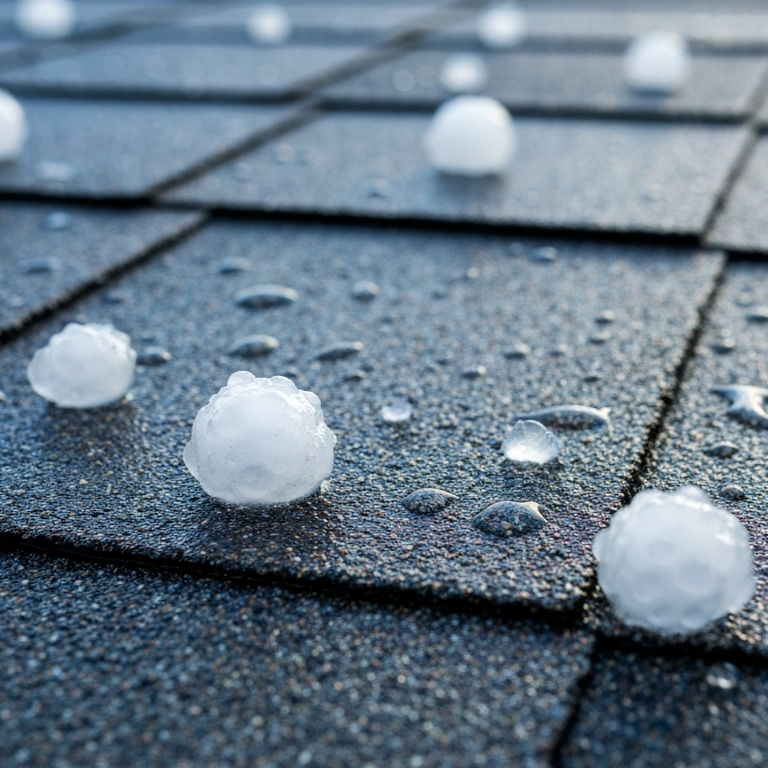
Hailstones striking asphalt shingles can cause hidden roof damage, granule loss, and future insurance-covered leak problems for homeowners.
Hail rolled through last weekend. Stones the size of marbles, maybe a few quarters, scattered across the lawn for about ten minutes. The roof looks fine from the curb. The shingles still appear to lie flat. No leaks inside, no water spots on the ceiling. Most homeowners conclude the storm missed them and move on.
Most homeowners are wrong. Hail damage on asphalt shingles is the most-disputed category in property insurance specifically because it's hard to see. The damage that drives expensive repairs and contested claims rarely shows up as cracked or missing shingles. It shows up as soft bruises in the asphalt mat, dislodged granules in the gutter, and compromised seal lines that fail months later when wind-driven rain finds the weakness. Spotting it requires knowing what to look for — and most national articles don't give Louisiana homeowners the specifics that matter.
What Size Hail Actually Damages a Roof
The National Weather Service classifies hail by diameter using a standard size scale. Damage thresholds for asphalt shingle roofs depend on the size, the angle of impact, and the age and condition of the shingles. The general rule: hail of 1 inch (quarter-sized) or larger produces roof damage on most asphalt shingle installations. Below that threshold, damage is possible on aged or low-quality shingles but uncommon on roofs in good condition.
| Hail Size | Diameter & Damage Risk |
|---|---|
| Pea | 1/4" — minimal roof damage; possible on aged shingles |
| Marble | 1/2" — minor granule loss possible; rare structural damage |
| Penny / Nickel | 3/4" - 1" — moderate granule loss; some bruising on aged shingles |
| Quarter | 1" — NOAA Storm Prediction Center severe-hail threshold; reliable damage start |
| Half Dollar | 1.25" — visible bruising; granule clusters dislodged |
| Walnut / Ping Pong | 1.5" - 1.75" — significant damage likely; soft-metal dents widespread |
| Golf Ball | 1.75" — severe damage on most asphalt roofs |
| Tennis Ball | 2.5" — broken shingles; deck punctures possible |
| Baseball / Softball | 2.75" - 4"+ — catastrophic damage; immediate replacement |
The 1-inch threshold matters for documentation. When NOAA Storm Prediction Center records a severe weather event, the database includes hail diameter. A claim filed for damage from a verified 1-inch-plus hail event sits on much firmer ground than one filed for marble-sized hail where the database doesn't show a severe event for that location.
Why Hail Damage Hides
Wind damage tends to announce itself. Lifted shingles, missing tabs, debris on the roof — visible from the ground after most storms severe enough to cause real problems. Hail damage is different. The storm passes in 10-15 minutes. The roof looks identical to before the storm from any angle the homeowner can reach. The damage develops on the surface of the shingles, where the eye can't see it without being on the roof itself.
Three damage mechanisms account for most hail-related shingle problems:
Asphalt mat bruising. The most common and most-missed sign. Hail strikes that don't crack the shingle still fracture the asphalt layer underneath the granules. The shingle looks intact from above but has lost structural integrity at the impact point. Roofers detect these by feel — pressing the shingle reveals soft, spongy spots where the mat is fractured. Adjusters mark them with chalk circles during professional inspections.
Granule displacement. The mineral granules that coat asphalt shingles protect the asphalt underneath from UV degradation. Hail dislodges these granules, exposing the asphalt to accelerated weathering. The displaced granules wash into gutters during the next rain. Significant granule accumulation in gutter corners and downspout splash blocks indicates hail damage even when the shingles themselves look unchanged.
Seal line compromise. Asphalt shingles are designed to seal together at the overlap line after installation, creating a wind-tight envelope. Hail impact can fracture the seal without lifting the shingle visibly. The seal failure shows up months later when wind-driven rain finds the gap and works under the shingle. By the time the leak appears inside, the claim window may have closed.
The 30-day inspection rule is not a courtesy recommendation. Most Louisiana homeowners' policies require notice of loss within 30-90 days of the storm event for the claim to be filed. Hail damage discovered six months later, after the leak appears, is functionally uninsurable in most cases — the carrier denies it as wear and tear because the timeline no longer connects the damage to a specific storm event.
The 7 Signs of Hail Damage on Asphalt Shingles
These indicators reliably appear after damaging hail. Three are visible from the ground or with binoculars. Four require either a roofer's inspection or a careful look at adjacent surfaces from the ground. A complete inspection covers all seven; missing any of them risks an under-scoped claim.
1. Granule accumulation in gutters and downspouts
Open the bottom of each downspout. Look for sand-like sediment in piles at the downspout exit, on splash blocks, or at the base of the home. Granule accumulation after a recent storm — versus the slow background granule loss of normal aging — is one of the clearest signs that hail struck the roof. A small handful per downspout is concerning; a half-cup or more indicates severe impact.
2. Soft "bruises" on shingles (felt, not seen)
Visible only from on the roof during a professional inspection. A roofer or adjuster presses suspected impact points and feels for soft spots where the asphalt mat has fractured underneath an apparently intact granule layer. Adjusters mark confirmed bruises with chalk circles. The chalk-circle pattern is the documented evidence that carriers accept for hail-bruised shingles. Without the bruise documentation, claims for hidden hail damage are routinely denied.
3. Soft-metal dents (the pro tell)
Aluminum vent caps, sheet-metal flashing, gutters, gutter screens, AC condenser fins, downspouts, mailbox, and garage door panels. Fresh dents on any of these confirm hail of damaging size hit the property. Adjusters use soft-metal dents as primary corroborating evidence for the hail's actual size and intensity at the address. Without soft-metal collateral, claims for severe roof damage are harder to substantiate.
4. Hail damage in roof valleys
Valleys are where two roof planes meet. Water and debris already concentrate here during every rain event. After a hailstorm, dislodged granules from the surrounding shingle area wash into the valley and accelerate wear in an area already under stress. Valley damage is one of the most commonly under-scoped items on initial insurance estimates. Visible signs: concentrated granule loss along the valley line, exposed asphalt mat, lifted or shifted valley shingles, dark streaks tracking down toward the gutters.
5. Damaged pipe boots, vents, and flashings
Roof penetrations are weak points in the system. Pipe boots — the rubber collars around plumbing vent stacks — are particularly vulnerable. A boot already weakened by Gulf Coast UV (typically 5-8 years on a Louisiana roof) can fail completely from hail impact. Cracked rubber, dented metal vent caps, bent or displaced flashings around chimneys and walls all indicate hail damage. Pipe boot failures account for a substantial portion of mystery leaks homeowners discover months after a storm.
6. Cracked skylights or damaged solar panels
Skylight domes and solar panel cells crack under hail impact more easily than asphalt shingles. A cracked skylight dome is a direct path for water into the home and almost always requires full unit replacement, not patching. Solar panel cells with visible fractures lose efficiency and create electrical hazards. Both are typically covered under the same dwelling claim as the roof damage, but homeowners often forget to include them.
7. Wood damage on decks, fences, and painted trim (corroborating)
Not roof damage itself, but powerful corroborating evidence that hail of damaging size hit the property. Round white impact marks on stained decks, chips or divots in painted fence boards, dimpling on garage door panels, and bare spots where paint was knocked off. Painted wood captures hail impacts more clearly than many other surfaces — useful evidence when a carrier argues the hail "wasn't large enough" to damage the roof.
Inspect adjacent properties' soft metals after a hailstorm before documenting the home's own. If neighboring vent caps, gutters, and AC units show no fresh dents, the storm may have been less severe at the property than weather reports suggest. If neighbors show dents, the documentation case for the roof strengthens. Adjusters routinely cross-check by walking the immediate neighborhood — knowing the local pattern in advance prevents surprises.
Hail in Louisiana — Where the Risk Actually Sits
Hail is generally associated with the Plains and Midwest, not the Gulf Coast. The geographic distribution within Louisiana is uneven and matters for how aggressively a homeowner should approach hail risk and inspection.
Inland and northern Louisiana parishes — Caddo, Bossier, Ouachita, Rapides, East Baton Rouge, and the surrounding regions — see meaningfully more hail events per year than the coastal parishes. Severe thunderstorms tracking northwest-to-southeast through the Mississippi Valley produce most of these events, typically in spring (March-May) and occasionally during fall transition.
Coastal and Northshore parishes — Orleans, Jefferson, St. Tammany, St. Charles, Plaquemines — see less hail than inland Louisiana but still get damaging events, especially from outer rain bands of tropical systems and severe spring squall lines. The Northshore is not a high-frequency hail zone, but treating it as a no-hail zone leads to missed damage after the events that do occur.
For verifying a specific Louisiana hail event for a claim file, the NOAA Storm Events Database (ncdc.noaa.gov/stormevents) lists severe weather by date and parish, including hail diameter. A claim filed for damage from a verified Louisiana hail event of 1 inch or larger sits on much stronger evidentiary ground than one without independent verification.
The Cosmetic Damage Exclusion Trap
Some Louisiana homeowners’ policies include a Cosmetic Damage Exclusion endorsement. The endorsement excludes hail damage that is purely aesthetic — dimpling on metal surfaces, minor granule disturbance — when the damage doesn't compromise the roof's functional performance. The exclusion is most common on policies written for older homes, properties in higher-hail-risk areas, or as a premium-reduction option offered at renewal.
The exclusion language matters because it shifts what's covered. A roof with visible hail dimpling but no fractured asphalt mat and no granule loss may produce a denied claim under a Cosmetic Damage Exclusion endorsement, even though the same damage would be covered under a standard policy.
Two practical steps: pull the declarations page now and look for any Cosmetic Damage Exclusion or aesthetic damage exclusion endorsement. If one exists, the documentation strategy after a hail event has to focus specifically on functional damage — bruised asphalt mat, granule displacement that exposes asphalt, fractured seal lines — not on visible cosmetic markers.
The Cosmetic Damage Exclusion is not standard on all Louisiana policies, but it appears frequently enough that homeowners should verify before assuming hail damage is covered. Reading the endorsement language before a storm hits is the only way to know what's actually covered. The Louisiana Department of Insurance consumer hotline (1-800-259-5300) can help interpret specific endorsement language if it's unclear.
How Insurance Companies Treat Hail Claims Differently
Three Louisiana-specific insurance considerations affect how hail claims should be filed and documented.
Hail deductible vs hurricane deductible vs standard deductible
A hail event from a non-named thunderstorm typically triggers the standard homeowners' deductible (often $1,000-$2,500). A hail event from a named tropical system can trigger the hurricane deductible instead (typically 2-5% of dwelling coverage, often $5,000-$15,000+). Some Louisiana policies write a separate wind/hail deductible distinct from both. The deductible structure can make a major difference in net settlement — pull the declarations page to verify which applies.
Annual Deductible Law applicability
Louisiana's Annual Deductible Law (La R.S. 22:1337) caps the hurricane deductible at one per calendar year for owner-occupied homes insured by admitted Louisiana carriers. The law applies to hurricane and named-storm deductibles specifically — not to standalone hail deductibles from non-named thunderstorms. A spring hail event followed by a fall hurricane may involve two separate deductibles, depending on policy language.
ACV vs RCV impact on hail settlements
Replacement Cost Value (RCV) policies pay full replacement cost minus deductible. Actual Cash Value (ACV) policies pay replacement cost minus depreciation, then minus the deductible. On a 12-year-old asphalt shingle roof with hail damage, the ACV depreciation reduction can exceed 50%. The same damage on the same roof produces dramatically different settlements depending on which coverage basis the policy uses. A full deep dive on ACV vs RCV mechanics appears in the companion article on insurance coverage for new roofs.
When to File a Hail Damage Claim and When to Pay Cash
Not every hail event warrants an insurance claim. The decision involves the documented damage, the deductible, and the impact of a claim on future premium and renewal eligibility.
Strong case for filing: documented hail event of 1+ inch diameter, multiple confirmed bruises during professional inspection, soft-metal collateral damage across the property, RCV policy in force, repair estimate at least 2-3 times the deductible amount.
Weaker case for filing: hail event under 1 inch with minor granule loss but no confirmed bruising, isolated dent on a single soft-metal item, ACV policy with significant depreciation already applied, repair estimate close to or below the deductible amount.
When the case is weak, paying cash for limited repair often makes more sense than filing. Multiple claims in a short period can affect renewal pricing or trigger non-renewal at some Louisiana carriers, particularly for homes already considered higher-risk. The decision is policy-specific — confirm impact on premium with the agent before filing.
How Class 4 Impact-Resistant Shingles Change the Math
Hail damage on a standard architectural shingle behaves differently from hail damage on a Class 4 impact-resistant shingle. UL 2218 Class 4 shingles are tested with a 2-inch steel ball dropped from 20 feet without splitting through to the reinforcement layer. They withstand hail impacts that would damage standard shingles, and they hold their granule coverage better after the impact.
Two financial implications matter for Louisiana homeowners considering an upgrade. First, Louisiana Act 533 (2024) requires every admitted Louisiana insurer to offer a discount on wind/hail premium for Class 4 (impact-rated) shingles. The discount range is 15-25% of the wind/hail portion, depending on the carrier, roughly 6-10% of the total premium. Second, Class 4 shingles produce fewer claim events over the roof's lifetime, reducing the cumulative impact of multiple smaller claims on premium and renewal.
A full deep dive on Class 4 impact-resistant shingles, brand SKUs (CertainTeed Landmark IR, GAF Timberline ArmorShield II, Owens Corning Duration STORM, IKO Nordic, Malarkey Vista AR), cost premium math, and where the upgrade makes sense in Louisiana appears in a separate article in this collection.
Frequently Asked Questions
1 inch (quarter-sized) is the National Weather Service severe-hail threshold and the size at which roof damage becomes reliable on most asphalt shingle installations. Smaller hail can damage aged or low-quality shingles but rarely damages roofs in good condition. Hail of 1.5 inches (ping pong ball) or larger produces significant damage on most roofs.
Yes, and it usually is. The most common hail damage on shingles — bruised asphalt mat and dislodged granules — looks normal from any angle the homeowner can reach. The damage compromises the shingle's water-shedding system in ways that produce leaks weeks or months later. A professional inspection within 30 days of any 1-inch-plus hail event is the only reliable way to find the damage before the claim window closes.
Most Louisiana homeowners’ policies require notice of loss within 30-90 days of the storm event. Some require initial notice within 24-48 hours for emergency mitigation coverage. Beyond that window, claims are generally denied as wear and tear because the damage timing no longer connects to a specific storm. Louisiana's 24-month prescriptive period for filing suit against the carrier (La R.S. 22:868, as amended in 2024) starts from the date of loss.
Single hail claims tied to verified weather events typically don't raise Louisiana premiums the way multiple wear-and-tear claims would. Multiple claims within a short period can affect renewal pricing or eligibility at some carriers. Confirm impact with the agent before filing if the claim amount is small relative to the deductible.
Fresh hail damage has sharp, unweathered edges — clear circular bruises 1/4" to 2" across with disturbed granules around the dimple, revealing the dark mat beneath. Normal wear is uniform, faded, and weathered across the whole shingle. The most reliable corroborating evidence is collateral damage on soft metals: fresh dents on aluminum vents, gutters, and AC fins confirm the hail was severe enough to damage shingles.
Typically, yes, under the same dwelling claim as the roof damage — but homeowners often forget to include them in the documentation. Cracked skylight domes and hail-damaged solar cells should be photographed during the same inspection as the roof and added to the claim with separate line items in the damage inventory.
Document first, then notify. The first call to the carrier creates the claim file. If the call happens before any photos are taken or any professional inspection is completed, the file starts with a verbal description and nothing else. A 30-minute photo session and a free professional inspection produce a much stronger claim opening than a phone call to the carrier. Some carriers also count an inquiry as a claim event on the homeowner's record even if no formal claim is filed.
The NOAA Storm Events Database (ncdc.noaa.gov/stormevents) maintains the official record of severe weather, including hail diameter by date and county. The NOAA Storm Prediction Center (spc.noaa.gov) tracks severe weather reports from spotters and weather stations. Both are free. A claim filed with NOAA verification attached resolves faster and faces fewer disputes than one without independent verification.
The Damage That Decides Settlements Is Rarely the Damage Seen First
Hail claims are won by the documentation that catches the bruises and granule loss most homeowners miss — and lost by the assumption that an apparently intact roof from the driveway means an intact roof on the surface. The 30-day window after any 1-inch-plus hail event is the time to know which side of that line the property falls on. Independent professional inspection produces the chalk-circled bruise photos, the granule density documentation, the soft-metal dent inventory, and the NOAA storm verification that carriers accept as definitive evidence. Skip that step, and the claim depends on whether the carrier's adjuster looks as carefully as a documenting roofer would.
