
Roof Leak Repair Cost in Louisiana: Real 2026 Pricing by Severity
Most Louisiana roof leak repairs fall in the $300-$1,500 range. Pipe boots are the cheapest single-source fix at $150-$400; chimney and valley flashing replacements run $800-$2,500. The numbers shift dramatically based on three things: how long the leak has been running (a $400 fix becomes a $7,400 reconstruction in 6 months), whether the property sits inside an active hurricane season window (30-50% emergency premium), and whether the work is filed under insurance or paid cash (insurance-tied pricing is often higher because of the documentation overhead carriers require).
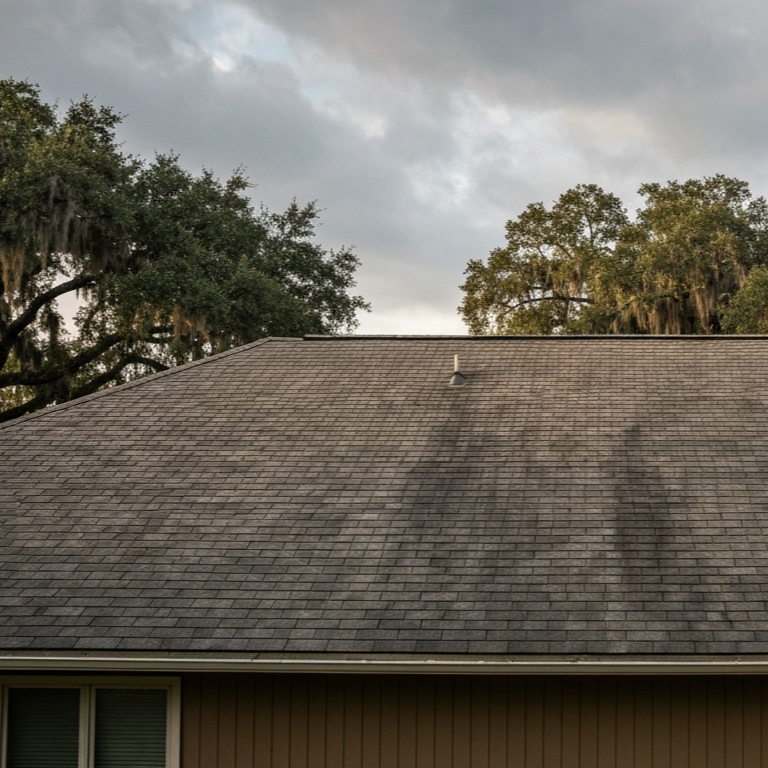
Louisiana roof showing aging shingles and moisture streaks requiring leak repair before storm damage spreads into interior living spaces.
Roof leak repair pricing is one of the most opaque categories in residential construction. Two contractors quoting the same leak can differ by 3x or more — not because one is honest and the other is dishonest, but because the actual scope of work depends on access, hidden damage, materials, season, and whether insurance is involved. A homeowner without context for what drives the number sees the spread and assumes someone is overcharging.
This guide walks through real Louisiana 2026 cost ranges by severity and source, the factors that move the final number up or down, the insurance-vs-cash math that decides whether to file a claim, and the red flags on both ends of the pricing spectrum. The goal is for a Northshore or Greater New Orleans homeowner to know what fair pricing looks like before the first contractor arrives.
The 3 Severity Tiers
Industry convention groups roof leak repairs into three severity tiers based on scope of work, time required, and materials involved. The same physical leak can fall into different tiers depending on how far the water has spread before discovery — which is why catching a leak early matters more than the leak's original size.
| Severity Tier | Louisiana 2026 Cost Range | Time to Complete |
|---|---|---|
| Minor — single source, isolated | $300 – $700 | 1-2 hours |
| Moderate — multiple components | $700 – $1,800 | Half day to 1 day |
| Major — structural or extensive | $1,800 – $5,000+ | 2-3 days |
Minor leaks are isolated, single-source events caught before water has spread beyond the immediate area. A cracked pipe boot, a single missing shingle, and a small flashing reseal. The repair is straightforward, and the materials cost less than a tank of gas.
Moderate leaks involve multiple components or have been active long enough to require some underlayment work. Chimney flashing replacement, skylight seal repair, valley shingle replacement, and multiple boots on an aging roof. The labor doubles, and the material costs increase with the additional components.
Major leaks involve structural elements, extensive water damage, or repeated failures. Decking replacement, valley flashing rebuild, chimney rebuild, and leaks affecting multiple rooms below. The repair scope often expands during the work as additional damage gets uncovered.
Cost by Leak Source — Louisiana 2026 Numbers
Pricing varies by what's actually leaking. The numbers below reflect typical 2026 Northshore and Greater New Orleans ranges from licensed Louisiana roofers, calibrated against national averages and adjusted downward 10-20% for Louisiana labor rates. High-cost coastal market pricing references should be discounted for the Louisiana context.
| Leak Source | Typical Louisiana Cost | Why It Costs This Much |
|---|---|---|
| Pipe boot replacement | $150 – $400 | Common Gulf Coast UV failure (5-8 yr. typical) |
| Single-shingle replacement (matched) | $200 – $500 | Color match difficult past 5-year roof age |
| Step flashing re-seal | $300 – $700 | Sealant aging fix; band-aid repair, not permanent |
| Chimney flashing replacement | $500 – $1,500 | Step flashing + counter-flashing; masonry work involved |
| Valley flashing replacement | $800 – $2,500 | Multiple shingle removal; precision work; access difficult |
| Skylight seal repair | $400 – $900 | Dome usually fine; gasket/seal replacement on flashing |
| Skylight unit replacement | $1,200 – $3,500 | Whole unit + flashing; roof penetration rebuild |
| Vent stack flashing | $200 – $500 | Lead or aluminum collar; common UV failure point |
| Ridge cap replacement (small section) | $300 – $800 | Cap shingles + sealant; access via ladder |
| Spanish moss / debris valley clearing | $150 – $400 | Louisiana-specific; often combined with valley flashing inspection |
Pipe boots are intentionally listed first because they account for the majority of single-source leaks Louisiana roofers see on residential properties 5-10 years old. Gulf Coast UV degrades the rubber collar around the plumbing vent stack substantially faster than the manufacturer's stated 10+ year lifespan suggests. A homeowner who replaces every pipe boot proactively at year 6 spends ~$200 on materials and prevents the most common leak source for the next several years.
Spanish moss in the valleys is a Louisiana-specific cause that doesn't appear in national cost guides. Northshore tree canopy drops moss into roof valleys after every wind event; the moss dams water flow and forces it sideways under shingle edges. The $150-$400 range covers the moss removal and a brief flashing inspection — often catching a developing leak before it produces interior damage.
What Drives the Final Number Up
The base cost ranges above assume straightforward access, isolated damage, and standard materials. Five factors push the final invoice higher than the table suggests, sometimes by multiples.
Multi-story access
Two-story Northshore homes typically run 20-30% more than equivalent single-story repairs. The labor includes more setup time, additional ladder work, and OSHA-required fall protection equipment for any work above 6 feet. Roofs above two stories or with steep pitches may require scaffolding rental, adding $200-$500 to the bottom line.
Hidden damage discovered during the repair
When a roofer pulls back shingles to repair a flashing leak and finds rotted decking, compromised insulation, or mold in the attic, the scope expands immediately. Decking replacement runs $60-$120 per 4×8 sheet of plywood (materials + labor). Insulation replacement adds $200-$800, depending on the affected area. Mold remediation is a separate specialty service that typically starts at $1,500.
Hurricane season emergency premium
Louisiana roofers running emergency response during an active tropical storm or hurricane charge a 30-50% premium above standard pricing. Same-day or after-hours response runs the same uplift. The premium reflects scheduling disruption, specialty crew deployment, and risk of working ahead of the next storm. A $500 standard pipe boot replacement becomes $700-$750 during an active storm window.
Insurance-tied pricing differential
Repairs filed under an insurance claim often price 10-25% higher than equivalent cash repairs. The difference reflects the documentation overhead — adjuster meetings, supplemental requests, photo packages, and the longer payment cycle from carrier approval to completion. Cash repairs paid at completion involve none of that overhead and typically price closer to the contractor's actual cost-plus-margin baseline.
Permit fees and parish-specific requirements
Most repairs under the Louisiana State Licensing Board for Contractors (LSLBC) $7,500 threshold don't require a permit. Larger repairs and most full replacements do. Permit fees vary by parish: St. Tammany Parish typically runs $50-$150 for a residential roof permit; Orleans Parish can run higher with additional inspection requirements. Permits add a few days to the timeline as well as the fee.
Louisiana-Specific Cost Factors
Three factors specific to Louisiana affect repair pricing in ways national cost guides miss entirely.
Labor rate differential
Louisiana licensed roofing labor runs approximately 10-20% below the national average and 25-30% below California Bay Area pricing. A repair that costs $1,500 in San Francisco might cost $1,150-$1,250 in Mandeville. Cost guides written for California or the Northeast overstate Louisiana pricing by meaningful margins.
LSLBC licensing threshold
Louisiana requires contractor licensing through the LSLBC for any project where total labor and materials exceed $7,500. Most roof leak repairs fall well below this threshold, which means unlicensed handymen can legally perform smaller repairs. The catch: unlicensed work doesn't carry the insurance protection that licensed contractor work does. If a leak repair below $7,500 fails or causes secondary damage, the homeowner's recourse against an unlicensed worker is limited.
Storm-season scheduling
Louisiana roofer queues fill within hours of any major storm event. A leak repair that would normally schedule for next week becomes a 2-4 week wait after a hurricane or severe thunderstorm event. Pre-season repairs (March-May) avoid this entirely; same repairs in September-October pay both the queue time and the emergency premium.
DIY vs Professional Repair — When the Math Works
Some leak sources have a clean DIY solution that materially undercuts professional pricing. Others don't — the labor savings disappear into materials cost, safety risk, or follow-on repairs from amateur work.
| Leak Type | DIY Materials Cost | Pro Cost | DIY Worth It? |
|---|---|---|---|
| Pipe boot replacement | $30 – $50 | $150 – $400 | Yes if comfortable on roof |
| Roofing cement on lifted shingle | $8 – $15 | $200 – $400 | Yes — 30-second fix |
| Single shingle replacement | $10 – $30 | $200 – $500 | Maybe — color match issue |
| Step flashing re-seal | $15 – $30 | $300 – $700 | No — flashing work where amateurs cause leaks |
| Chimney flashing replacement | $80 – $200 | $500 – $1,500 | No — masonry work, leak risk |
| Valley flashing replacement | $150 – $300 | $800 – $2,500 | No — precision work, multiple shingles |
| Skylight seal repair | $30 – $80 | $400 – $900 | No — leak risk on reseal-impacting fixture |
The DIY math works best for the simplest single-source repairs where the failure mode is obvious and the work is bounded. Pipe boots and roofing cement on a single lifted shingle are reasonable DIY projects for a homeowner comfortable on a roof with proper safety equipment. Anything involving flashing detail, chimney work, or skylight seals is where amateur repairs reliably create bigger leaks within 6-12 months.
Personal Fall Arrest System (PFAS) is required by OSHA for any work above 6 feet. Most homeowners don't own one. Falls from one-story Northshore home roofs (~12-15 feet to the eave) cause the majority of post-storm DIY emergency room visits in Louisiana. The DIY savings on a single pipe boot are not worth the orthopedic surgery cost from a fall.
The Cost of Waiting — How a $400 Repair Becomes $7,400
A leak that gets caught and repaired within the first 30 days is a small expense. The same leak six months later involves decking replacement, mold remediation, insulation work, and interior repair to drywall and ceiling fixtures. The cost progression is not linear — it accelerates as water damage compounds.
| Time Since Leak Started | Damage Added | Added Cost |
|---|---|---|
| Day 0 — initial repair | Source repair only (e.g., pipe boot) | $400 |
| Day 14-30 — early intervention | Ceiling staining, minor drywall touch-up | +$200-$500 |
| Day 30-60 — decking damage starts | Plywood replacement at leak path | +$1,500-$3,000 |
| Day 60-90 — mold begins growing | Mold remediation in wall cavity (EPA 24-48 hour threshold) | +$1,000-$3,000 |
| Day 90-180 — insulation saturated | Insulation replacement, framing inspection | +$800-$2,000 |
| Day 180+ — structural framing at risk | Rafter replacement, structural reinforcement | +$500-$1,500+ |
The Environmental Protection Agency's mold guidance puts the safe-drying window for wet building materials at 24-48 hours. Beyond that window, mold begins growing in the damp insulation and wall cavity. Active leaks that go unaddressed for weeks produce mold growth that requires specialty remediation in addition to the original repair.
The math of waiting tells the story: a $400 same-day repair routinely becomes a $7,000-$10,000 reconstruction within 6 months. Same leak. Same source. Different timeline.
Insurance Claim vs Cash Payment — When Each Makes Sense
Not every leak repair belongs on an insurance claim. The decision depends on the deductible, the cause of damage, and the impact of a claim on future premium and renewal pricing.
When cash payment makes sense
Repair costs less than 2x the deductible. A $400 pipe boot repair on a policy with a $1,000 standard deductible doesn't trigger insurance — the carrier pays nothing because the cost is below the deductible. Filing a claim still goes on the insurance record without any payout.
Wear-and-tear cause. Every Louisiana homeowner's policy excludes wear and tear. Pipe boots cracked from age, flashing sealant aged out, granule loss from UV — none of these are claimable. Filing wastes time and goes on the claims history.
Recent claim history. Multiple claims within a short period can affect renewal pricing or trigger non-renewal at some Louisiana carriers. If a small repair can be paid out of pocket, doing so often preserves better long-term policy terms.
When insurance filing makes sense
Storm-related damage with documented cause. Hurricane, hail, wind, tree impact, and lightning. The damage is covered, the deductible is reasonable, and the repair cost meaningfully exceeds the deductible amount. The Louisiana Annual Deductible Law (La R.S. 22:1337) caps the hurricane deductible at one per calendar year for owner-occupied homes — relevant for back-to-back storm damage in the same season.
The repair cost is significantly above the deductible. A $4,500 chimney flashing rebuild on a policy with a $1,500 standard deductible nets the homeowner $3,000 minus depreciation. The math favors filing for repairs of this scope.
Multiple damage areas from the same event. Wind damage, hail damage, and tree impact from one storm should be filed as a single claim covering the full scope. Splitting into separate incidents increases the deductible exposure.
Independent inspection before filing — even a free roofer inspection — gives the homeowner a documented baseline before the carrier sends their adjuster. The two reports get compared during the claim process. When they agree, the claim resolves quickly. When they disagree, the homeowner's documented report is what holds up the claim. A separate companion article walks through the full claim documentation discipline.
Cost Transparency — Red Flags on Both Ends
Pricing extremes signal problems on both ends. A quote substantially below the typical range usually indicates an unlicensed contractor cutting corners; a quote substantially above usually indicates pressure tactics or an attempt to scope-creep the work.
Too-low signals
Storm chasers offering $200 "complete" leak repairs after a hurricane. Door-knocking contractors with out-of-state license plates. Verbal-only quotes with no written estimate. Quotes that don't include materials cost, labor cost, or permit fees as separate line items. Cash-only payment with no receipt. Any of these patterns indicates an unlicensed or fly-by-night operator. The work may complete on day one and fail by month three, with no recourse.
Too-high signals
Same-day pressure to sign before the contractor leaves. Quote substantially above the typical range with vague justification. Insistence that the entire roof needs replacement when only a localized leak source is visible. Refusal to itemize the bill. Bundling of unrelated work (siding, gutters) into a leak repair quote. Any of these patterns indicates a scope-creep or upsell tactic.
What credible pricing looks like
Written estimate with line items for materials, labor, permits, and any travel charges. License number visible (LSLBC for Louisiana). Insurance certificate available on request. Quote within or close to the typical Louisiana ranges in the tables above. Itemized discussion of what's required vs what's optional. Time to think about the decision before signing.
When Repair Becomes Replacement — The Threshold
At some point, the running cost of repeated leak repairs exceeds the cost of a full roof replacement. Five indicators suggest the repair-vs-replace threshold has been crossed.
Multiple active leaks across different sections of the roof. A single leak is a problem; three leaks in three different spots is a roof telling the homeowner it's done.
Granule loss visible in the gutters at more than half a cup per gutter section. The shingles are wearing through their UV-protective layer. Patching individual leaks is spending money on a roof already past its useful life.
Roof age 18+ years on a 30-year shingle. Louisiana's heat and humidity cut every shingle's stated lifespan by 20-30%. A 30-year shingle rarely makes it to 25 in the Louisiana climate.
Decking sponginess discovered during the repair. If the roofer pulls a few shingles and the plywood beneath flexes, the deck is failing. Patch repairs at that point are throwing money at a roof that needs to come off.
Repeat leak at the same location. A pipe boot replaced last year, leaking again this year, indicates either a workmanship problem (re-do under warranty) or a deeper roof system issue. Repeated repairs at the same spot signal that the underlying problem has not been addressed.
When replacement becomes the right answer, considering a FORTIFIED Roof upgrade or Class 4 impact-resistant shingles changes the math significantly. The Louisiana Fortify Homes Program grant can offset $10,000 of the upgrade cost, and the mandatory wind/hail insurance discount under Act 533 produces recurring annual savings. Separate companion articles in this collection cover both topics in depth.
Frequently Asked Questions
The typical Louisiana roof leak repair costs $300-$1,500, depending on the source and severity. Pipe boots are the cheapest at $150-$400. Chimney and valley flashing repairs are the most expensive at $800-$2,500. The Louisiana average runs 10-20% below the national average due to lower labor rates.
Emergency or after-hours leak repairs during active hurricane season typically run 30-50% above standard pricing. A $500 standard pipe boot replacement might cost $700-$750 during an active storm window. Tarping is the lower-cost emergency stabilization option at $80-$150 in materials for DIY or $300-$800 for professional installation.
Storm-related leaks are typically covered minus the deductible. Wear-and-tear leaks (aged pipe boots, flashing sealant failure, granule loss from UV) are excluded from every Louisiana homeowner's policy. The cause determines coverage. A separate companion article walks through the full insurance claim process for Louisiana storm damage.
Repair is cheaper for isolated leaks on roofs less than 15 years old and in good overall condition. Replacement becomes the better option when multiple active leaks appear, when the roof is past 18+ years on a 30-year shingle, or when decking damage is discovered during repair. The repair-vs-replace threshold typically lands when total repair cost approaches 30-50% of full replacement cost.
Some leak types are reasonable DIY projects (pipe boot replacement, single lifted shingle); others are not (chimney flashing, valley flashing, skylight seals). The DIY math depends on comfort with roof work, fall protection equipment, and the specific leak source. Anything above one story or near a chimney/skylight typically does not pay back the safety risk.
Minor repairs complete in 1-2 hours. Moderate repairs take half a day to a full day. Major repairs involving structural work, decking replacement, or chimney rebuilds take 2-3 days. Weather windows and material availability can extend the timeline.
A credible written quote includes: materials cost, labor cost, permit fees if applicable, any travel or trip charges, scope of work description, warranty terms, and the contractor's Louisiana State Licensing Board contractor (LSLBC) license number. Verbal-only quotes, or estimates without itemization, are red flags.
Three reasons. Demand spikes — entire roofer queues fill within hours of a major event. Materials become scarce as supply houses sell out. Labor shifts to emergency response premium pricing (30-50% above standard). Combining all three, post-storm repair pricing can run 1.5-2x normal until supply normalizes 2-4 weeks after the event.
Fair Pricing Looks Like a Written Estimate, a License Number, and Time to Decide
The honest range for a Louisiana roof leak repair is $300-$1,500 for most cases, with specific sources and severity factors moving the number within or beyond that range. A quote substantially below or above the typical range warrants a second opinion. Cost transparency from a licensed contractor — written estimate, itemized line items, license number on the quote, time to compare — is the baseline for a fair process. Anything missing those elements is a signal to keep looking.
