
What Hurricane Francine Did to Northshore Roofs (and What the 2026 Season Suggests)
Hurricane Francine made landfall in southwest Terrebonne Parish near the St. Mary parish line (about 25 nautical miles south-southwest of Morgan City) on September 11, 2024, as a Category 2 hurricane with maximum sustained winds of approximately 105 mph (NWS) / 90 kt (NHC). The storm crossed inland and weakened to tropical storm strength as it tracked north-northeast across south Louisiana, reaching the Northshore overnight Wednesday into Thursday morning. Northshore roof damage was concentrated in three patterns: lifted shingles at edges and ridges, downed trees on structures, and chimney flashing failures from sustained tropical-storm-force winds and heavy rain. The homes that came through best had a FORTIFIED designation or had completed pre-season maintenance — the homes that fared worst had deferred routine repairs for 3+ years.
Francine made landfall on a Wednesday afternoon. By Thursday morning, Mandeville roofers were fielding hundreds of inspection requests across St. Tammany Parish. The damage pattern was familiar to anyone who had worked Hurricane Ida in 2021 — but with one important difference: the homes that had upgraded to FORTIFIED designation in the three years between storms came through Francine with measurably less damage than equivalent neighbors.
What follows is the post-Francine damage pattern data the Northshore roofing industry collected, the homeowner-side patterns that predicted who got hit hardest, and what those patterns suggest for the 2026 hurricane season prep window.
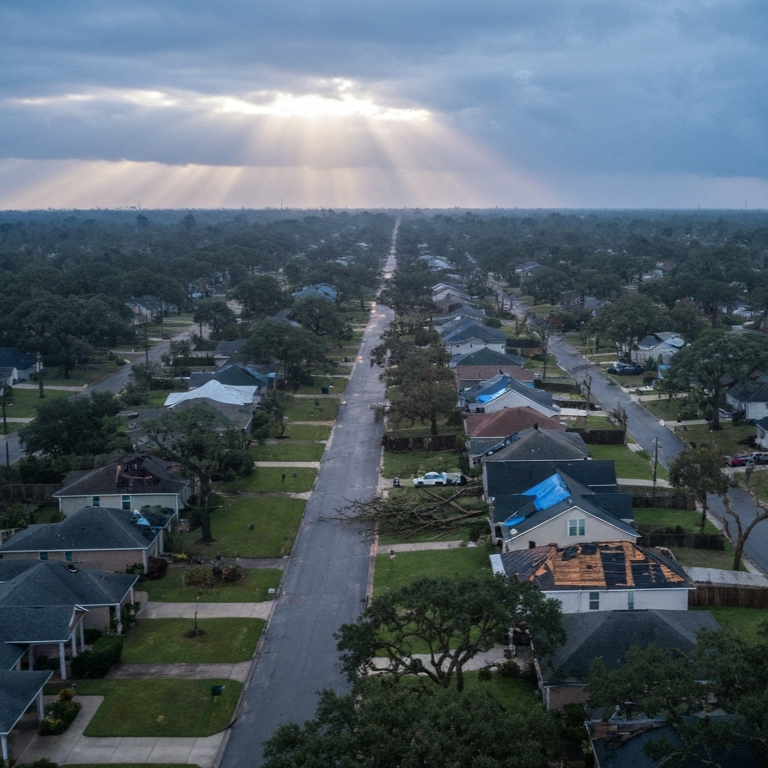
Hurricane Francine caused widespread Northshore roof damage, exposing homes to wind uplift, fallen trees, and severe storm-related water intrusion.
The Storm Itself — Francine's Northshore Path
Hurricane Francine made landfall in southwest Terrebonne Parish near the St. Mary parish line (about 25 nautical miles south-southwest of Morgan City) at approximately 5:00 p.m. Wednesday, September 11, 2024, with maximum sustained winds of approximately 105 mph (NWS) / 90 kt (NHC) — a Category 2 hurricane. The storm tracked north-northeast across south Louisiana, weakening as it crossed land. By the time the storm center reached the Northshore overnight Wednesday into Thursday morning, sustained winds had dropped to tropical-storm strength (35-50 mph) with higher gusts.
Three weather characteristics drove Northshore roof damage:
Sustained tropical-storm-force winds (35-50 mph per NWS Slidell post-storm reports) for several hours — long enough to fatigue marginally-attached shingle edges and produce progressive uplift failures, particularly on older roofs with deferred maintenance.
Gusts higher than sustained winds at peak — sufficient on the Northshore to lift compromised ridge cap and edge components and snap weakened tree limbs, though well below the destructive gust speeds experienced near landfall in southwest Terrebonne and St. Mary Parishes.
Heavy rainfall (10-12 inches across much of the Northshore, including 11.93 inches recorded at Covington per NHC's tropical cyclone report) on saturated ground from the preceding wet week — accelerating tree root failures and producing localized flooding that complicated post-storm repair logistics.
The 4 Damage Patterns Francine Produced
Pattern 1 — Lifted shingle edges and ridge cap failures
The most common Francine damage pattern across the Northshore. Shingles installed with standard 4-nail patterns and field-cut starter strips lifted progressively over the 6-8 hour sustained-wind window. Ridge cap separation showed up on roofs 12+ years old, where the original ridge sealant had aged out.
Insurance claim implications: this damage type is the bread-and-butter of post-Francine roof claims. Carriers consistently approved shingle-blow-off claims when the homeowner had documented date-stamped photos of the damage within the first 48 hours.
Pattern 2 — Tree-on-structure damage
Live oak limbs and pine trees fell on Northshore homes throughout St. Tammany and Tangipahoa Parishes. The damage ranged from isolated branch impacts (covered by standard wind/hail) to catastrophic tree-trunk failures that required structural repair in addition to roofing work.
Tree damage was not evenly distributed. Heavily-treed neighborhoods in Mandeville (Beau Chene, Tchefuncta Country Club, parts of Old Mandeville) saw far more tree-on-house claims than newer subdivisions with less mature canopy. The pre-season tree trimming that Northshore arborists recommend in March-April was the single biggest predictor of which homes avoided this damage type.
Pattern 3 — Chimney flashing failures and water intrusion
Sustained wind-driven rain combined with worn chimney flashing produced widespread water intrusion at chimney junctions. Homes with original 15+ year-old step flashing and counter flashing developed leaks that were not visible from the ground but showed up as ceiling stains in adjacent rooms within 24-48 hours.
Insurance claim challenge: chimney flashing leaks discovered after Francine often required documentation that the leak was a direct result of the storm rather than pre-existing wear. Homeowners with pre-storm photo documentation of the flashing condition had dramatically easier claim experiences than those without.
Pattern 4 — Pipe boot failures triggered by storm-driven debris
Already-cracked pipe boots (the rubber collars around plumbing vents that fail in 5-10 years in Louisiana UV) became active leak sources during Francine's heavy rainfall. The boots themselves did not necessarily fail because of the storm — but the rainfall exposed pre-existing failures the homeowner had not noticed.
These post-Francine pipe boot leaks frequently produced ambiguous claim outcomes. Some carriers covered the resulting interior damage as wind-driven rain claims; others denied based on "failure to maintain." The homes with documented pre-season inspections almost always saw coverage approval.
Who Came Through Francine Best — Three Patterns
Three homeowner profiles emerged from post-Francine inspections as having significantly less damage than baseline:
Profile 1 — FORTIFIED-designated roofs
Homes that had completed FORTIFIED Roof retrofits between Hurricane Ida (2021) and Hurricane Francine (2024) showed measurably less shingle blow-off, ridge cap failure, and edge damage. The FORTIFIED system's sealed deck, ring-shank nails, and 6-nail high-wind pattern performed exactly as the engineering predicted under the 35-50 mph sustained tropical-storm-force winds Francine produced across the Northshore (per NWS Slidell post-storm reports).
Insurance-side benefit: FORTIFIED-designated homeowners filing post-Francine claims had cleaner inspection outcomes and faster settlement. The IBHS certificate plus the engineering documentation underlying it shortcut many of the cause-disputes that complicate standard roof claims.
Profile 2 — Homes with pre-season maintenance documentation
Homeowners who had completed pre-season inspections in March-April 2024 — and had documented invoices for boot replacements, flashing re-seals, and ridge cap maintenance — showed significantly fewer claim disputes after Francine. Documentation of "good repair" status before the storm gave carriers no grounds to argue "failure to maintain" on borderline claims.
Profile 3 — Homes with cleared tree canopy
Properties where overhanging tree limbs had been trimmed back to 10+ feet of clearance from the structure consistently avoided tree-impact damage. The pre-season arborist visit that costs $300-$800 prevented post-storm structural repair that often runs $15,000-$80,000 when a live oak limb punches through asphalt shingles, decking, and rafters.
What Francine Suggests About 2026 Season Prep
Three lessons from the Francine damage pattern that apply directly to 2026 hurricane season prep on the Northshore:
Lesson 1 — Sustained moderate winds matter as much as peak gusts
Francine's Northshore winds never reached major-hurricane levels — but the multi-hour duration of tropical-storm-force winds combined with heavy rainfall was enough to fatigue compromised roof components. The roofs that failed under Francine were not the ones designed for 70 mph and tested at 100 mph. They were the ones with marginal maintenance history that had been quietly aging since the previous storm.
Implication for 2026: even a quiet hurricane season with one tropical storm passing through still generates the kind of sustained-wind exposure that produces damage on under-maintained roofs. Pre-season maintenance is not just for major hurricanes.
Lesson 2 — Tree work has the highest single ROI of any pre-season action
The pattern of tree-on-house damage from Francine — and from Ida before it — confirms that arborist work in March-April is the single highest-ROI pre-season expenditure for Northshore homeowners. A $500-$1,000 arborist visit prevents $15,000-$80,000 in tree-strike repair on average across multi-storm cycles.
Lesson 3 — Documentation before the storm is what wins claims after
The sharpest Francine claim experiences belonged to homeowners who had pre-season photo documentation of their roof's condition. Carriers consistently paid post-storm claims faster and with fewer disputes when the homeowner could produce date-stamped baseline evidence.
What Northshore Roofers Saw During the First 30 Days After Francine
Three operational realities became visible in the post-Francine weeks:
Reality 1 — The roofing queue saturated within hours
Established Northshore roofers were fully booked for inspections within 24-48 hours of the storm passing. Repair scheduling stretched to 3-5 weeks. New replacements stretched to 6-12 weeks. Homeowners who had relationships with local roofers got service first; homeowners cold-calling after the storm waited longest.
Reality 2 — Out-of-state contractors arrived in force
Within 72 hours of landfall, out-of-state contractors began knocking doors across the Northshore. Some were competent; many were not. The Louisiana State Licensing Board for Contractors (LSLBC) and the Louisiana Department of Insurance both issued consumer warnings about unlicensed contractors and Assignment of Benefits scams in the weeks following the storm.
Reality 3 — Material supply tightened locally
Asphalt shingles, synthetic underlayment, and ice and water shield ran short at Northshore supply houses in the second week after Francine. Distributors prioritized established contractor accounts over walk-in supply purchases. Homeowners who had pre-season tarp supplies on hand managed temporary stabilization without competing for the limited remaining inventory.
After every major Northshore storm, unlicensed contractors flood the area within 72 hours. Verify the LSLBC license at lslbc.louisiana.gov before signing any contract. Refuse to sign the Assignment of Benefits documents that transfer the insurance claim to the contractor. The post-storm window is when the worst contracting decisions get made.
What This Means for Pre-Season 2026 Decisions
Five Francine-informed actions that change 2026 pre-season prep:
Schedule a roof inspection in March or early April. The inspection windows fill by late February most years.
Replace any pipe boots over 5 years old preemptively — they will fail in 2026 if they have not already.
Have an arborist trim back overhanging trees before the season starts. The single highest-ROI pre-season action.
Document the roof's condition with date-stamped photos. Wide shots from the four corners, close-ups of every flashing detail, attic moisture check.
Confirm insurance carrier admitted status, policy structure (RCV vs ACV), hurricane deductible amount, and FORTIFIED discount eligibility before any storm threat appears on the Gulf.
Frequently Asked Questions
Yes — but Northshore parishes were not all included. President Biden issued a major disaster declaration (DR-4817) covering Ascension, Assumption, Jefferson, Lafourche, St. Charles, St. James, St. John the Baptist, St. Mary, and Terrebonne Parishes for Individual Assistance. St. Tammany, Tangipahoa, and other Northshore parishes were not in the federal Individual Assistance designation, though Public Assistance and other federal programs extended to additional parishes. Northshore homeowners with damage who did not qualify for FEMA IA could pursue the state's Restore Louisiana program.
Emergency tarping: 1-3 weeks for established local contractors; same day for FEMA Operation Blue Roof crews, if activated. Partial repairs: 3-8 weeks. Full replacements: 6-16 weeks, depending on scope and material availability. Insurance settlement timelines added 2-12 weeks to the timeline for many homeowners.
Yes — measurably. FORTIFIED-designated roofs showed lower rates of shingle blow-off, ridge cap failure, and edge damage in post-storm inspections. The performance differential under sustained moderate-hurricane winds was significant enough that several Louisiana insurers cited Francine performance data when justifying FORTIFIED discount renewals.
Most Louisiana homeowner premiums rose at the 2025 renewal — partly due to Francine claims and partly due to ongoing tightening in the broader Louisiana insurance market since Hurricane Ida. The premium increase made the FORTIFIED wind/hail discount under La R.S. 22:1483 more valuable in dollar terms.
Pre-season 2026 forecasts from major commercial outlooks point to above-normal activity. NOAA's official 2026 outlook publishes in late May. Regardless of seasonal forecast specifics, Northshore homeowners should plan for landfall every year — the difference between an active and quiet season is more about national damage totals than individual parish exposure.
Francine Was a Test Run for the Bigger Storm
Francine produced moderate damage across the Northshore — bad enough to fill claim queues for months, manageable enough that no single neighborhood was wiped out. The Category 2 landfall and the subsequent weakening to tropical storm winds across St. Tammany made Francine a useful stress test of which homes had been maintained and which had not. The next named storm to make Northshore landfall will not necessarily be as forgiving. Homeowners who used the Francine experience to upgrade pre-season maintenance discipline in 2025 are the homeowners best-prepared for 2026.