
Signs of Roof Storm Damage: A 10-Point Inspection Checklist for Louisiana Homeowners
Wind damage on a Louisiana roof concentrates at the corners, eaves, ridges, and rakes — not in the middle of the slope visible from the front yard. Hail damage scatters randomly with no directional pattern. The most reliable post-storm clue most Louisiana homeowners miss: dents on soft metals (vent caps, flashing, gutters, AC fins). Soft-metal dents confirm the storm hit hard enough to damage shingles, even when the shingle damage itself looks subtle.
The wind dropped a few hours ago. Power's still out down the street. Walking outside reveals small branches scattered across the lawn and a couple of shingle fragments in the driveway. The roof looks mostly fine from the curb. Maybe it is. Maybe it isn't.
Hurricane and severe-storm damage often hides in plain sight. A roof that looks intact from the front yard can have broken shingle seals, lifted edges that haven't fully detached yet, subtle hail bruising on aged shingles, or compromised flashing that won't show up until the next rain band drives water sideways under the shingles. The point of a structured post-storm inspection is to catch damage that determines whether a claim is covered under the policy window or denied as too late.
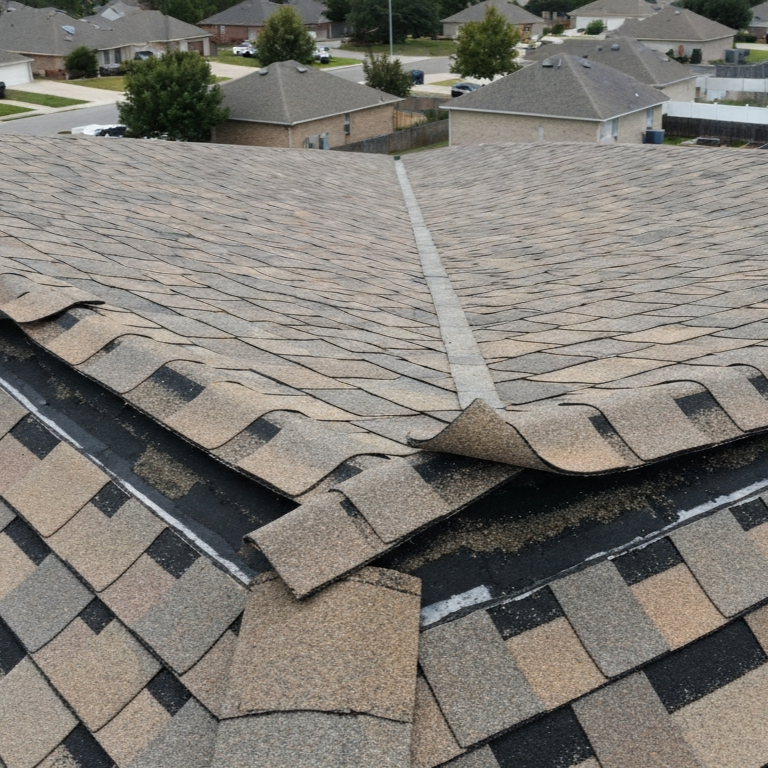
Storm-damaged asphalt shingles with lifted ridge cap and exposed roof seams after high winds on a residential Louisiana roof system.
Where Wind Damage Concentrates (and Why)
Wind damage on a residential roof is rarely random. Building science research from the Insurance Institute for Business and Home Safety (IBHS) and post-hurricane Mitigation Assessment Team reports from FEMA converge on the same physics: wind uplift forces are highest at the corners of a roof, then along the perimeter (the eaves, the rakes, the ridges), and lowest in the field — the broad middle of each slope.
That distribution is why the first shingles to lift, crease, or blow off after a storm are almost always near the corners or the perimeter, not in the visible middle of the slope. A homeowner who scans only the front-facing slope from the lawn often concludes the roof is fine when the actual damage sits at the rake edge above the gable end — out of view from the street.
There's a second, subtler wind failure mode most homeowners miss. Wind can break the adhesive seal on an asphalt shingle without immediately blowing the shingle off. The shingle still looks attached from the curb. It flaps loose during the next rain band, lets wind-driven rain under the layer, and silently soaks the underlayment for weeks before any ceiling stain appears below. The visible tell is a thin horizontal scuff line where granules have rubbed off just below an otherwise-intact shingle — a cosmetic mark that signals a structural problem.
The National Hurricane Center classifies hurricane-force wind at 74 mph or higher and gale-force wind at 39-54 mph. Both can damage Louisiana residential roofs. The shingle damage threshold doesn't wait for hurricane categorization — sustained gusts in the 50-70 mph range produce uplift damage on asphalt shingle roofs every storm season.
The 10-Point Inspection Checklist
Walk the perimeter of the home with a phone camera and binoculars. Stay on the ground; do not climb a wet or storm-damaged roof. The inspection covers the four sides of the house, the yard, and a quick attic check. Total time is about 15-20 minutes if everything looks clean, longer if findings show up.
1. Missing or torn shingles
Bare patches where the shingle is gone entirely. Visible from the ground with binoculars on most slopes. Look closely along the rake edges (the sloped sides at the gable ends) and along the lower eaves — those are the highest-uplift zones.
2. Lifted, curled, or creased shingles
Shingle edges sitting noticeably higher than their neighbors, or shingles with a clean horizontal fold across the tab, indicating wind has bent them upward. Even shingles that appear to have settled back down may have broken adhesive seals — the next storm finishes the job.
3. Granule piles at downspout exits
Open the area below each downspout. Fresh asphalt granules accumulating in piles at the concrete or splash block indicate hail impact, wind scuffing, or accelerated aging. A small pile after one storm is a finding to document; a large pile signals the roof may have lost significant UV protection.
4. Dented vent caps, flashing, or gutters
Soft-metal damage. The pro tells. Dents on aluminum vent caps, sheet-metal flashing, gutters, gutter screens, or AC condenser fins corroborate hail or debris impact severity. Photograph with a coin or ruler in frame for scale.
5. Displaced or missing flashing
The metal pieces around chimneys, skylights, plumbing vents, and roof valleys. Wind or debris can pull flashing away from masonry or wall surfaces, leaving gaps that water will exploit. Flashing failures are the most common single source of post-storm interior leaks.
6. Tree limbs or debris on the roof
Anything resting on the roof surface that wasn't there before the storm. Even small branches can punch through asphalt shingles when wind drives them at high velocity. Larger limbs need professional removal — pulling them off without inspection can lift shingles attached to the limb or expose punctures hidden underneath.
7. New ceiling stains or water on floors (interior)
Walk through every room with the lights on. Look at ceilings, around skylights, around recessed lighting, and at the tops of interior walls. Fresh stains, wet drywall, or water on hard floors below indicate active leak paths that started during the storm.
8. Damp insulation or dark stains in the attic
With a flashlight or headlamp, scan the underside of the roof decking for dark water stains, matted-down or visibly damp insulation, mold rings, or daylight pinholes piercing through. Attic stains usually appear 24-48 hours before water reaches the ceiling drywall in the rooms below — catching damage at the attic stage prevents thousands in interior losses.
9. Sagging or uneven roofline visible against the sky
Stand far enough back from the house to see the roof silhouette against the sky. Any visible dip, wave, or sag along the ridge line or between rafters indicates structural compromise — saturated decking, broken rafters, or impact damage. Sagging is a same-day call to a professional, not a documentation-only finding.
10. Damage to soft items in the yard
Scan patio furniture, AC condenser units, vehicles, and screened-in porches for hail dents or impact damage. If hail damaged a car parked outside, it almost certainly damaged shingles too. The yard inspection corroborates the roof inspection.
Never climb on a roof to do this inspection — wet, debris-covered, or storm-damaged roofs are unstable. OSHA requires fall protection for any work above 6 feet. From the ground with binoculars, most damage signatures are visible. Confirmation of subtle damage requires a professional inspection with proper safety equipment.
How to Tell Wind Damage From Hail Damage
Wind and hail damage have distinct visual signatures. The difference matters for two reasons: it determines what kind of repair the roof needs, and it shapes how the insurance claim is documented.
| Wind Damage Signs | Hail Damage Signs |
|---|---|
| Creased shingles with a clean horizontal fold | Random circular bruises 1/4" to 2" diameter |
| Lifted edges or corners that flap in light breeze | Pockmarks or dimpling on aluminum vents and flashing |
| Thin scuff lines below intact-looking shingles | Splatter pattern in granules where impact disturbed surface |
| Damage clusters at corners, eaves, rakes, ridges | Damage scattered across all slopes with no directional pattern |
| Missing tabs, full shingles, or ridge cap pieces | Soft-metal dents that line up with bruises elsewhere |
| Flashing bent or pulled away from chimneys/walls | AC condenser fins bent or flattened (corroborating evidence) |
Hail damage is the most-disputed category in property insurance because it's genuinely hard to see. Bruises on aged shingles can look like normal wear. Granule loss on a 15-year-old roof can be cumulative aging or a single recent hail event. Pros separate the two by examining collateral evidence — the damage hail leaves on nearby softer materials. Sharp, unweathered dents on aluminum vent caps, steel gutters, or AC condenser fins confirm the storm was severe enough to damage shingles even when the shingle bruising itself is subtle.
The Soft-Metal Collateral Test
Insurance adjusters use this technique routinely; most homeowners don't know it exists. Before climbing a ladder or photographing shingles, walk around the home and inspect every soft-metal piece for fresh dents.
Items to check: aluminum gable vents and roof vent caps, sheet-metal flashing around the chimney, gutters and gutter screens, downspouts, AC condenser fin coils, mailbox, and metal patio furniture. Look for sharp, unweathered indents — fresh dents have crisp edges and bare metal color where the impact removed paint or oxidation.
If the soft metals show clear hail dents, the storm was severe enough to damage the roof. Photograph each dent with a coin or ruler for scale. The collateral evidence builds a claim file that matches what the adjuster will look for on their own visit. If every soft-metal piece is pristine, claims of severe hail damage to the roof are harder to defend and more likely to be denied.
Louisiana-Specific Damage Signatures
Several damage patterns show up disproportionately on Louisiana roofs because of the climate, the dominant tree species, and the storm history. Northshore and Greater New Orleans homes share most of these.
Spanish moss in roof valleys
After hurricane-force wind passes, dislodged Spanish moss often ends up dammed in the roof valleys — the seams where two roof planes meet. Moss-blocked valleys cause water to back up and run sideways under shingle edges, creating leak paths far from the visible blockage. Photograph any moss accumulation in valleys; remove it carefully or have a roofer handle it.
Cracked pipe boots after wind events
The rubber collar around plumbing vent stacks. Gulf Coast UV degrades these boots in 5-8 years — substantially faster than the 15+ year lifespan typical in northern climates. Wind events can complete the failure on a boot already weakened by UV. Visible cracking around the pipe collar after a storm is a finding worth documenting and repairing immediately.
Live oak limb damage
Live oaks dominate the Northshore canopy. They fail differently than pines: live oaks uproot when saturated soil and sustained wind exceed their root anchorage; pines tend to snap mid-trunk. Either failure can drop a substantial limb across a roof. Even smaller oak limbs, the diameter of a wrist, can punch through asphalt shingles, decking, and the rafter beneath in a single impact.
Wind-driven rain through ridge and gable vents
Tropical-storm-force wind drives rain at angles standard ridge vents and gable vents weren't designed to seal against. Water inside the attic immediately after a storm — without any visible roof damage from the outside — often traces to wind-driven rain through ventilation openings rather than roof failure.
When the Visible Signal Constitutes an Emergency
Most post-storm findings are documentation-only — they go into the claim file, get a professional inspection scheduled within the week, and don't require a 2 a.m. response. A smaller set of findings indicates the roof envelope is open, and the next rain band will cause serious interior damage. Those need same-day action.
| Same-Day Emergency | Document Now, Inspect This Week |
|---|---|
| Active water entering the home | A few lifted or curled shingles |
| Daylight visible through the attic decking | Granule piles at downspout exits |
| Sagging or uneven roofline | Dented vent caps with no interior leaks |
| Exposed underlayment after wind tore shingles off | Single missing shingle in the field |
| Tree limb resting on the roof above living space | Small soft-metal dents (claim documentation) |
| Multiple active leaks in different rooms | Bent flashing without active water entry |
The threshold is straightforward. If water is actively entering the home, if the underlayment is exposed to the next rain, if the decking is sagging, or if daylight is visible through the attic, the response is same-day tarping and immediate professional contact. Anything else is a documented finding that goes into the claim file but does not warrant emergency calls.
The Environmental Protection Agency's mold-prevention guidance puts the safe-drying window for wet building materials at 24-48 hours. Beyond that window, mold typically begins growing in damp insulation and saturated drywall. Emergency-threshold findings should be tarped and dried inside that window. For step-by-step guidance on safe tarping after a storm, see the companion article on roof tarping technique.
How Damage Signatures Differ by Roof Material
Most Louisiana residential roofs are asphalt shingle — typically 90%+ of the homes a homeowner sees driving through any Northshore neighborhood. The asphalt shingle damage signatures discussed above apply. Less common materials show different patterns.
Standing-seam metal roofs lift at the seams when wind catches an edge. Popped fasteners appear along the seam lines. Subtle waves develop where the wind has stressed the panels. A single popped seam can let salt-laden water under the adjacent panels for the entire next storm season — particularly relevant for coastal Louisiana installations.
Concrete and clay tile roofs (uncommon in residential Louisiana but present on some older Spanish-influenced homes in Greater New Orleans) crack, slide, or displace rather than lift. A single missing tile lets water track under several adjacent ones, so damage spreads quickly under the surface. Tile damage assessment usually requires a professional ground-level inspection, which rarely reveals the full scope.
Document, Don't Touch — Setting Up the Insurance Claim
The documentation captured in the first hours after a storm decides the outcome of the insurance claim that follows. Carriers settle claims based on the documented difference between the property's pre-storm condition and its post-storm condition. Photos, video, and structured notes are the evidence.
The documentation set every Louisiana adjuster expects to see includes wide ground-level shots from each side of the home (north, east, south, west), close-up photos of every visible damage point with a coin or ruler in frame for scale, attic photos with timestamps showing stains and damp insulation, and short video sweeps that establish the relationship between the storm event and the damage. A separate detailed companion article walks through the full storm-damage documentation checklist.
Do not make permanent repairs before the adjuster has inspected the damage. Emergency mitigation — tarping, water extraction, plywood over a window — is expected and usually covered as a separate expense category. Permanent shingle replacement, flashing re-seal, or any work that obscures the storm cause weakens the claim. Stabilize the damage; let the adjuster see what the storm did.
Louisiana Insurance Timing Rules That Affect the Claim
Two Louisiana statutory protections affect any storm damage claim a Louisiana homeowner files. Knowing them before the storm hits changes the outcome.
First, La R.S. 22:1337 — the Annual Deductible Law passed in 2009 — caps the hurricane deductible at one per calendar year for owner-occupied one- and two-family homes insured by admitted Louisiana carriers. If two or more named storms cause damage in the same year, the deductible doesn't reset for each claim. The carrier covers anything above the unpaid balance of the original deductible. The protection does not apply to surplus lines (non-admitted) carriers.
Second, the claim filing window. Most Louisiana homeowners’ policies require notice of loss within 30-90 days of the storm event. Some require initial notice within 24-48 hours for emergency mitigation coverage. Missing the window can disqualify the entire claim. Check the policy declarations or call the agent immediately after any damage event — filing notice doesn't commit the homeowner to anything; it preserves the claim right.
The Louisiana Department of Insurance maintains a consumer hotline at 1-800-259-5300 for policyholders who run into disputes with their carrier or have questions about Louisiana-specific protections. Louisiana Citizens Property Insurance — the state's insurer of last resort — operates a separate claims line at 1-888-568-6455 (option 3).
When to Stop and Call a Professional
Hidden damage is the rule, not the exception, in storm losses. A roof can look clean from the curb and still have broken shingle seals, compromised flashing, or saturated decking that fails the next time it rains. Several findings warrant a professional inspection regardless of how the rest of the roof looks.
Any soft-metal dent visible from the ground. Confirms hail severity sufficient to damage shingles, even if the shingle damage isn't visually obvious.
Any granule pile at a downspout. Indicates either acute hail impact or accelerated aging — both warrant professional confirmation.
Any interior ceiling stain, even a small one. Visible water damage inside means the roof envelope was breached, and the visible stain is usually weeks behind the actual damage.
Any tree limb resting on the roof. Removal without prior inspection can lift shingles attached to the limb or expose punctures hidden underneath.
Sagging roofline. Same-day call. Structural compromise is a safety risk and a same-week ceiling collapse risk.
Damage near a chimney, skylight, dormer, or roof valley. Flashing work is where amateur repairs make leaks worse. Professional flashing assessment is more cost-effective than the repeated leak repairs that follow a poor DIY fix.
Frequently Asked Questions
Yes. Wind can break the adhesive seal on an asphalt shingle without immediately blowing the shingle off. The roof looks intact from the curb, but leaks during the next rain band. Hail bruising can be subtle on aged shingles. The reliable way to surface hidden damage is a structured ground-level walkaround with binoculars, an attic check for water stains, and a professional inspection if soft-metal collateral evidence appears anywhere on the property.
As soon as the weather window safely allows — ideally within 2-6 hours after the storm passes. The EPA's mold-prevention guidance puts the safe-drying window for wet building materials at 24-48 hours, so every hour erodes the safety margin. Start with a ground walkaround the same day, do the attic check the same day, and file claim notice within the first 12-24 hours. Never inspect a wet, windy, or actively storming roof from above.
Missing shingles, lifted or curled shingle edges, creased shingles with a clean horizontal fold across the tab, and thin scuff lines below an otherwise-intact shingle (a sign the adhesive seal broke). Wind damage clusters at corners, eaves, rakes, and ridges — not in the field of the slope — because uplift forces are highest at the perimeter.
Fresh hail damage has sharp, unweathered edges — clear circular bruises about 1/4" to 2" across, with disturbed granules around the dimple revealing the dark mat beneath. Normal wear is uniform, faded, and weathered across the whole shingle. The most reliable corroborating clue is collateral damage on soft metals: if vent caps, flashing, gutters, or AC fins have fresh dents, the storm was severe enough to damage shingles too.
Document first, then notify the carrier, then schedule any professional inspection. Filing notice with the insurance carrier preserves the claim window. Independent roofer inspection produces a documentation package that the adjuster will compare to their own findings. Most Louisiana roofers offer free post-storm inspections.
Generally, only if a covered storm event created a sudden opening that let the rain in. Wear-and-tear leaks and gradual leaks are typically excluded as maintenance issues. The fact pattern that gets covered: a documented storm caused identifiable damage (lifted shingles, missing flashing, debris impact), and rain entered through that opening. The fact pattern that gets denied: an aging roof developed a gradual leak unrelated to a specific storm event.
Schedule a professional inspection regardless. Hidden damage — broken shingle seals, subtle hail bruising, displaced flashing — only becomes visible to a trained eye on the roof itself. A free inspection within the first 30 days catches damage that won't otherwise appear until the next storm tears it open. Documenting the inspection, even if no damage is found, also helps any future claim that depends on showing the property's pre-storm condition.
It depends on the carrier and the claim outcome. Single-event storm claims tied to a named weather event typically don't raise premiums on Louisiana policies — the loss is treated as catastrophic rather than usage-based. Multiple claims in a short period or claims tied to wear-and-tear may affect renewal pricing. Confirm with the agent before filing if the expected claim amount is small relative to the deductible — sometimes paying out of pocket is the cleaner option.
What the Inspection Misses Costs the Most
Most storm losses are decided in the first 48 hours — not in the back-and-forth with the adjuster weeks later. A structured ground walkaround with the right cues (corners and edges first, soft-metal collateral as the professional's diagnostic tell, attic stains as the early warning), tied to disciplined documentation, is what separates covered claims from denied ones. The damage that matters is rarely the damage seen first. The patient inspection — the one that starts on the lawn with binoculars before anyone touches a ladder — is the one that protects the home.
