
Tree on the Roof? A Louisiana Step-by-Step From Safety to Insurance Settlement
When a tree hits a Northshore roof, the first hour decides whether the claim pays in full or gets disputed. Standard Louisiana homeowners' policies cover tree-on-roof damage as a sudden accidental event — but only when documentation supports the cause. The sequence: safety first (no entering compromised structure, no approaching downed power lines), then photograph everything before anyone moves the tree, then file the claim before scheduling tree removal.
A live oak limb the diameter of a forearm comes through the ceiling of a Mandeville bedroom at 3 a.m. during a thunderstorm. The roof is still raining water onto the bed. Power may or may not be on. The homeowner has a hundred decisions to make and very little information about what to do first.
What follows is the step-by-step sequence Northshore homeowners should follow in the hour, day, and month after a tree-on-roof event. Each step protects either the people in the home, the structure, or the insurance settlement that has to fund the repair. Skipping steps in the first hour creates problems that cannot be fixed in the next 30 days.
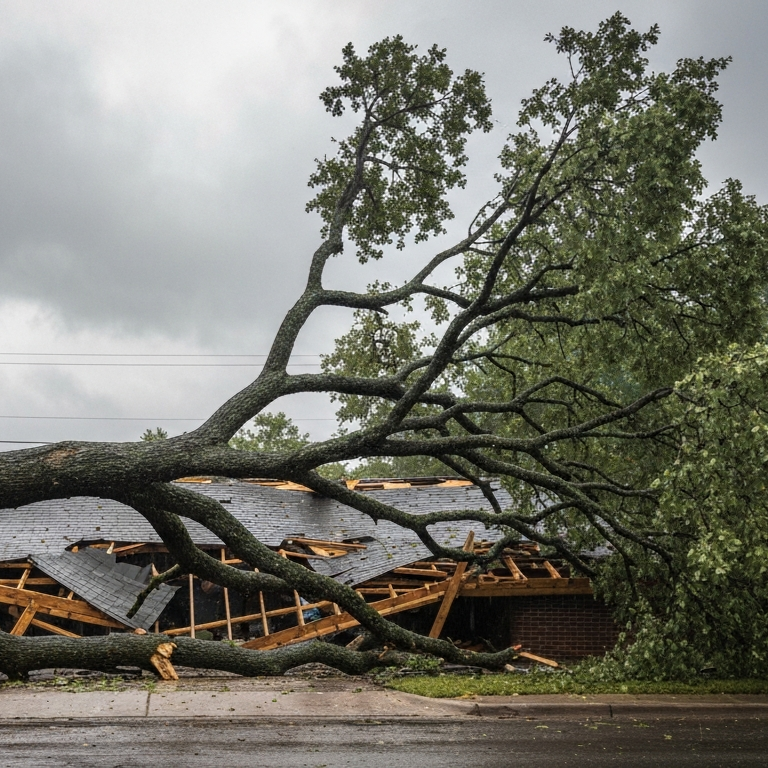
Massive fallen tree crushed Louisiana home roof during severe storm, causing structural damage and emergency insurance claim response efforts.
Hour 1 — Safety First, Documentation Second
Step 1 — Get everyone out of the affected area
Roof structural damage from a tree strike is unpredictable. The visible damage is rarely the full damage. Rafters, decking, and framing in adjacent rooms may have shifted enough to fail under additional load. Move people, pets, and irreplaceable items out of the affected room and any room directly beneath it.
If the strike compromised a load-bearing area or knocked walls off-plumb, evacuate the entire structure until a structural engineer or qualified contractor can assess. Personal safety is the only Hour 1 priority that matters more than documentation.
Step 2 — Check for downed power lines
Tree strikes frequently take service drops down with them. Power lines on or near the structure can be live even when the home's interior power appears off. Stay 30 feet minimum from any visible wire on the ground. Call Entergy (1-800-368-3749) or the local utility for service disconnect before any other work begins.
Never approach a downed power line. Never assume a downed line is dead. Louisiana utilities respond to downed-line calls within hours and will safely disconnect service. Until they confirm disconnect, treat the area within 30 feet of any line as a no-approach zone.
Step 3 — Check for gas leaks
Tree strikes that damage walls or foundations sometimes rupture gas service. A natural gas smell (rotten egg/sulfur) inside the structure means immediate evacuation, no flipping switches or lighting anything, and a call to Entergy emergency line (1-800-9OUTAGE / 1-800-968-8243) or Atmos Energy emergency line (1-866-322-8667 in Louisiana) from outside the home. Do not return until the utility confirms it is safe.
Step 4 — Photograph everything before touching anything
Once safety is confirmed, document the scene before any cleanup or stabilization happens. Wide shots of the exterior showing the tree's position on the structure. Close-ups of every visible damage location. Interior photos showing where the tree penetrated, what fell, and what is wet. Date-stamped if the phone supports it. Video the scene with audio narration — the metadata becomes evidence later.
Photo the tree's source point if visible — the broken trunk, the uprooted base. Insurance carriers occasionally argue that a tree was already dead or compromised before the storm, which can shift coverage. A photo of the green leaves and intact root structure settles that question early.
Hour 2-12 — Stabilize and Notify
Step 5 — Tarp the opening if conditions are safe
If the tree created a roof opening and the structure is safe to approach, a tarp over the opening prevents additional water damage to the interior. Tarp ON TOP of the tree if the tree is still on the roof — do not move the tree until the adjuster has documented its position. Tarp installation should follow the wood-anchor-strip method that holds in the wind. Active wind, lightning, or unsafe roof conditions mean wait — interior water damage costs less than a homeowner falling from a wet Northshore roof.
Step 6 — File the insurance claim immediately
Most Louisiana homeowners’ policies require notice within 30-90 days of the loss event. Filing within the first 24-48 hours preserves emergency mitigation coverage (tarp materials, professional tarping, water extraction). Call the carrier's claims line directly. Provide claim details, request a claim number, and confirm the adjuster assignment timeline.
Filing the claim does not commit the homeowner to anything. It preserves the right to recover. Carriers cannot deny coverage for an event the homeowner has not formally reported.
Step 7 — Document interior damage as it appears
Water from a roof opening continues to spread for 6-24 hours after the tree strike. Photograph each new ceiling stain, wet drywall section, water on the flooring, and any damaged contents as they appear. Time-stamped photos showing damage progression strengthen the claim by establishing the scope.
Day 1-7 — Tree Removal and Initial Assessment
Step 8 — Schedule professional tree removal (after photos)
Tree removal from a structure is specialized work — the wrong removal technique can cause additional structural damage as the tree shifts during cutting. Use a licensed Louisiana tree service with experience in structure-impact removal. Get the adjuster's documentation completed before removal if possible; if removal must happen first for safety, ensure the contractor photographs the tree-on-structure position before starting.
Tree removal cost typically runs $1,500-$8,000 for a structure removal, depending on tree size, access, and complexity. Most Louisiana homeowners' policies cover tree removal costs as part of the loss, subject to specific policy limits (typically $500-$1,500 per tree, $1,000-$3,000 total). Excess removal cost may be out-of-pocket — confirm coverage limits with the carrier before authorizing removal.
Step 9 — Get an independent contractor inspection
Hire a licensed Louisiana roofing contractor (LSLBC verification at lslbc.louisiana.gov) for an independent damage assessment. The contractor's report becomes the second opinion that supports the homeowner's settlement position when the carrier's adjuster scope comes in. Most reputable Northshore contractors do storm-damage inspections at no charge.
Tree-on-structure damage frequently extends beyond the visible puncture point. Adjacent decking can be cracked, rafters or trusses may be compromised, and framing in walls below the impact may have shifted. A contractor's inspection that includes an attic walk-through and an adjacent-room evaluation produces a complete scope.
Step 10 — Coordinate with the insurance adjuster
The carrier's adjuster typically inspects within 3-7 days of claim filing on Northshore tree-strike claims (longer after major storms when adjuster capacity is saturated). The contractor's report and the adjuster's inspection should produce two scopes that get compared. Discrepancies become supplemental requests — additional payments the carrier authorizes when the contractor identifies items the adjuster missed.
Day 7-30 — Repair Authorization and Project Start
Step 11 — Settle the claim before authorizing repairs
Permanent repairs should not start until the carrier has approved the scope and provided the initial settlement (or actual cash value advance for replacement-cost policies). Starting work before settlement creates two problems: the carrier loses the ability to verify scope at the inspection stage, and supplemental approval becomes harder once damage is concealed by repair.
Step 12 — Pick the contractor on the right filters, not the fastest available
Tree-strike repair is more complex than standard roofing — it frequently includes structural repair (rafter or truss replacement), framing repair in walls below the impact, drywall and ceiling replacement, and full roof system restoration in the affected area. Pick a contractor with structural roofing experience, not just shingle-installation capacity.
Filters: LSLBC license verification, certificate of insurance (general liability + workers' comp), manufacturer certifications, documented experience with structural roof repairs (not just re-shingles), and Louisiana tenure of 5+ years.
Step 13 — Document the rebuild
Photograph each phase of the rebuild as it happens — tree removal, tarp condition, framing exposure, structural repair, decking replacement, underlayment installation, shingle install. The documentation supports the supplemental claim if additional damage is discovered during the rebuild and protects against warranty disputes years later.
Insurance Coverage Realities for Tree-on-Roof Damage
Standard Louisiana homeowner insurance covers tree-on-roof damage as a sudden accidental event when the tree falls due to wind, storm, or other covered cause. Coverage includes structural repair, roofing repair, interior damage, contents damage, and (within policy limits) tree removal cost.
What is typically NOT covered:
Trees that fell due to obvious pre-existing decay or disease (insurer can argue "failure to maintain" if the homeowner had knowledge of the dangerous tree).
Tree removal where the tree did not damage covered structures (a tree falling in the yard with no structure impact is typically not covered).
Damage to landscaping that was hit by the tree (some policies include landscaping coverage with specific limits).
Tree removal cost beyond policy-specified limits ($500-$3,000 in most Louisiana policies).
Do not sign an Assignment of Benefits (AOB) document, handing the claim to a tree removal company or roofing contractor. After Northshore storms, contractors sometimes offer to "handle the insurance side" in exchange for AOB. The homeowner loses control of the claim, the settlement check goes to the contractor, and scope disputes become contractor vs. carrier, with the homeowner having no say.
Where This Doesn't Apply
A tree fell from neighbor's property
Standard Louisiana law and most insurance policies treat damage from a neighbor's tree as the affected homeowner's claim — meaning the homeowner's policy covers the damage, not the neighbor's. Exceptions exist where the neighbor had documented knowledge of a dangerous tree and failed to act; those become liability claims and benefit from attorney consultation.
Old-growth tree on historic structure
Tree strikes on historic Louisiana homes (registered historic districts in NOLA, certain Mandeville, and Covington structures) trigger preservation review for repair. Standard contractors may not be qualified to do the repair work; specialized historic preservation contractors are required. Insurance settlement negotiations also become more complex due to like-kind material requirements.
Multiple-tree storm event
When multiple trees fall during a single storm event, the claim becomes a single multi-tree claim rather than multiple separate incidents. Hurricane deductible applies once per storm event, not per tree. The Louisiana Annual Hurricane Deductible Law (La R.S. 22:1337) caps hurricane deductibles at one per calendar year for owner-occupied residential properties.
Frequently Asked Questions
Both, within policy limits. Most Louisiana homeowners’ policies include tree removal coverage of $500-$1,500 per tree, $1,000-$3,000 total. Excess tree removal cost is out-of-pocket. The structural repair, roofing repair, and interior damage are covered separately under the dwelling and contents portions of the policy.
Initial claim filing: same day. Adjuster inspection: 3-7 days (longer after major storms). Initial settlement: 30 days from satisfactory proof of loss under La R.S. 22:1892. Full repair completion: 30-90 days, depending on scope. Replacement-cost depreciation holdback released after work completion and receipts submitted.
Yes. The fallen tree becomes the homeowner's property after the incident. Some homeowners keep usable wood for firewood; some sell to mill operators (live oak in particular has value). Tree removal contractor agreements often include disposal as part of the service — confirm whether the homeowner can keep specific sections before signing the removal contract.
Standard answer: the affected homeowner's insurance covers the damage, not the neighbor's. The homeowner's policy may pursue subrogation against the neighbor's policy if the neighbor had documented knowledge of a dangerous tree. Most cases settle without subrogation — the affected homeowner is made whole through their own carrier.
Depends on whether the National Hurricane Center had named the storm at the time of the loss. Tree strikes during a named tropical storm or hurricane trigger the hurricane deductible (typically 2-5% of dwelling coverage). Tree strikes during a non-named thunderstorm or wind event use the standard deductible ($1,000-$2,500 typical). The carrier's claim form specifies which deductible applies.
The Tree Came Down. The Sequence Is What Matters Now.
Safety first. Document before moving anything. File the claim within 24-48 hours. Get an independent contractor inspection. Settle the scope before authorizing repairs. Pick the right contractor with objective filters. Follow the sequence, and the claim usually pays cleanly. Skip steps, and the same damage event produces months of disputes and out-of-pocket costs that should have been covered. The first 12 hours decide most of the next 90 days.
