
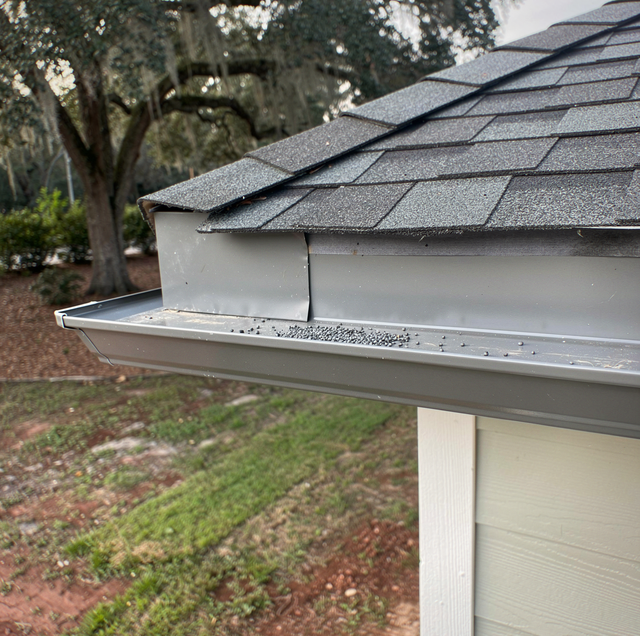
Stand under a roof that lost shingles in a hard wind, and the bare patch has a shape. It is a wedge, narrow at the bottom and wider as it climbs, and the point of that wedge sits at a corner or along a rake edge. At the bottom is the shingle that let go first, and the evidence around it is readable: nails still standing in the deck with nothing on them, torn slots in the mat where shingles pulled over their heads, and a sealant strip on the course above showing a clean dull line where it never gripped.
What makes your roof wind-resistant is the set of connections between that shingle surface and the framing underneath it. There are five, in series: the exposed leading edge of a shingle, the adhesive bond between courses, the fasteners into the deck, the deck's own fasteners into the rafters, and the edge detail closing the perimeter. Wind finds the weakest of them, and the link that gives way sits at the perimeter, because that is where the suction is highest.
Wind Pulls a Roof Upward, and Hardest at the Corners
Air arriving at a house does not stop at the wall. It cannot turn the sharp corner at the eave, so it separates from the surface there and leaves a pocket of slow, recirculating air lying over the roof behind that line, at a pressure well below the oncoming stream. Inside the attic, pressure stays close to ambient. The difference across the deck acts outward, and the covering on your roof is pulled away from the wood it is nailed to during a wind event.
That pull is not spread evenly. Wind-load engineering divides a roof into three zones for exactly that reason: an interior field, a strip around the perimeter, and the corners, with design suction rising sharply from the first to the third.
The corner is the worst of the three because of how the flow behaves there. When wind meets a building at an angle rather than square on, the air separating along the two roof edges that meet at that corner rolls into a pair of tight vortices lying over those edges. A vortex core is a region of very low pressure, and it sits a short distance in from each edge. That is the highest suction on the roof, which is why wind-load zoning treats the corner separately, and it lands where the covering has the least holding it down. A roof built identically from ridge to eave is overspecified across the middle of your house and underspecified at its corners.
The First Course Is What the Wind Gets Under
A shingle is held in two places. Nails run across its upper portion, and its lower edge, the part you can see from the ground, carries no fastener at all. That edge is held down by adhesive bond to the course beneath it, and without the bond it is loose.
At the eave, there is no course beneath. The first row lands on the starter, a strip whose own sealant bead sits low, near the eave, so that it comes up under the leading edge of that row. Put the bead in the wrong place and your first course is bonded nowhere along its bottom edge. A starter installed upside down carries the bead at the top instead. A cut-down three-tab shingle used as starter puts its factory sealant line several inches up-slope of where the leading edge actually is.
Edge metal is the other half of that detail. Its flange gives the starter a flat, fastened surface at the perimeter and closes off the deck edge so there is no free lip for moving air to catch. That matters out of all proportion to the amount of material involved.
Once a leading edge lifts, air gets underneath it. Pressure under the shingle climbs toward stagnation while suction over the top continues, and the load peeling the next course up multiplies. That course lifts, the one above it lifts, and the failure runs up the slope until it reaches a shingle bonded well enough to stop it. That is why the bare patch is a wedge.
The Sealant Strip and What Activates It
Across the face of an asphalt shingle runs a band of thermoplastic adhesive laid down at the factory. It bonds when the surface warms enough for the asphalt to soften and flow, the weight of the course above beds into it, and it cools and grips.
A shingle's printed application instructions say this outright: shingles applied in cool weather may not seal until warm weather arrives, and the instructions give a hand-sealing method with asphalt roof cement for those conditions. A roof you have finished during a cold stretch hangs on its nails until the sun finishes the job.
Sun exposure is the second variable, and it is not uniform across one house. A north-facing slope takes less direct sun through the year than the south side of the same ridge, and a plane shaded by mature trees or by a taller wing of your house is colder still. Those slopes can sit a full season with the strip never softening enough to flow, and until it does, each shingle on them is a flap: fasteners across the top, a free lower edge, nothing in between.
Where the Nail Lands Decides What It Holds
An asphalt shingle has a nailing zone, a narrow band across its width sitting just below the sealant strip. A nail placed inside that band passes through the shingle being laid and through the head of the shingle in the course below, where the two overlap. One fastener holds two courses, and that double engagement is the reason the band is where it is.
A nail set above the band misses the underlying course completely. The shingle below is left holding itself with its own fasteners, and the shingle above is pinned only at its top edge, which leaves a long span of material between the fastener and the free lower edge for uplift to work against. Drive one below the band, and it lands in the exposed portion, missing the overlap the same way and leaving its head uncovered in the weather, so the shank is a water path, and the shingle is pinned through the part of it that flexes most under uplift.
Depth counts as much as position. Driven too hard, the head cuts into the fiberglass mat, and the shingle can tear over it under load. Left standing proud, the head works against the underside of the shingle above. Driven at an angle, only one side of the head bears on anything.
Two separate things can fail at a fastener. The nail can withdraw from the deck, or the shingle can tear over a nail head that never moved. The deck below decides the first and the mat above decides the second, and the torn slot around a nail head is how you tell them apart.
Deck Attachment Is the Link Nobody Sees
Follow the load one step further. Uplift on the covering goes into the shingle nails, out of those nails into the sheathing panel, and out of the panel into the rafters or trusses through the panel's own fasteners. That last connection carries everything above it.
The fastener type there decides a great deal. A smooth-shank nail resists withdrawal from friction against wood fiber alone, and framing lumber shrinks as it dries and moves with every seasonal swing in humidity, which loosens a smooth shank over the years. A ring-shank nail carries annular rings rolled into its shank, and each ring physically engages the wood fiber, so withdrawing the nail has to shear that fiber rather than slide past it. Which of the two is in your deck was settled when your house was built.
A voluntary above-code standard called FORTIFIED addresses this connection, and what it specifies sits outside this article. When the deck leaves the framing, nothing above it matters. That is the failure that takes whole sections of roof at once.
What the Rating on the Wrapper Describes
A shingle's wind rating is the result of a laboratory test on a specimen, and that specimen is built to the manufacturer's instructions: a specified deck, underlayment and starter course, a specified number of fasteners in specified positions, and shingles sealed before testing begins.
One wind-resistance test tilts a test deck, blows air across it at a set velocity for two hours, and sorts the result into classes at 60, 90, and 110 mph. A separate uplift test works from a different direction, calculating the uplift a shingle would see from measured pressure coefficients and comparing that against its mechanically measured uplift resistance.
A shingle's wind class is a laboratory result. A wind-uplift test standard sorts shingles into Class D, G and H, tied to 90, 120 and 150 mph, and each class is earned with the fastening the manufacturer's instructions specify.
Both are honest measurements of a specimen built to a controlled recipe under laboratory conditions. A wind rating belongs to an assembly and an installation, not to a shingle. If the starter under the first course is a cut three-tab, if the fasteners on half the field sit above the band, if the shaded slope never bonded, then your roof has departed from the specimen that class was earned on.
Which rating your house calls for is a question for the local building authority, since wind provisions and their adoption dates differ from one jurisdiction to the next. What holds anywhere is the arithmetic of a chain in series: the weakest connection sets the number for all of them.
Frequently Asked Questions
No. That cellophane film is a release strip. It sits on the back of the shingle, landing against the sealant of the one stacked beneath it and keeping the bundle from fusing solid. It does not lie over the sealant of the shingle it is attached to, so pulling it before you lay the shingle changes nothing.
Yes, with asphalt roof cement under the tabs, and the printed application instructions specify the method: small spots roughly the diameter of a quarter, placed a set distance up from the lower edge. An oversized bead of solvent holds the asphalt against the shingle and can soften or blister the shingle above it.
Pitch moves the suction around rather than removing it. On a low slope, both faces of the roof sit in suction. As pitch increases, the windward face can go into net inward pressure while the leeward face stays in suction, so a steep roof trades a uniformly lifted surface for one pushed on one side and pulled on the other.
In warm, sunny weather it can happen within days of installation. In cool weather, the strip may not soften until the following warm season, which is how a roof you had finished late in the year goes months on fasteners alone. There is a check for it: a bonded shingle resists a firm hand lift at the corner, and the mat tears before the bond lets go.
It has two jobs. Before shingles go down, they have to stay on the deck itself, which is why synthetic underlayment is fastened with cap nails or cap staples, whose wide plastic or metal heads spread the load rather than pulling through the sheet. After the roof is finished, a sealed deck of taped seams or a self-adhering membrane is a water barrier if you lose shingles.
Look along your eave line in low, raking sun. A first course bonded to its starter reads as one straight, unbroken shadow line across the whole way. If you can instead pick out a repeating row of small crescent shadows, one at each shingle's lower corner, those corners are standing off the course below and are not bonded.
The connections that decide a roof's wind resistance are not visible from the driveway — an inspection can confirm the edge detail, fastening, and deck attachment on the roof you already have. Epic Roofing LLC serves Mandeville, Covington, and Baton Rouge. Call (225) 819-3742.