
A roof replacement looks simple from the driveway: a crew shows up, and soon after there's a new roof. Underneath that, a full tear-off is a sequence of decisions and inspections that happen out of sight. Knowing the order those decisions happen in, and what each one checks for, turns the day from something that happens to your house into something you can follow step by step.
What Gets Decided Before the Crew Arrives
Step 1: Inspection and scope: Before a single shingle comes off, an inspector walks the roof and the attic to confirm the scope of the job: how many layers are already on the deck, whether any sections sag or feel soft, and what the flashing looks like around each chimney, wall and pipe. From the attic, the underside of the decking shows old stains, daylight at gaps, and the condition of the rafters. That inspection sets the scope, and the scope determines what follows, including the crew size and the number of days the job is planned for.
Step 2: Material choice: The homeowner selects the shingle line and color within this same window, and the crew confirms quantities, underlayment type, and any upgrades, such as impact-resistant shingles or a heavier nailing pattern. Roofing is ordered in squares, and one square covers 100 square feet of roof surface, so the order is figured from the measured roof area plus the extra that hips, valleys and starter courses consume. Getting this settled before the delivery truck shows up matters, because a mid-job material change stalls a crew that is already staged and ready to work.
Tear-Off and What It Reveals
Step 3: Tear-off and protecting the property: Tear-off day starts with protecting the property. Tarps go down over landscaping and beds, boards can lean against windows near the eaves, and a chute or trailer is staged to catch debris so it does not pile against the house or the gutters. Only after that setup does the crew start stripping the old roofing down to bare decking.
Falling shingles and stray roofing nails make the tear-off zone unsafe. Keep people and pets well back from the work area until the crew has run its magnetic sweep across the yard and confirmed the ground clear.
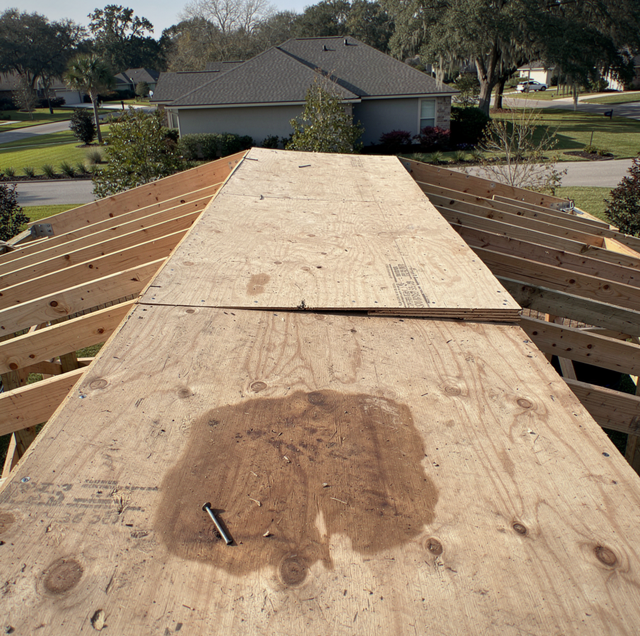
Step 4: Decking inspection and replacement: Once the decking is bare, the crew walks it, as tear-off is the only point where the top face of the decking can be seen and walked on. Soft, spongy, or darkened sections get marked, and each damaged sheet is cut out so the new piece breaks over a rafter, where both edges have framing to nail into.
Whether a slow leak has rotted the deck depends on how long the wood stayed wet. Heavy rain soaks it again before it can dry, and humid air slows the drying in between, so the wood can stay wet long enough to soften. Under light rainfall and dry air, the same slow leak can leave a stain on sound wood. That is why the same tear-off can turn up a full sheet of replacement decking on one roof and a few stray nails on the next, and why a written estimate can list decking as a per-sheet item instead of a fixed number.
Ask to see the bare decking before underlayment covers it, and ask for photos of each replaced sheet. Keep those photos with the invoice, since a later buyer's inspector may ask what sits under the shingles.
Replaced or Reused: Flashing, Vents and Pipe Boots
Once the deck is sound, the layers go back on in a fixed order, and each part is either replaced outright or kept only if it still does its job.
Step 5: Underlayment: New underlayment goes down over the whole deck on a tear-off, since it is the backup barrier if a shingle fails. Along valleys and eaves, the crew can lay a self-adhering membrane that seals around each nail, with a synthetic sheet across the open field. A valley carries runoff from two slopes at once, and the eave is where water can back up under the roof edge.
Step 6: Drip edge and flashing: Drip edge along the eaves and rakes is replaced on a tear-off basis when it is bent, rusted, or missing, since a damaged piece won't direct water into the gutter as it should. Step flashing at walls and valley metal should be removed and replaced, since reusing bent or nail-punctured metal reintroduces the leak. Counter-flashing set into a chimney's mortar stays when it is sound and tight, and the new step flashing tucks under it.
Step 7: Vents: Box vents and other hooded vents set in the shingle field come off with the old roofing, because each one's flange sits under the course above it. Each opening gets a vent again as the shingles reach it, a new one wherever the old hood is cracked, dented, or rusted. Where the roof vents at the ridge, the slot along the peak stays open through the new underlayment and is covered with ridge vent before the cap shingles go on. Pipe boots get new ones on a reroof, since the rubber collar has spent the old roof's life drying in the sun, and a cracked collar lets water run down the pipe.
Step 8: Shingles: A starter strip runs along the eaves first, so the first course has a sealed edge. Courses then work up from the eave, each one lapping the one below it with fasteners placed in the nailing zone printed on the shingle, and the ridge cap goes on last over the peak and the hips.
How Weather Affects the Schedule
A tear-off exposes bare decking to the sky, so the forecast sets each day's plan. The crew opens only as much of the roof as it can dry-in before quitting time, which means underlayment is fastened over every stripped section, so the house is sealed against rain even with no shingles on top. A forecast with a real chance of rain shrinks how much area gets opened at once. If rain moves in while a section is bare, the work shifts to getting underlayment fastened over whatever is already stripped, even if that means stopping mid-roof and finishing once the weather clears.
Wind matters too. Steep or high roofs get paused in sustained gusts, both for crew safety and because underlayment and loose shingles can lift before they are fastened. Heat plays a part as well: asphalt shingles soften on a hot roof and can scuff under foot traffic, which is one reason a crew can start at first light. A run of clear days can let a simple reroof finish in a single day, while a stretch of unsettled weather can spread the same scope across several, with the crew opening smaller sections each morning to keep exposure within what it can cover.
The Homeowner's Part on Tear-Off Day
Before the crew arrives, clear the perimeter: move vehicles out of the driveway, remove breakables from walls and shelves along the exterior, since hammering vibrates the whole house, and relocate patio furniture, grills, and planters that tarps or falling debris could damage. Pets belong indoors in a closed room or off-site for the day, since hours of noise and strangers on ladders can stress even a calm animal. The crew may ask for a working exterior outlet to run its air compressor, so check that one works and its breaker is on, and point out sprinkler heads, septic lids, or anything buried where the trailer will park.
You don't need to be home. The crew doesn't need to come inside for a standard shingle replacement, so the job can run while you're at work. Keep a phone reachable, in case tear-off turns up something like widespread decking rot that changes the scope of the day and the crew needs a decision before closing that section.
Cleanup, Final Inspection and the Paperwork
Step 9: Cleanup and final inspection: Cleanup closes the job: a magnetic roller sweep of the yard, beds and driveway for stray nails, debris cleared from the gutters, a final walk of the roof and a last look from the ground to confirm the ridge lines are straight and each vent cap is seated. For the next few days, check the lawn before children or pets run barefoot on it, since a nail can settle into thick grass where the magnet passed over it.
Somewhere in that closing paperwork is the warranty registration that an extended shingle tier may require, which the contractor can file for you; keep the confirmation page with the invoice.
Frequently Asked Questions
Yes. Every existing layer is stripped down to the deck in the same pass, so a roof with two layers produces about twice as much shingle debris and requires a container sized for it. Old nails that stay behind get pulled or hammered flat, since a raised head would press up through the new underlayment and show as a bump under the shingle.
Torn-off shingles, old underlayment, and any cut-out decking go into the staged trailer or dumpster. When the container sits on a driveway, boards laid under its rails or wheels can spread the load and keep the steel from gouging concrete or asphalt. Ask for the haul date so you know when the driveway is clear again.
Cover them or move them away from the roof deck. Prying off old shingles and hammering new ones knocks dust, grit, and old debris loose from the boards and down through gaps in the decking. The points of new roofing nails also come through the underside of the deck, so boxes stacked against the rafters can get snagged, and anyone working in the attic afterward should watch their head.
Sometimes. A gutter can stay hung during a reroof, although a section may be loosened and rehung where the new edge metal has to fit behind it. Siding along the roofline is covered rather than removed, and a course is lifted only where wall flashing tucked behind it needs to be removed and replaced.
A roof-mounted dish is unbolted before tear-off and remounted afterward, with its old bolt holes sealed and the new mount sealed at the deck. The signal may need re-aiming by the TV provider once it is back up. Solar panels are a separate job: the array has to come off before the shingles under it can be replaced, and that removal and reinstall is scheduled with a solar installer around the tear-off dates.
Whether a full tear-off needs a permit depends on the local building department. Ask whether your contractor pulls the permit and schedules any inspection. If a permit is issued, it may include a card to post in the front window until the job is signed off.
Schedule a full roof replacement estimate — a crew goes over the roof and attic with you, sets the scope and the material choice, and shows how the decking will be checked at tear-off. Epic Roofing LLC serves Mandeville, Covington, and Baton Rouge. Call (225) 819-3742.