
Wind Damage vs Hail Damage: What to Look For After a Storm
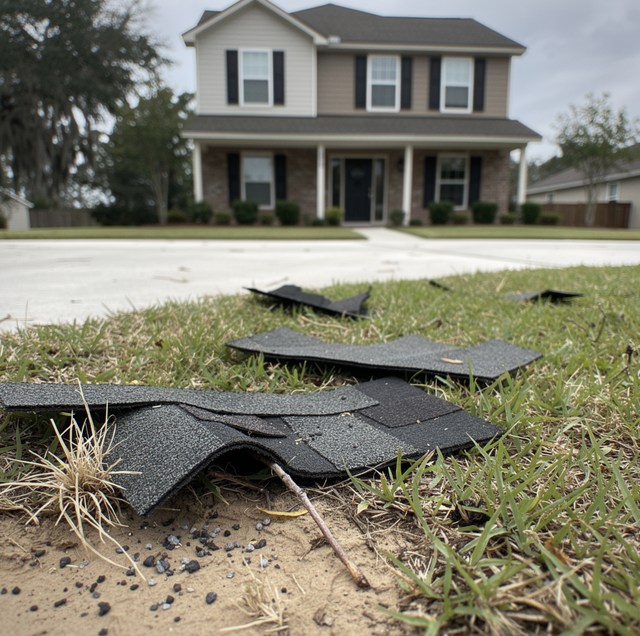
The morning after a windstorm has a way of announcing itself before you even open the front door. You hear it in the wind chimes still swinging, see it in the branches scattered across the lawn, and then notice something else: a few dark, gritty shingles lying in the grass near the driveway, and up along the roofline, a ridge cap that looks slightly off-kilter, like a book left open on a shelf. Nothing about the yard looks catastrophic. But something up top has clearly shifted.
That small detail is often the only visible clue a roof has taken a wind hit. Unlike hail, which leaves obvious dents and bruises scattered across a surface, wind damage tends to be quieter and more localized. It shows up at the edges, corners, and ridges first, subtle enough that homeowners drive right past it for weeks before a leak forces the issue.
How Wind Actually Attacks A Roof
Wind doesn't damage a roof the way hail does. Hail is a blunt impact, straight down, leaving circular bruises or cracked mats on shingles wherever it lands. Wind works differently. As gusts move across a roof plane, they create pressure differences that behave a lot like the lift under an airplane wing: air moving fast across the top surface creates lower pressure there, while higher pressure builds underneath, and that difference generates lift. On a roof, this effect concentrates hardest at the edges, ridges, and corners, the places where wind first catches a surface and starts prying at it instead of pushing straight down.
That's why a wind event and a hail event on the same roof, even from the same storm, tell two different stories. Hail scars the open field of the roof. Wind attacks the perimeter and the high points, tugging at seal strips, lifting tabs, and working nails loose one gust at a time. A single gust might do nothing, but a string of them, each one flexing a shingle up and back down, can fatigue the adhesive seal until a shingle tears free or flips backward.
This is also why sustained straight-line wind and short tornadic gusts leave different footprints. A steady wind event tends to loosen and lift broad sections along an edge or ridge, while a brief, intense gust can rip a cluster of shingles away almost instantly, leaving a small patch of bare decking rather than a scattering of loosened tabs.
Wind Damage Vs Hail Damage: Why They Look Different
These two threats leave distinct marks, so it helps to know what separates them first.
| Feature | Wind Damage | Hail Damage |
|---|---|---|
| Location | Edges, ridges, corners, rake lines | Scattered across the open field |
| Appearance | Lifted, creased, torn, or missing tabs | Round bruises, dented mats, cracked granules |
| Onset | Can worsen gradually as loosened seals fail | Fixed at the moment of impact |
| Ground evidence | Shingle pieces in the yard, bent flashing, displaced ridge caps | Dented gutters, dinged vents and downspouts |
| Attic evidence | Daylight, drafts, staining that spreads over time | Usually none unless impact cracked the deck |
A single storm can deliver both at once. Straight-line winds often arrive alongside hail cores, so a roof might show a torn ridge cap on one slope and a cluster of hail bruises on another. Separating the two matters, since the repair approach for a lifted, wind-torn section differs from the approach for hail-cracked shingle mats.
Signs Of Wind Damage You Can Spot From The Ground
You don't need to get on a roof to find the first clues wind has done its work. Walk the perimeter and look up at each slope from a safe distance.
- Shingles in the yard or gutters: A whole shingle, a torn corner, or granules collecting like dark sand point to wind lifting and tearing material loose.
- A ridge cap that looks uneven: Ridge caps take some of the hardest uplift force. A section that looks raised, wavy, or misaligned is a strong sign wind worked underneath it.
- Lifted or curled tabs along the edges: Binoculars help here. Look for tabs that catch light differently than the rest of the roof, a sign they're no longer lying flat.
- Gutters, downspouts, or fascia pulled loose: Wind strong enough to strain these fasteners is often strong enough to strain roofing fasteners too.
- Damaged siding or soffit: These components share exposure with the roof edge. Cracked, bowed, or missing panels signal the same gusts likely reached the roofline above.
- Debris pinned against one side of the house: Leaves and granules piled unusually thick against one wall often mark the direction the strongest gusts came from.
Signs Of Wind Damage Inside Your Attic
Some of the clearest evidence of wind damage doesn't show up outside at all. A quick look in the attic, standing safely on solid flooring or a joist, can reveal problems long before they appear as a stain on the ceiling below.
- Points of daylight: Pinpricks or streaks of light through the roof deck, especially near the ridge or an edge, mark a gap where a shingle has lifted or torn away.
- A draft you can feel: Even without visible light, moving air near the ridge or gable ends suggests an opening that wasn't there before.
- Dark staining or water spots on the decking: Wind-driven rain finds its way through even a small gap where a seal strip failed, and the stain often appears before a drip reaches the living space below.
- Damp or matted insulation, or a musty smell: Insulation that feels heavier or looks compressed near an outside wall or ridge, or trapped moisture announcing itself with odor, often signals water getting in gradually rather than all at once.
None of this requires climbing onto the roof surface itself. Ground-level and attic-interior checks are the safe, useful first pass. Confirming what's happening on the roof surface, and fixing it, is work for a professional with the training and equipment to be up there safely.
Roof Edges, Ridges, And Corners: The Areas Wind Targets First
These zones take the brunt of it for reasons rooted in how air moves around a structure. Corners see wind approaching from multiple directions at once, multiplying the lifting effect. Ridges sit exposed on both sides, catching pressure changes as the wind crosses whichever slope. Edges, especially rake edges along a gable end, are where wind first grabs a surface before rolling across the rest of the field.
Think of a strong gust catching a loose tarp. It doesn't tear from the middle first. It starts at a corner or edge where wind gets underneath, and once it has a grip, the tearing spreads inward. Roofing works the same way: fasteners and seal strips at the perimeter hold everything down, and once wind compromises that line, the rest of the field becomes far more vulnerable to the next storm.
This is why wind-uplift construction standards, like those behind FORTIFIED roof certification, focus on reinforcing those same zones with sealed roof decks, reinforced ridge attachment, and stronger perimeter fastening. In wind-prone areas, wind rather than hail is typically the dominant threat to roof integrity, which is why those standards exist. A roof built or upgraded to that standard is engineered specifically to resist uplift forces, not just impact.
Impact-resistant Class 4 shingles solve a related but different problem, built with a reinforced mat designed to resist cracking and bruising from hail. Pairing Class 4 shingles with wind-uplift-rated installation practices addresses both threats a storm can bring, not just one.
A Word On Aging Versus Storm Damage
Not every curled tab or granule-bare patch traces back to a single storm. Sun exposure and heat cycle a roof through expansion and contraction every day, and over years that steady thermal aging can make shingles brittle and curled on its own, with no wind or hail involved. That wear tends to spread evenly across a roof's sun-facing slopes rather than concentrate at edges and ridges. Scattered wear across an entire slope, with no fresh debris in the yard and no new attic staining, points toward ordinary aging rather than storm damage. One calls for a replacement conversation, the other for a targeted repair after a specific event.
What To Do After Spotting Wind Damage
Once you've noticed any of the signs above, a few steps protect the roof and the rest of the home while you arrange a closer look.
- Photograph what you can see from the ground: Wide shots of each slope, plus close-ups of any shingles or debris in the yard, create a useful record right after the storm.
- Check the attic for early leak signs: Catching a small stain or damp insulation early can mean the difference between a simple repair and a larger interior issue.
- Contain any active drip from inside if it's safe to do so: Leave anything on the roof surface itself to a professional.
- Schedule a storm damage inspection: A trained inspector can safely check for lifted seal strips, torn shingles, and damaged flashing that aren't visible from the ground, looking closely at ridge caps, edges, and corners.
- Have siding and soffit checked at the same time: These components share exposure with the roof edge, so storm damage often touches more than one system at once.
A roof that's shown wind damage once has already revealed its weak points. Addressing those areas gives the next storm less to grab onto.
Frequently Asked Questions
Sooner is better, even if nothing looks obviously wrong. Wind can loosen a seal strip without tearing a shingle free, so the roof may look intact for weeks while a slow leak develops underneath. An inspection within days of a storm catches problems while they're still small, rather than after they've spread to decking or insulation.
Manufacturer warranties for shingles typically require timely repair of storm-related damage to remain valid, and some require records showing when the damage occurred and when it was addressed. Keeping dated photos from right after a storm can matter later if a warranty claim ever needs to reference the timeline.
Not necessarily. A shingle can lose its seal strip bond and lift slightly with every gust without ever tearing free. From a distance it looks intact, but the adhesive locking it to the shingle below has already failed, leaving it open to wind and water intrusion the next time weather rolls through. That's part of why wind damage is easy to underestimate compared to the obvious bruising hail leaves behind.
A wind-affected shingle typically shows a fresh tear at the seal strip or a crease where it folded under pressure, with the adhesive line still intact on the section that hasn't separated. An aged shingle tends to show even curling along its entire edge and dry, brittle granule loss, with no sign of a sudden tear, since it's been slowly stiffening under sun and heat rather than being pulled loose all at once.
Yes. In commercial membrane-based systems, wind uplift tends to manifest as blistering, seam separation, or a membrane edge pulling loose from its attachment strip rather than as missing shingles. Built-up roofing (BUR) can show cracking or lifting in the surface layer, and coatings may peel at parapet edges and corners, the commercial equivalent of the shingle edges and ridges that take the hardest hit on a house.
Not always, but it's worth checking closely. Siding and soffit sit at the same exposed perimeter as roofing edges, so damage there signals the wind was strong enough to test the roofline too. It doesn't guarantee roof damage occurred, but it's a strong enough indicator that an inspection of both systems together makes sense.
Schedule a storm damage inspection — check for wind uplift at your roof's edges, ridges, and corners before small damage turns into a leak. Epic Roofing LLC serves Mandeville, Covington, and Baton Rouge. Call (225) 819-3742.
