
FORTIFIED Roof Cost in Louisiana: Real Numbers and the Insurance Math That Pays It Back
A FORTIFIED Roof in Louisiana 2026 typically costs $1,500-$3,500 more than a standard architectural replacement. Median total project cost: $16,229. After the $10,000 Roof Strong grant, median net out-of-pocket: $6,229. Plus a recurring 15-25% insurance discount under La R.S. 22:1483 that runs $750-$1,500 per year on a typical Northshore home. The upgrade does not pay back over time — in Louisiana, it almost always becomes a net-negative cost.
Most national articles about FORTIFIED roofing list the upgrade cost and stop. That misses what makes the math work in Louisiana. Two alternative pathways exist here that do not in most states: a $10,000 Roof Strong grant OR a $10,000 state income tax credit (under La R.S. 47:6044(G), the homeowner pursues one or the other, not both), plus the actuarially justified insurance discount required under La R.S. 22:1483 that recurs for the life of the roof. Either pathway, combined with the recurring discount, flips the FORTIFIED upgrade from a premium expense into a meaningful net cost reduction within 1-2 years for most Northshore homeowners.
What follows is the actual 2026 cost breakdown — base FORTIFIED Roof pricing on Northshore homes, the upgrade premium over standard code, the program stack that reduces it, and the recurring savings that compound over time. With concrete dollar examples on real Mandeville-sized homes.
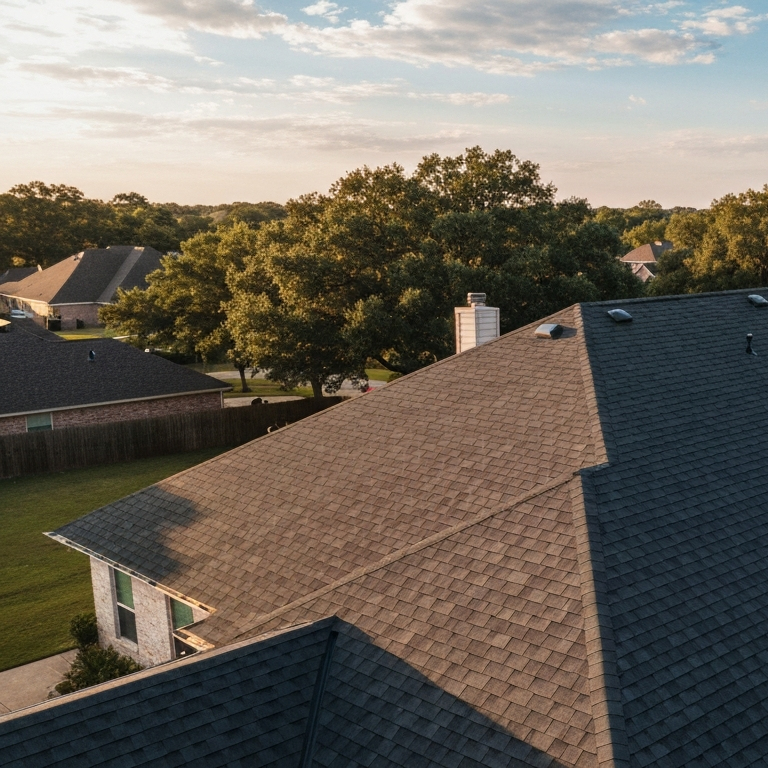
FORTIFIED roof installation on Louisiana home improves hurricane resistance while lowering long-term insurance costs through state-approved protection standards.
What a FORTIFIED Roof Actually Costs in Louisiana 2026
Three cost layers stack to produce the total: standard replacement base, FORTIFIED upgrade premium, and FORTIFIED-specific add-ons (evaluator fees, certification process). All Northshore-specific 2026 pricing.
Layer 1 — Standard architectural replacement base
A typical 2,000-2,500 sq ft Northshore home with standard architectural asphalt shingles runs $13,000-$23,000 installed in 2026. This is the floor before any FORTIFIED upgrade. Base costs include tear-off (1 layer), synthetic underlayment, drip edge, ice and water shield (eaves), field shingles, ridge cap, basic flashing, and standard cleanup.
Layer 2 — FORTIFIED upgrade premium
Baseline FORTIFIED Roof (Bronze) designation requires three upgrades above standard code, with a fourth required for the FORTIFIED Hail Supplement (additional designation):
Sealed roof deck — secondary water barrier under shingles ($400-$800 added).
Ring-shank nails in 6-nail pattern (vs standard 4-nail with smooth shank) ($200-$400 added).
Enhanced edge components — drip edge, starter strip, edge metal upgrade ($300-$600 added).
Class 4 impact-resistant shingles (required for the FORTIFIED Hail Supplement, and required by most Louisiana insurance carriers to grant the wind/hail discount even without the Hail Supplement designation) — $500-$1,500 added.
Total FORTIFIED upgrade premium: $1,500-$3,500 above standard replacement. The Louisiana Legislative Auditor reported the median total FORTIFIED upgrade cost across the state at $16,229 in recent data — meaning median base + median upgrade lands in that combined range.
Layer 3 — FORTIFIED certification process costs
The FORTIFIED Evaluator (an independent third party, not the contractor) performs the initial inspection and the final verification inspection. Evaluator fees typically run $300-$700 for a residential FORTIFIED Roof. The Roof Strong grant does not cover the fee — it is an out-of-pocket cost separate from the construction.
Permit fees ($75-$250 in St. Tammany Parish) and any pre-FORTIFIED repair work needed to bring the home to passing condition are additional. Most Northshore homes pass initial inspection without pre-FORTIFIED repair; older homes with significant pre-existing damage sometimes need $1,000-$3,000 of preparation work.
The Louisiana Stack That Reduces What's Paid Out of Pocket
Three programs combine to reduce net out-of-pocket dramatically:
Program 1 — Louisiana Fortify Homes Program (LFHP) Roof Strong grant
Up to $10,000 reimbursed toward the FORTIFIED Roof retrofit. The grant pays the contractor directly on completion of work and issuance of the IBHS FORTIFIED certificate. Application windows open periodically through the Louisiana Department of Insurance at ldi.la.gov/fortifyhomes. Lottery-based selection — registration is first-come, but selection is random within the window.
On the median $16,229 FORTIFIED project, the grant covers $10,000, and the homeowner's net is $6,229. Plus the evaluator fees and any construction cost above the $10,000 cap.
Program 2 — FORTIFIED state income tax credit
Louisiana state income tax credit of up to $10,000 for IBHS-certified FORTIFIED Roof installations completed on or after July 1, 2025. Subject to a $10 million annual statewide cap on a first-come, first-served basis. Applied at state tax filing for the year of installation.
The credit reduces Louisiana state income tax owed dollar-for-dollar. For a typical Northshore household with a $5,000-$10,000 annual state tax liability, the credit substantially reduces the out-of-pocket cost of a self-funded FORTIFIED project. Under La. R.S. 47:6044(G), the credit is available only to homeowners who did NOT receive the Roof Strong grant on the same project.
Program 3 — Construction Code Retrofitting Deduction
50% of the install cost up to $10,000, deductible against Louisiana income taxes. Effective for taxable periods beginning January 1, 2026. Note: under La R.S. 47:6044(H), this deduction does not stack with the FORTIFIED tax credit on the same project. It does stack with the Roof Strong grant pathway.
Stacked example on a $16,229 median FORTIFIED project
| Cost Component | Amount |
|---|---|
| Median FORTIFIED Roof project (full install) | $16,229 |
| Roof Strong grant pathway (Path A) | -$10,000 |
| Net out-of-pocket cash at install | $6,229 |
| OR FORTIFIED tax credit pathway (Path B, alternative under La R.S. 47:6044(G)) | Either path: ~$6,229 net cash effect (grant paid to contractor; or credit reducing state tax owed) |
| Net cost after either pathway | $6,229 cash equivalent (one pathway only — credit + grant cannot stack on same project) |
| Recurring annual insurance discount (R.S. 22:1483) | -$750 to -$1,500 / year |
| Net cost after Year 1 | Negative ($750-$1,500 saved/yr) |
Within 1-2 years of completion (depending on the chosen pathway), the typical Northshore homeowner with a FORTIFIED project sees the upgrade premium fully offset by either the Roof Strong grant or the FORTIFIED tax credit, plus the recurring insurance discount. The FORTIFIED upgrade is one of the rare Louisiana home improvements that turn long-term cash flow positive within a year or two.
The Recurring Insurance Discount Math
La R.S. 22:1483 requires admitted Louisiana insurers to offer an actuarially justified discount on the wind/hail portion of the homeowner premium for FORTIFIED-designated roofs. As of 2026, carrier filings typically produce discounts in the ~9-25% range; LDI is finalizing benchmark discount rules effective January 1, 2027. The discount applies for the life of the FORTIFIED designation (re-certified every 5 years).
Real-world Northshore math: a $4,500 annual homeowner premium where the wind/hail portion is roughly 40% ($1,800/year). A 20% discount on that wind/hail portion = $360/year. A higher-premium $7,000 annual policy can produce $1,500/year in recurring discount.
Compounded over the 25-year lifespan of the roof, the recurring discount on a typical Northshore home generates $9,000-$37,500 in premium savings — on top of the immediate grant or tax credit offset (whichever pathway the homeowner pursued). The FORTIFIED upgrade cost recovery typically happens in the first 1-2 years; the next 23-24 years are pure recurring benefit.
When the FORTIFIED Math Doesn't Quite Work
Three scenarios where the standard FORTIFIED stack produces weaker payback:
Scenario 1 — Homeowner is on a surplus lines insurance carrier
Surplus lines (non-admitted) carriers are not subject to the La R.S. 22:1483 discount mandate. Some surplus carriers offer the discount voluntarily; many do not. A common situation for high-risk coastal Louisiana properties is where admitted carriers will not write policies. Confirm carrier admitted status before counting on the recurring discount.
Scenario 2 — Homeowner plans to sell within 18 months
Whichever pathway the homeowner chose (grant or credit), the offset applies, but the homeowner captures only 12-18 months of recurring discount before selling. The FORTIFIED designation transfers to the buyer and is valuable at sale, but the seller does not see most of the long-term recurring benefits.
Scenario 3 — Homeowner does not have a Louisiana state income tax liability
The state tax credit only offsets state income tax owed. Households with low or zero Louisiana state income tax (retirees on out-of-state pensions, certain agricultural households) cannot fully use the $10,000 credit. For these households, the Roof Strong grant pathway is almost always the better choice, since the grant pays out as cash to the contractor regardless of the homeowner's tax liability.
Apply for the Roof Strong grant before construction begins. The Louisiana Fortify Homes Program disqualifies any project where work started before grant acceptance. Wait for written acceptance, then schedule the contractor — in that order. Reversing the order loses the $10,000 reimbursement.
What the Quote Should Look Like
A FORTIFIED-approved contractor's quote should explicitly itemize the upgrade components above standard code:
Sealed deck product (specific brand/SKU) and area covered.
Ring-shank nail specification and nail pattern.
Enhanced drip edge gauge and product.
Manufacturer-matched starter strip.
Class 4 shingle SKU (Landmark IR, Timberline ArmorShield II, Duration STORM, etc.).
FORTIFIED Evaluator coordination plan and timing.
Roof Strong grant payment timing (paid to contractor on certificate issuance).
Quotes that say "FORTIFIED upgrade — $3,000" without itemizing the above components are estimates that the homeowner cannot evaluate. The credentialed FORTIFIED contractor walks through each component during the inspection conversation.
Frequently Asked Questions
Median total project cost: $16,229 per Louisiana Legislative Auditor data. Range typically $14,000-$23,000 on Northshore single-family homes depending on roof size, complexity, and pre-existing condition. The upgrade premium above standard architectural replacement is $1,500-$3,500.
Worth it for the vast majority of Northshore homes with admitted insurance carriers, regardless of which pathway (grant or tax credit) the homeowner pursues. Either pathway, plus the recurring insurance discount, typically produces meaningful net cost reduction within 1-2 years. Less compelling for surplus-lines-insured properties (no mandated discount) or homeowners selling within 18 months.
Five years per certification. Re-certification requires a renewal inspection by an IBHS-approved FORTIFIED Evaluator. The recurring insurance discount continues as long as the certification is current.
Most existing Northshore single-family homes can support a FORTIFIED Roof retrofit. Homes that fail initial FORTIFIED Evaluator inspection (significant existing damage, certain structural conditions) can sometimes complete prerequisite repairs and re-apply. Mobile homes, condos, and new construction are typically excluded from the Roof Strong grant.
Yes. The IBHS certificate stays with the property and transfers to the buyer at closing. The buyer submits the certificate to their insurer, and the recurring discount continues for the new owner. The FORTIFIED designation is a documented feature in MLS listings on the Northshore.
FORTIFIED Math in Louisiana Is Different from Anywhere Else
Louisiana's FORTIFIED program structure — Roof Strong grant OR FORTIFIED tax credit (alternative pathways under La R.S. 47:6044(G)), plus Construction Code Retrofitting Deduction and recurring insurance discount under La R.S. 22:1483 — does not exist in most other states. National articles that cite the FORTIFIED upgrade as a 5-7% premium with a 10-year payback are describing markets without the Louisiana program structure. Here, the upgrade typically pays back in 1-2 years, and the recurring discount continues for the life of the designation. The right question is not whether to pursue FORTIFIED. It is which pathway — grant or credit — fits the specific homeowner's situation, and how soon to act.
Note on credit timing: The FORTIFIED tax credit under La R.S. 47:6044 sunsets December 31, 2031. Self-funded FORTIFIED projects completed before that date qualify; later projects may not. Plan around that timeline.
