
Quick Answer: UV breaks down asphalt at the surface through oxidation. Heat speeds that reaction, and a poorly vented attic keeps the deck from shedding it. Daily cycling adds fatigue. Reflective surfaces and ventilation lower the load; neither stops the oxidation.
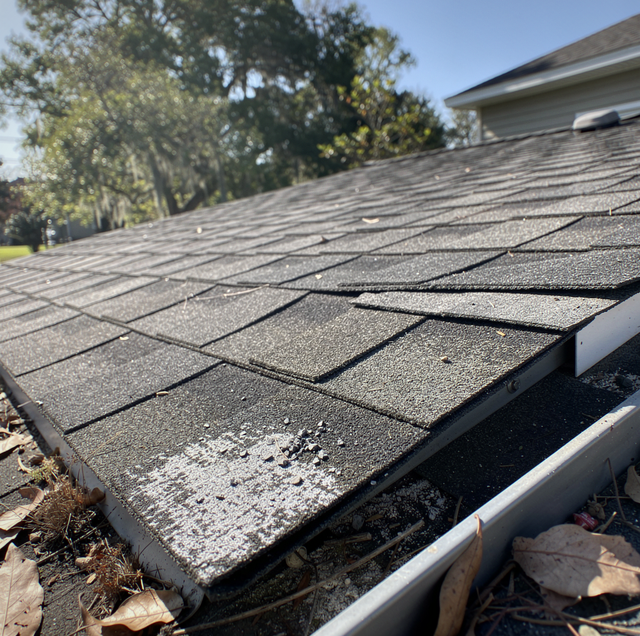
A shingle that started out a deep, uniform color can fade to a dull, chalky gray over its service life, even on a roof with no leak and nothing a homeowner would call an emergency. Nothing about that change looks urgent from the ground. It is still a sign the roofing material itself has begun to break down, a process that starts long before the color shift is obvious enough to notice.
Asphalt roofing does not fail all at once. It ages the way most exposed materials do: a slow chemical and physical breakdown driven mostly by two things working on the roof at the same time, sunlight and heat. They attack different layers of the shingle in different ways, and understanding each one separately helps make sense of the wear you eventually see.
Sunlight Breaks Down the Asphalt at the Surface
An asphalt shingle is a fiberglass mat coated in asphalt and topped with a layer of mineral granules that serve as the shingle's UV shield. A shingle with a full, firmly bonded granule layer sees far less direct ultraviolet exposure on its asphalt than one where granules have thinned or washed away.
Ultraviolet light carries enough energy to break the chemical bonds in the oils that keep asphalt flexible, a process roofers and material scientists both call oxidation. As those oils break down, the asphalt hardens and grows brittle, losing the pliability that lets it flex with the roof underneath it. Once a meaningful share of a shingle's surface granules is gone, the asphalt beneath has lost part of its UV shield and oxidizes faster thereafter. How much granule loss is normal for a given roof's age is a separate question; what matters mechanically here is that less granule coverage leaves more raw asphalt directly exposed to UV.
Heat Speeds the Same Breakdown From Within
Heat does not create a separate kind of damage. It speeds up the same oxidation reaction UV starts, the way most chemical reactions run faster at higher temperatures. A shingle sitting in full, unbroken sun for a long afternoon runs its surface temperature well above the surrounding air, and that extra heat accelerates the asphalt's oxidative aging over the same stretch of calendar time. That puts the pace of this reaction in the roof's setting. Under intense sun and heat, the shingle spends more of its service life at high surface temperatures that accelerate oxidation, so heat is doing a real share of the aging, and a cool-rated shingle chosen at replacement has a real load to remove. Under gentler sun and heat, those hours are fewer, the heat side of the aging is smaller, and the reflective option has less to take away.
Darker shingles absorb more solar energy than lighter ones and reach higher surface temperatures in the same sun, which is one reason color shows up in how a roof ages, even when the material underneath is identical. The sealant strip, the line of adhesive that bonds each course of shingles to the one below it, is also heat-sensitive: it activates in warm weather to form the bond, but the same heat cycling that helps it seal also works the adhesive over the years, softening and hardening it.
Where UV mostly damages what it can reach directly, exposed granules and surface asphalt, heat's effect runs deeper into the shingle's material properties, which is why a roof can show heat-driven brittleness even in spots that still hold most of their granules.
A Stagnant Attic Keeps the Deck From Shedding Heat
UV and direct solar heat both reach the shingle from above. The attic below determines how quickly the deck beneath that shingle releases heat, and none of that is visible from the yard.
Poor ventilation does not push attic heat up into the shingles; the deck is the hotter surface on a sunny day, heated directly by the sun through the shingles above it. What a stagnant, poorly vented attic does is leave that deck with nowhere to shed the heat it has already absorbed, so the shingles run somewhat warmer through the afternoon than they would over a ventilated attic. The effect is a few degrees rather than a second sun, but it applies to every hot day the roof sees over its life, and a shingle running a few degrees warmer for years is undergoing the same oxidation reaction described above, just with slightly more heat behind it.
Whether that heat has anywhere to go depends on the attic's intake and exhaust openings staying clear and roughly balanced against each other, which is its own system with its own sizing rule, covered in what balanced airflow changes further down.
A summer attic gets hot enough to cause heat exhaustion, and a misstep between joists goes through the ceiling below. Leave the attic walk-through to the roofer; soffit and ridge vents can be spotted from the yard.
Daily Expansion and Contraction Add Their Own Wear
Separate from the chemistry, there is a purely physical stress at work. A roof heats up every day it sees sun and cools every night, and asphalt, the fiberglass mat, and the wood deck underneath all expand and contract at slightly different rates as that happens.
That daily cycle puts small, repeated stress on every joint in the system: the sealant strip bond between courses, the fasteners holding each shingle to the deck, and the deck boards themselves. No single cycle does meaningful damage. It is the accumulation of thousands of them, one per day for years, that eventually shows up as a fastener working slightly loose or a sealant bond weakening at its edge. A shingle that has already gone brittle from UV and heat oxidation has less flexibility to absorb daily movement without cracking, so the two kinds of stress act on the same weakened material rather than independently.
Reflective Coatings and Shingles Lower the Heat Load
A reflective, or "cool roof," surface works by increasing the amount of incoming solar energy that bounces off the shingle rather than soaking into the asphalt. A lighter, more reflective surface runs cooler in the same sun, and a cooler surface goes through the same oxidation reaction described earlier at a reduced rate, simply because the reaction has less heat energy driving it.
What a reflective option looks like depends on the roof. On a low-slope or commercial section, a field-applied coating raises reflectance on the existing surface. On a sloped shingle roof, the manufacturer's warranty terms decide whether any field-applied coating is allowed at all, so the reflective choice there is a cool-rated or reflective-granule shingle selected at replacement, carrying its solar reflectance built into the product rather than added on afterward.
Either way, the choice changes only the heat side of the aging equation. It does not block ultraviolet light the way an intact granule layer does, and it cannot undo oxidation that has already hardened the asphalt beneath a roof that has been without one for a long time.
Ventilation Clears the Heat a Reflective Surface Can't Reach
A reflective surface, whether a low-slope coating or a cool-rated shingle, addresses heat arriving from above. It does nothing about whether the deck can shed the heat that still gets through. That is the gap balanced ventilation closes.
Sizing the intake and exhaust openings is a separate calculation, determined by the attic's floor area and construction. What matters here is balance: intake low and exhaust high, neither starved, so air moving through the attic draws the trapped heat away from the deck instead of letting it collect there.
A reflective surface and a well-ventilated attic are not competing fixes. One lowers the heat the shingle takes in; the other lets the deck give it back, and a roof that gets only one of them still carries the part the other would have removed.
Frequently Asked Questions
Yes, and manufacturers now quantify it. Shingles marketed as cool-roof or energy-rated products carry a solar reflectance figure tested and listed through an independent ratings program, both an initial rating and a separate rating measured after three years of weathering, so the difference between a standard dark shingle and a reflective one is a number on the product data sheet, not a guess.
A radiant barrier stapled under the rafters blocks radiant heat from the hot deck from entering the attic, which helps the rooms below. It does the shingles no favors: by keeping that heat in the deck, it raises shingle temperature by a few degrees, which studies put at roughly 2 to 5 degrees Fahrenheit.
Orientation changes how many hours of direct sun a given slope sees each day, since a south- or west-facing plane faces the sun for a longer, more direct stretch of the afternoon than a north-facing one on the same roof. That is a difference in exposure, not a guaranteed rate of wear, but it is one reason two slopes on the same house can end up looking noticeably different in age.
Many manufacturers' limited warranties make ventilation that meets their stated requirements a condition of coverage, so an under-vented attic can affect a claim as well as the shingles themselves. That is one more reason the attic side of a roof is worth checking alongside the surface, not only when something looks wrong from the ground.
No. Many cool-rated shingles use granules coated with infrared-reflective pigments, which reflect part of the sun's invisible energy while the shingle still looks mid-tone or dark. That is why two shingles of similar color can carry very different solar reflectance figures on their data sheets.
It can. Synthetic underlayments carry a maximum UV exposure time on their data sheets, because the same sunlight that ages shingles degrades the underlayment when it is left uncovered. Shingles are meant to go on within that window, which is one reason a roofer schedules tear-off and dry-in with the shingle delivery.
Have the attic and shingle surface checked together — a roofer reads the heat and UV wear on the shingles and whether the attic is letting the deck shed heat. Epic Roofing LLC serves Mandeville, Covington, and Baton Rouge. Call (225) 819-3742.