
Roof Flashing 101: Why Flashing Causes Most Roof Leaks and How to Spot a Failure
Roof flashing — the metal sheets at every chimney, sidewall, valley, vent, and edge — causes more residential roof leaks than the shingles themselves. Properly installed flashing sheds water through geometry (overlap), with sealant as a secondary backup. Failed flashing is the source of roughly 60-70% of leaks that Louisiana roofers diagnose. The good news: most failures are visible from the ground with binoculars before the leak ever reaches the ceiling.
When a Mandeville homeowner discovers a ceiling stain after a thunderstorm, the instinct is to assume the shingles failed. The truth is more useful — most residential roof leaks come from flashing failures, not shingle failures. Flashing is the metal system that protects every place water has a chance to enter: where the chimney meets the roof, where the roof meets a wall, where two roof planes meet in a valley, where a plumbing vent pierces the deck, and where the roof edges meet the gutter.
What follows is the complete roof flashing reference — every type Northshore homeowners encounter, what each one does, the failure signs visible from the ground, and the diagnostic logic that separates a flashing leak from the other suspects.
The 7 Types of Residential Roof Flashing
| Flashing Type | Where It Lives | Typical Failure Mode |
|---|---|---|
| Step Flashing | Chimney sides, sidewalls | Sealant aging, rust, lifted by wind |
| Counter Flashing | Chimney sides (overlaps step) | Mortar joint failure, separation |
| Apron Flashing | Front face of chimneys | Sealant aging, lifted edges |
| Valley Flashing | Where two roof planes meet | Granule wear, debris dam, rust |
| Drip Edge | Roof eaves and rakes | Rust, separation from fascia |
| Pipe Boot Flashing | Plumbing vent stacks | Rubber collar UV cracking |
| Vent / Skylight Flashing | Around penetrations | Sealant aging, fastener corrosion |
Step Flashing — The Chimney and Sidewall Workhorse
Step flashing is L-shaped pieces of metal (typically aluminum or galvanized steel) installed in alternating layers with shingles anywhere a roof slope meets a vertical surface — chimney sides, sidewalls where roof meets wall, dormers. Each piece overlaps the shingle below and tucks under the shingle above, creating a stepped waterproof seam.
How step flashing fails: sealant ages and pulls away from the wall surface in 10-15 years. Galvanized steel rusts at the bend lines after 20+ years. Hurricane wind lifts edges. Roofers who reuse old step flashing during a re-roof create the source of the next leak.
What to look for from the ground: visible gaps between the metal and the chimney or wall, rust streaks on the shingles below, and sealant beads that have cracked or peeled. Binoculars from the yard catch most step flashing failures before the leak appears.
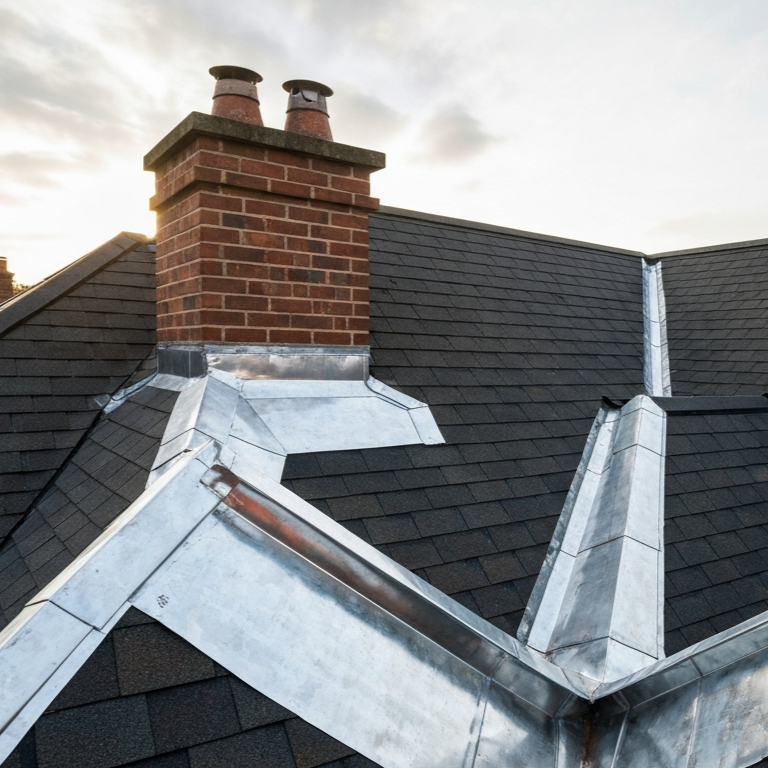
Roof flashing around chimneys and valleys protects Louisiana homes from leaks, water intrusion, and long-term storm-related roof damage.
Counter Flashing — The Chimney Cap Detail
Counter flashing is the second piece of metal that overlaps step flashing on the chimney sides. The vertical leg embeds into the chimney's mortar joint (or attaches to a reglet — a slot cut for the flashing). The horizontal portion overlaps the step flashing vertical leg below it, creating a redundant water barrier.
How counter flashing fails: mortar joints deteriorate over time, loosening the embedded edge. Some installations use sealant alone instead of mortar embedment — those fail faster (5-8 years vs 20+). The visible result is counter flashing that has separated from the chimney, leaving a gap through which water flows.
Visual clue from the ground: any visible space between the horizontal metal flange and the chimney brick or stucco. Counter flashing is supposed to lay flat against the chimney; any separation is failure.
Apron Flashing — The Front Chimney Detail
Apron flashing is a single piece of metal at the downslope (front) face of a chimney. The vertical leg seals against the chimney front, and the horizontal portion extends out onto the shingles to shed water around the chimney's downslope side.
Apron flashing failures show up as water staining on the ceiling directly below the chimney, often on the wall adjacent to the fireplace. The failure mechanism is sealant aging and thermal movement from the heated chimney, which expands and contracts against the cooler roof surface.
Valley Flashing — Where Two Roof Planes Meet
Valley flashing protects the V-shaped seam where two roof slopes meet. Two main configurations: open valley (visible metal valley with shingles cut back from the centerline) and closed valley (shingles woven across the centerline with no visible metal).
Open valleys: the metal is exposed and visible. Failures show as rust, granule accumulation that creates dams, or shingles cut too short to overlap the metal properly. Closed valleys: failure is harder to see from the ground because the metal is hidden under the shingles. Closed-valley leaks usually appear as ceiling stains 10-15 feet below the actual valley.
Why Louisiana valley flashing fails uniquely: Spanish moss, oak leaves, and pine needles dam up in roof valleys here. The dammed debris holds water against the shingles and the side of the flashing, which finds its way under the shingles and into the deck. Annual valley cleaning is the single biggest preventive maintenance task on Northshore roofs with a mature tree canopy.
Drip Edge — The Roof Perimeter
Drip edge is L-shaped or T-shaped metal trim installed along eaves and rakes. At eaves, the drip edge goes down before underlayment to direct water into the gutter. At rakes, the drip edge goes down after underlayment to seal the rake edge against wind-driven rain.
Drip edge failures: rust on galvanized drip edge after 20+ years, separation from the fascia where fasteners failed, and missing drip edge entirely on older roofs that pre-date code requirements. The 2021 IRC requires a drip edge on all Louisiana residential roofs.
What a missing drip edge does to a Louisiana home: gutter overflow during heavy rain pushes water back under the shingle edge, the water saturates the fascia board, the wood rots, and the eave framing becomes structurally compromised. Roofs without a drip edge develop fascia rot within 5-7 years on the Northshore.
Pipe Boot Flashing — The Most Common Failure Source
Pipe boots are the rubber-and-metal flashing assemblies that seal around plumbing vent stacks. The metal flange sits on the roof deck under the shingles; the rubber collar extends up around the pipe and forms a watertight seal at the top.
Pipe boots are the single most common roof leak source on Northshore homes 5-10 years old. The rubber collar fails first — UV exposure in the Gulf Coast sun degrades the rubber and creates cracks around the pipe in 5-10 years. The manufacturer's stated lifespan is typically 10+ years; the Louisiana climate cuts that significantly.
What to look for from the ground: cracks visible around the rubber collar where it meets the pipe, dark staining on the shingles below the pipe penetration, and water dripping from the penetration during heavy rain. Replacement is straightforward — $40 in materials, 30 minutes for a roofer, and $150-$400 for the service call.
Sealing a cracked pipe boot with caulk or roofing cement is a 12-month band-aid, not a fix. The rubber continues to degrade underneath the sealant. Full pipe boot replacement is the only long-term solution. Most quality contractors will not charge much more for replacement than for sealant repair, because the labor is similar.
Vent and Skylight Flashing — The Less-Common Penetrations
Powered attic vents, static roof vents, ridge vents, and skylights all have their own flashing details. The principles are similar to pipe boot flashing — a metal flange under shingles, sealant where the penetration meets the flange.
Skylight flashing in particular is high-failure: the perimeter flashing kit that comes with curb-mounted and deck-mounted skylights ages out in 15-20 years. Most reputable Northshore roofers replace flashing kits during any re-roof on skylights more than 12 years old, even when the skylight itself is performing fine.
How to Tell a Flashing Leak From a Shingle Leak
Diagnostic logic that points the homeowner toward the right suspect:
Pattern 1 — Leak appears near a chimney, dormer, or skylight
Almost certainly flashing. Step flashing, counter flashing, apron flashing, or skylight perimeter flashing are the most likely sources. The visible leak point on the ceiling is often 2-8 feet from the actual entry point because water travels along the framing before dripping.
Pattern 2 — Leak appears in heavy rain only, not in light rain
Often flashing — specifically the kind that involves wind-driven rain pushing water at angles standard rain does not produce. Step flashing on chimneys facing the prevailing wind direction frequently shows this pattern.
Pattern 3 — Leak appears at the eave or where the roof meets a wall
Almost certainly drip edge or sidewall step flashing. Gutter overflow under the drip edge, or wind-driven rain getting behind the step flashing at the wall.
Pattern 4 — Leak appears in a valley line on the ceiling
Valley flashing failure or debris damming in the valley. Valley leaks often track diagonally down the ceiling because water follows the rafter alignment.
Pattern 5 — Leak appears directly below a plumbing vent location
Pipe boot, almost certainly. Walk the attic with a flashlight — water staining on the deck right around a pipe penetration confirms the diagnosis.
When Flashing Repair Is the Right Call vs Full Replacement
Spot repair makes sense when:
The roof itself is under 10 years old and otherwise sound.
The failed flashing is isolated to a specific location.
Other flashing on the roof appears intact.
The shingles can be carefully lifted and re-laid without damage (roofs over 10 years old often cannot — the shingles become brittle).
Full re-roof becomes the better answer when:
Multiple flashing locations are failing simultaneously (pattern indicates the entire flashing system is at the end of life).
The roof is 18+ years old and approaching shingle replacement age.
Decking damage is visible from the attic.
Granule loss in gutters is widespread.
Where This Doesn't Apply
Tile and slate roofs
Tile and slate roofs use specialized flashing details that are different from asphalt-shingle systems. Lead flashing is common; the installation methods require specialty trade knowledge. Most Northshore residential is asphalt-shingled; tile and slate represent a small fraction.
Standing seam metal roofs
Metal roofing systems use integrated flashing details specific to the panel system — proprietary closures at ridges, valleys, and penetrations. The flashing principles still apply (geometry first, sealant second), but the specific products are panel-system specific.
Frequently Asked Questions
Roughly 60-70% of residential roof leaks that Louisiana roofers diagnose originate at flashing details rather than at the shingles themselves. Pipe boot failures alone account for the largest single category. The shingles get the homeowner's attention; the flashing does most of the failing.
Pipe boots: 5-10 years in the Louisiana climate (vs 10+ years stated lifespan). Step flashing (aluminum or galvanized): 25-40 years, depending on installation quality. Counter flashing: 20+ years when properly embedded in mortar; 5-10 years when sealed only. Drip edge (aluminum): 30+ years. Valley flashing: 25-40 years.
Yes, for isolated failures on roofs under 10 years old. Spot repair of a single chimney's flashing or a pipe boot is straightforward ($150-$1,500 typical range). On older roofs where shingles have become brittle, pulling shingles to access flashing often damages the surrounding shingles, making spot repair impractical.
Storm-caused flashing damage (hurricane wind lifting flashing, hail denting flashing) is typically covered by Louisiana homeowner policies. Wear-and-tear flashing failures (sealant aging, rubber UV degradation) are not covered. The cause distinction drives the coverage outcome — documentation showing storm involvement is essential for the claim.
Flashing is metal (or rubber for pipe boots) installed at specific transitions and penetrations. Underlayment is a continuous water-resistant sheet that covers the entire roof deck under the shingles. Both are part of the waterproofing system; flashing handles geometry-specific water control, and underlayment handles the continuous backup layer.
Most Roof Leaks Are Flashing Leaks
Homeowners think shingles when they should think about flashing. The shingle is the visible surface—and the third- or fourth-most failure-prone component on the roof. Flashing handles every place the shingle cannot: chimneys, sidewalls, valleys, vents, and edges. When flashing fails, water finds the path the shingle cannot block. The first place to look on any leaking Louisiana roof is the nearest flashing detail. Six to seven times out of ten, that is where the source is hiding.
