
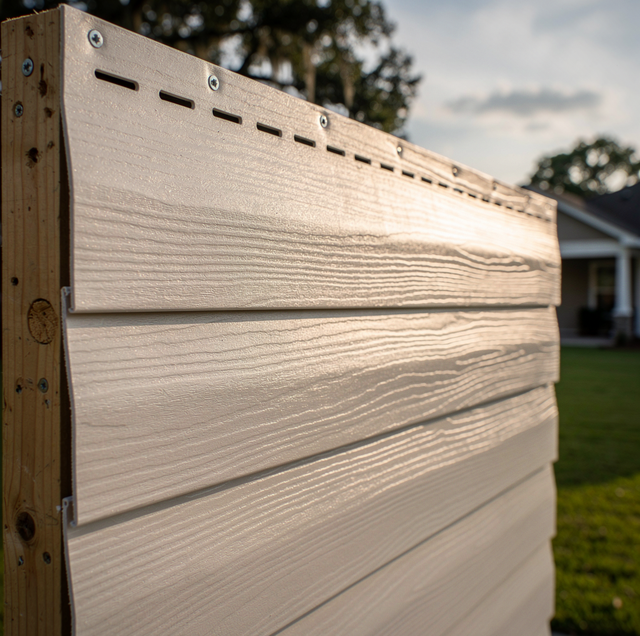
Vinyl siding is a plastic that expands and contracts along its length as temperatures change throughout the day and across the seasons. Installers account for that by hanging each panel rather than pinning it down: the panel locks into the course below along its bottom edge, and a nail goes through a slotted hole punched in the top nailing hem, driven to hold the panel against the wall without clamping it. The panel is free to slide a little at each fastener as it warms and cools, and the ends are left with room inside the trim for the same reason. When any step in that chain gets skipped or done too tight, the panel keeps trying to move and has nowhere to go but out of the wall's plane, showing up as a bow, a wave, or a buckle.
That is a different condition from the wear an older wall shows, where the vinyl itself has begun to fade, chalk, or lose its grip on a fastener over years of service. On recently installed siding, the vinyl is still sound, and the distortion comes from how it was hung, the wall behind it or nearby heat.
Each distortion pattern has its own cause and its own fix.
| Pattern | Installation Cause | What Fixing It Involves |
|---|---|---|
| A course sits tight and will not slide by hand | Nails driven tight to the hem, or the panel nailed through its face or face-screwed | Relieving and refastening along the run |
| A panel bulges between two nails | A nail driven outside the center of its slot | Resetting the course, with the fastener repositioned to slot center |
| Buckling where panels meet a corner post or J-channel | No gap left at the panel ends in the trim pocket | Recutting the ends to restore clearance |
| Waves across a whole course, visible in low sun | An uneven or bowed wall surface behind the siding | Correcting the wall surface before refastening |
| Ripples confined to the sunniest wall | Sun exposure bringing out a nail or end-gap constraint along that elevation | Relieving and refastening along that elevation |
| Distortion near a grill, a reflective window, or another heat source | Concentrated, localized heat build-up on the surface | Moving the grill or blocking the reflection, or replacement where a panel is already heat-warped |
How Vinyl Moves with Temperature and Why It Has to Float
Every rigid material changes size with temperature, but vinyl does it more than wood, fiber cement, or metal siding, and it does it along the panel's length more than across its width. A wall of panels installed end to end and course over course has to accommodate that movement somewhere, or the stress goes into the panel itself.
The system is built to let the panel do the moving. The locking leg at the bottom of each panel hooks loosely into the course below, so panels are not glued or screwed to one another; a panel can slide sideways in that lock without losing its grip on the course beneath it. The nailing hem along the top is punched with elongated slots rather than round holes, and the fastener is meant to sit centered in that slot, driven flush enough to hold the panel to the wall without pulling the hem tight against the shank. A panel fastened that way is anchored at the top and still free to slide at both the lock and the nail as it changes length.
Take away either kind of freedom and the panel is fighting the wall instead of moving with it. A panel pinned at the nail, boxed in at the ends, or backed by a non-flat substrate has nowhere left to release that expansion and contraction except by bowing out of the wall's plane.
Nailing Too Tight or Off the Slot Center
A panel loses its freedom to slide at the fastener itself. A nail driven flush and centered in its slot holds the panel against the wall while leaving the hem free to travel left and right as the panel changes length. Drive that same nail tight enough to compress the hem against the wall, and the vinyl is clamped rather than hung; it can no longer slide at that point, however loose the rest of the panel is.
A course fastened that way will not shift when pushed by hand along its length, a sign of a fastening problem rather than a substrate one. A panel nailed through its face, or fastened with a screw instead of a nail through the hem, has the same effect for a different reason: the fastener bites into the vinyl itself rather than riding loose in a slot, so that point on the panel is fixed no matter how the rest of the panel wants to move around it.
Off-center nailing ends in the same pin. A nail driven near one end of its slot leaves that panel free to slide in only one direction; once it reaches the end of the room that remains, it is pinned there, too, and a bulge appears between that fastener and the next along the course.
A panel pulled loose in wind can tear free at its lock, and pulling on it from a ladder shifts a person's weight off balance at height. A roofer re-seats or replaces it from stable footing.
End Gaps at Corner Posts and J-Channel
Panel ends need the same freedom to move as the fasteners along their length, and that room has to be built into the trim they meet. A corner post and a J-channel both form a pocket that the panel end slides into, and that pocket is cut a little deeper than the panel needs so the end has somewhere to go as it lengthens.
Cut a panel to fit tight against the bottom of that pocket, or leave no clearance at all, and the panel has room to grow in only one direction: toward the trim it is already touching. As the panel lengthens with heat, the end pushes against the post or channel with nowhere left to go, and the panel buckles outward at that joint rather than sliding into the pocket the way it is meant to. The same buckling shows up where a course meets a window or door casing that was trimmed without its own expansion room.
The Wall Behind the Siding
Not every wave in a wall traces back to how the siding itself was hung. Vinyl is thin enough to telegraph what sits underneath it, and a sheathing surface that is bowed, uneven, or has an old layer of siding left in place beneath the new panels will show that unevenness through a course that was fastened correctly. In that case, the fasteners are doing their job. The panel is only following a wall surface that was never flat to begin with.
A separate wall problem sits behind the siding, too: the water barrier and flashing that keep rain off the framing, which is its own failure and reflects the wear an older wall shows rather than a new installation. For distortion, the wall surface must be flat and continuous before the siding goes up, because the panels have no way to compensate for a wave that was already there.
Outside Heat on the Surface
The Sun is the main source of the temperature swings a panel experiences, but it is not the only heat source a wall faces. A window nearby that reflects and concentrates sunlight onto one section of the wall can push that patch of siding through a wider heat swing than the rest of the same course, even though every panel around it was hung the same way.
A grill run close to a vinyl wall adds the same kind of load: repeated radiant heat aimed at one spot, on top of whatever the sun is already contributing there. Keeping a grill clear of the wall prevents heat from stacking where the vinyl has to absorb it.
A panel with room to slide at its nails and its ends can take an ordinary hot afternoon without distorting. A panel already constrained at a nail or an end has nothing left to give when a reflective window or a grill adds heat. Heat concentrated enough to soften the vinyl distorts a correctly hung panel as well.
What Correcting It Involves
Fixing a bowed or buckled panel starts with releasing whatever is holding it. A nail driven too tight is pulled and reset flush and centered in its slot; a face-driven nail or screw is pulled, and the panel refastened properly through the hem. An end with no clearance is recut to restore the gap the trim pocket was meant to leave, and the panel is reseated in the pocket rather than forced flat against it.
Where the cause sits behind the siding rather than in the fastening, the fix moves to the wall itself: correcting the uneven or bowed surface underneath, which means opening that section and addressing what the sheathing is doing before any panel goes back up. Refastening a panel over a wall that is still uneven puts the same wave back the next time that wall sees a hot stretch.
Upper courses near the roofline can bring a ladder or a long panel within reach of the overhead service drop, a shock hazard to anyone on it. Work near that line stays with the roofer, who sets the ladder clear.
Heat can close off the repair option. A panel that has been softened by concentrated heat and cooled back down out of its original shape has taken a permanent set; relieving the fastener does not return it to flat the way it does for a panel that was only pinned. That panel gets replaced, and the source of the concentrated heat, whether a reflective window or a grill positioned too close, gets addressed at the same time so the replacement does not fail the same way.
Frequently Asked Questions
A panel that is warped because a nail is driven too tight can look better in cooler weather, since the vinyl contracts, but the fastener causing it is unchanged. The bow returns the next time temperatures climb, so correcting the fastening is the fix rather than waiting for the weather to change.
Yes. Color affects how much heat a panel carries at any given moment: a panel finished in a dark color is working through a wider daily heat swing than a nearby pale one, so a nail or end-gap mistake that stays invisible on light siding can show up as a bow on a dark run.
Wind cracks a panel, tears it at the lock, or pulls it loose outright, rather than leaving it smoothly bowed. A panel that is intact, evenly wavy, and still locked into the course below is an installation issue: fastening, end clearance, or the wall behind it.
Not if the trim itself was installed without room for the panel end. A corner post or J-channel cut or set too shallow has to be reset with its own clearance restored; recutting the siding alone does not fix a pocket that was never given room to begin with.
No. Each panel is a single continuous piece, fastened at several points along its length, and freeing a single nail does not relieve the panel elsewhere. Every fastener along that panel's length needs the same amount of slack, or the panel remains constrained where the fasteners were not corrected.
Yes. A panel pinned by an over-driven nail or boxed in at the ends can bow from ordinary daily temperature swings alone, with no direct sun or reflected heat involved.
Arrange vinyl siding installation work — panels refastened with room to move, ends recut at the trim. Epic Roofing LLC serves Mandeville, Covington, and Baton Rouge. Call (225) 819-3742.