
Roof Pipe Boot: The Small Part That Springs Big Leaks
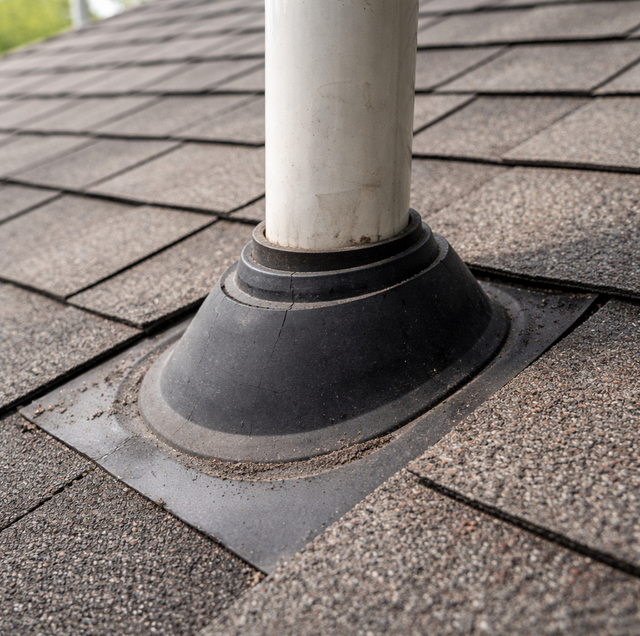
A brown ring on the ceiling below an upstairs bathroom rarely means the whole roof has failed. More often it points to a part smaller than your hand: the pipe boot that seals where a plumbing vent pokes through the shingles. The shingles around it can have a decade of life left while the boot itself has already given up. Knowing what this part does, and why it quits early, tells you whether a stain is a minor repair or the start of a bigger problem.
Quick Answer: A roof pipe boot (also called a vent boot, pipe flashing, or plumbing vent flashing) is the collar that seals the gap where a vertical plumbing vent pipe passes through the roof. It has a flat metal or plastic base tucked under the shingles and a flexible rubber gasket that hugs the pipe. The rubber is the weak link: sun exposure dries and cracks it in a handful of years, long before the shingles wear out, which makes the pipe boot one of the most common single-point roof leaks.
What A Pipe Boot Actually Seals
Every home has plumbing vent pipes. These are the vertical pipes that let sewer gas escape and let air into the drain lines so sinks and toilets drain properly. At least one of them runs up through the attic and out the top of the roof. That creates a hole in an otherwise sealed surface, and a hole in a roof is exactly what a roof is built to avoid.
The pipe boot closes that hole. It seals two joints at once: the seam between the base flashing and the roof deck, and the tighter seam between the rubber collar and the round pipe. Rain that hits the roof runs downhill across the shingles and is supposed to pass right over the boot without finding either seam. When the part is new and flexible, it does. The trouble starts when one of those seals loses its grip.
The Two Seams That Matter: The base seam is protected by shingles, which overlap the top edge of the flashing so water sheds onto the boot rather than under it. The pipe seam depends entirely on the rubber staying snug and elastic. Of the two, the pipe seam fails far more often, because rubber ages faster than metal or asphalt.
How A Pipe Boot Is Built And How It Works
A standard boot has two parts working together. The base is a flat sheet of galvanized steel, aluminum, or molded plastic that lies against the roof deck and gets woven into the surrounding shingles. Rising from that base is a cone or sleeve, and at its top sits the gasket: a ring of rubber or neoprene sized to stretch over the vent pipe and press against it.
Water management here is all about layering, not sealant. The base slides under the shingles on the uphill side and over them on the downhill side, so gravity carries runoff across the top of the flashing every time. Roofers fasten the base with nails or screws placed high, under the covering shingles, where water never reaches them. Done right, a pipe boot needs no caulk at all to stay dry. It sheds water by shape and overlap, the same principle that keeps the rest of the roof watertight.
That design is durable in every way but one. The rubber gasket is the single flexible component in an assembly meant to last decades, and flexible parts exposed to weather have the shortest clock.
Why The Rubber Fails First
Sunlight is the culprit. Ultraviolet rays break down the polymers in rubber and neoprene, drying the collar out and making it brittle. This happens year-round, not just in summer, because UV reaches the roof on cold, clear days too. Over several years, the once-pliable ring hardens, then cracks. A brittle collar can no longer grip the pipe, so a gap opens right at the top of the vent.
Several failures tend to arrive together:
The Collar Cracks or Splits: The most common ending. Fine cracks appear around the top of the rubber, widen, and eventually split all the way through. A split collar leaves an open channel straight down alongside the pipe.
The Collar Pulls Away From The Pipe: Rubber shrinks as it ages and loses elasticity. The ring that once hugged the pipe loosens and lifts, leaving a visible gap between rubber and pipe even before any crack forms.
Fasteners Back Out: Roofs move. Wood expands and contracts with temperature swings across the year, and that constant cycling can slowly work the base nails loose. A raised nail head lifts the flashing and breaks the seal at the base seam.
The Metal Base Corrodes: On older galvanized boots, the base can rust through where it meets the deck, opening the lower seam. Plastic bases avoid rust but grow brittle and can crack under the same UV that ruins the rubber.
Wind matters too, in both directions. Wind-driven rain does not simply fall; it is pushed sideways and upward against the roof, and it will find any gap a dried collar has opened. A boot that would shed a straight downpour can leak in a slanting one. So while UV is the year-round cause of the damage, wind is what turns a small crack into an active leak on any given stormy day.
The Warning Signs To Watch For
A failing boot usually announces itself well before you see water indoors, if you know where to look.
The clearest indoor sign is a ceiling or wall stain below an upstairs bathroom, laundry, or kitchen, since those rooms sit under the vent pipes. The stain often appears offset from the pipe rather than directly beneath it, because water travels along the pipe or a rafter before it drips.
In the attic, look near where a vent pipe passes up through the deck. Dark streaks on the wood, damp insulation, or a water trail running down the pipe all point to a boot letting water in above. Catching it here is the goal, because a slow boot leak can quietly rot the roof decking and feed attic mold for months before a single drop reaches your ceiling.
From the ground with binoculars, or from a safe vantage, a bad collar is often visible: cracked, curled, or clearly gapped rubber at the base of a pipe sticking up through the shingles.
Never climb up to inspect a pipe boot yourself. Roof-edge and steep-slope work is fall-hazard territory best left to someone with the training and gear, and a wet or steep roof should never be walked at all.
How A Pipe Boot Gets Repaired
The real fix is replacement, not patching. A roofer lifts the surrounding shingles, pulls the old base flashing, and works a new boot into place, weaving the base under the uphill shingles and over the downhill ones exactly the way the original was set. When done correctly, the new flashing disappears into the roof surface and sheds water by overlap, no different from the day the roof was installed.
There is a middle option too. A retrofit collar, sometimes called a storm collar or an adjustable rubber-and-metal collar, slips over the existing pipe and clamps down to reseal the top without tearing out the whole base. It is a legitimate repair when the base flashing is still sound, and only the rubber has failed, and it saves disturbing good shingles.
Why Caulk Is Only A Stopgap: It is tempting to smear roofing sealant over a cracked collar and call it done. That buys time, not a repair. Caulk sits on top of a surface that flexes and bakes in the sun; within a season or two it dries, shrinks, and cracks along the same lines as the rubber underneath, and the leak returns. Sealant can be a reasonable emergency measure to get through a storm until a roofer arrives, but it is not the fix. The seal on a roof should come from how the parts overlap, not from a bead of goo holding a failing part together.
Because the rubber ages on its own schedule regardless of the shingles, plan on a pipe boot being replaced at least once during a roof's service life. It is a normal maintenance item, not a sign the roof was built wrong. A boot installed with the roof will very often need attention years before the shingles around it do.
Frequently Asked Questions
The rubber collar commonly starts cracking in roughly six to fourteen years, well short of a shingle roof's typical lifespan. Some builders now install boots with a lead sleeve or a stainless clamp-ring collar instead of exposed neoprene, and those can outlast the roof, which is why replacement boots are often upgraded rather than matched to the failed original.
Yes, when the base flashing is still watertight. A metal storm collar or a lead retrofit sleeve can be fitted over the existing pipe and sealed at the top, resealing the pipe seam without lifting shingles. This only works if the base and its shingle weave are undamaged; if the base itself is corroded or the nails have backed out, the whole boot has to come out.
It does. Most homes have two to four vent penetrations, and each one is an independent potential leak, so a stain in a new spot may be a different boot than one repaired before. A house with several bathrooms or a two-story plumbing stack usually has more vents, and each collar ages at its own rate depending on how much direct sun that roof slope receives.
A roofer traces it from the attic side, not the ceiling. The true origin shows up as a dark, fanned-out water track on the underside of the deck right around the vent pipe, and the stain follows the framing downhill from there before it drips, so the ceiling mark can land several feet off. Wet or matted insulation between the pipe and the visible stain is the trail to follow. This is why a boot leak is confirmed by a look in the attic during or just after rain, rather than by measuring straight up from the ceiling spot.
The flashing base is hidden under the surrounding shingles, so only the pipe collar and a small strip of new base are ever visible, and both are neutral or paintable. A roofer reuses or replaces only the shingles immediately around the penetration, so a boot swap does not leave an obvious patch the way a larger repair might. On very old roofs, the surrounding shingles may be brittle enough that a few adjacent ones need replacing too.
A slow one can. Before water ever marks the ceiling, it can soak the roof decking around the pipe, and repeated wetting rots that plywood and can seed mold on the framing and insulation. It can also drip onto attic wiring or ductwork. Because the damage compounds out of sight, a boot leak found early as an attic stain is far cheaper to resolve than one left until the ceiling gives it away.
Spotted a stain under an upstairs bath? Have the vent flashing checked before it rots the deck. Epic Roofing serves Mandeville, Covington, and Baton Rouge. Call (225) 819-3742.
