
Roof Replacement Cost in Louisiana 2026: A Northshore Homeowner's Pricing Breakdown
Most Northshore replacement quotes for a typical 1,500-2,500 sq ft home with architectural asphalt shingles will land between $9,500 and $22,000 in 2026. The number that varies most across quotes is not the shingle price — it is the three line items most homeowners do not see coming. Decking replacement, tear-off layer count, and hurricane upgrades can swing a $14,000 quote to $20,000 without anything looking unusual on the proposal.
A Mandeville homeowner gets three roof replacement quotes after a Hurricane Francine inspection. Quote A: $11,800. Quote B: $16,400. Quote C: $19,200. All three contractors looked at the same roof. All three proposed architectural asphalt shingles. The line items mostly match. The numbers don't.
This is the experience nearly every Northshore homeowner has when facing a roof replacement, and it is the reason the question "how much does a new roof cost" produces such useless answers from national pricing articles. The real number depends on the specific house, the specific roof, the specific upgrades the homeowner does or does not opt into, and the specific labor radius the contractor operates in.
What follows is the actual 2026 cost breakdown for the Northshore market — Mandeville, Covington, Madisonville, Slidell, Lacombe, and the surrounding St. Tammany Parish neighborhoods Epic Roofing serves. Real per-square pricing. Real home-size ranges. The hidden line items that swing quotes by thousands. The Louisiana-specific upgrades that pay back through insurance discounts. And the cost-saving moves that actually save money — separated from the ones that just sound like they should.
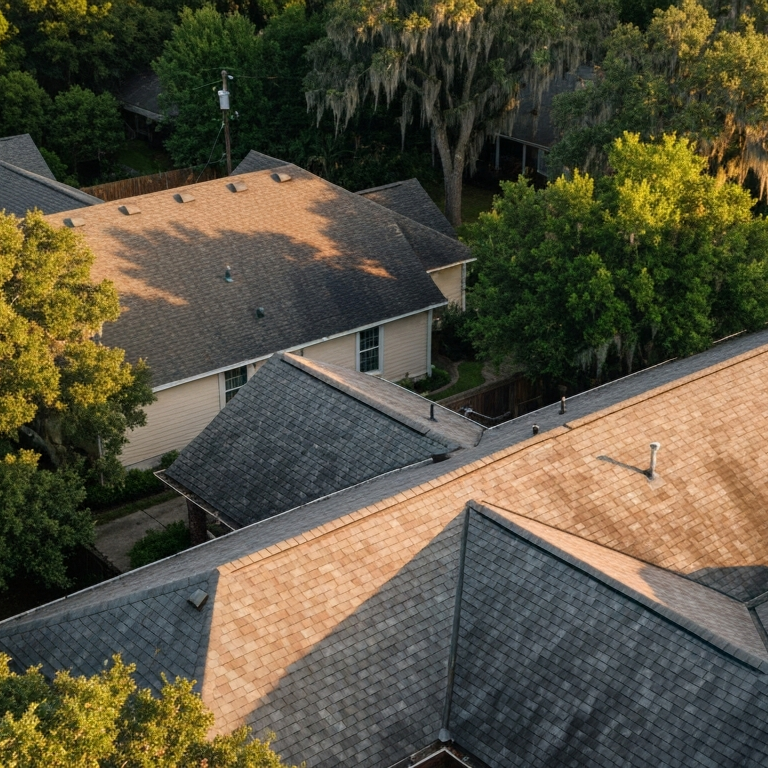
Aerial view of Louisiana neighborhood roofs showing architectural shingles designed for durability, hurricane resistance, and long-term weather protection performance.
The Average Number — and Why It Doesn't Tell a Northshore Homeowner Much
Angi's 2026 national average for roof replacement comes in at $9,541. Forbes Advisor publishes a typical range of $5,800-$13,000. Homewyse calculates asphalt shingle installation at $5.09-$6.66 per square foot as of May 2026. Each of these numbers is technically correct. None of them describes what a Mandeville homeowner is going to pay.
Three reasons the national averages mislead. First, they blend small Midwest replacements with high-cost coastal markets — pulling the median below what Gulf Coast pricing actually looks like. Second, they report base-grade asphalt without the Louisiana-specific code requirements (sealed deck, ice and water shield, high-wind nailing) that the 2021 International Residential Code requires in this state. Third, they exclude the decking replacement and tear-off layer items that hit nearly every roof more than 15 years old in this climate.
The realistic Northshore range for an architectural asphalt shingle replacement on a typical 1,500-2,500 sq ft home in 2026 is $9,500-$22,000. The realistic range for the same home with Class 4 impact-resistant shingles and a FORTIFIED Roof designation is $13,000-$28,000. That is the number Mandeville homeowners should plan around — not the $9,541 national average.
Roof Replacement Cost by Home Size — Northshore 2026
The single biggest driver of total cost is roof size, measured in "squares" (one square equals 100 square feet of roof surface). The table below shows installed pricing for standard architectural asphalt shingles in the Mandeville and Covington labor radius, with a single tear-off layer and minor decking repair included.
| Home Footprint | Roof Squares | Northshore Installed Cost (2026) |
|---|---|---|
| 1,200 sq ft (small ranch / cottage) | 14-16 sq | $8,000-$11,500 |
| 1,500 sq ft (typical 3-bed) | 17-20 sq | $10,000-$14,500 |
| 2,000 sq ft (mid-size family home) | 22-27 sq | $13,000-$18,500 |
| 2,500 sq ft (larger 4-bed) | 28-34 sq | $16,000-$23,000 |
| 3,000 sq ft (executive home) | 35-42 sq | $19,000-$29,000 |
| 3,500+ sq ft (large custom) | 43+ sq | $23,000-$38,000+ |
These ranges reflect Mandeville and Covington pricing for early 2026 and run roughly 5-10% higher than equivalent Baton Rouge quotes. The labor differential is real — Northshore contractors compete with the New Orleans metro labor pool, which is more expensive than the Baton Rouge or Lafayette markets.
The roof footprint is not the same as the house footprint. A 2,000 sq ft house with a complex hip-and-valley roof can produce 25-28 squares of roof surface; a 2,000 sq ft house with a simple gable roof might produce just 22-23 squares. When comparing quotes, ask each contractor for the square count they measured — it should be within 1-2 squares across all bidders. A 5+ square gap means somebody measured wrong.
Per-Square-Foot vs Per-Square — The Industry Term That Confuses Every Homeowner
Roofing pricing is published in two ways, and the terminology trips up almost every first-time replacement buyer.
Per-square-foot pricing is based on the roof area itself. National articles cite $4-$7 per square foot installed for asphalt; industry pricing data publishes $4-$10 per square foot for Class 4 architectural; Homewyse calculates $5.09-$6.66 per square foot as of May 2026. These are roof-surface numbers — multiply by total roof square footage to approximate the materials-and-labor portion of the cost.
Per-square pricing measures 100 sq ft of roof — one "square." ProMatcher's Mandeville data publishes $130-$180 per square installed for asphalt shingles. That works out to $1.30-$1.80 per square foot — but that number is shingle-only or shingle-plus-basic-install. It does not include underlayment, drip edge, ridge cap, ice and water shield, tear-off, or decking. Quotes that lead with the per-square number and bury the rest end up confusing the comparison.
Apples-to-apples Northshore math: total installed cost (everything the homeowner pays) for an architectural asphalt replacement runs $450-$750 per square in the 2026 market. Multiply by the roof's square count to get the realistic total. A 25-square (2,500 sq ft) roof at $550 per square installed = $13,750. Quotes that come in dramatically below this range are missing line items that the homeowner will pay for one way or another.
Material Choice — The Single Biggest Lever
Material selection moves the total cost more than any other variable. The table below covers what gets installed on Northshore residential roofs and what each option costs in 2026, all installed pricing.
| Material | Installed Cost / Square Foot | Lifespan | Wind Rating |
|---|---|---|---|
| 3-Tab Asphalt | $3.50-$5.00 | 15-20 yrs | 60-70 mph |
| Architectural Asphalt | $4.50-$7.00 | 25-30 yrs | 110-130 mph |
| Class 4 Impact-Resistant | $5.50-$8.50 | 25-35 yrs | 110-130 mph |
| Standing Seam Metal (24-26 ga) | $10.00-$16.00 | 40-70 yrs | 140-160 mph |
| Concrete Tile | $12.00-$22.00 | 50+ yrs | 130-150 mph |
| Slate | $25.00-$45.00 | 75-100+ yrs | 120-140 mph |
Architectural asphalt is the Northshore default — for good reason
Roughly 90% of residential roofs in St. Tammany Parish are architectural (also called dimensional) asphalt shingles. The product category dominates the Northshore market because it balances three things buyers actually care about: 25-30 year lifespan in this climate when properly installed and ventilated, wind ratings up to 130 mph (sufficient for everything except direct major-hurricane landfall), and pricing that fits the typical Northshore home equity budget. GAF Timberline HDZ, Owens Corning Duration Series, and CertainTeed Landmark Pro are the three product lines most reputable Mandeville contractors install.
Class 4 impact-resistant is the single best upgrade in Louisiana
Class 4 shingles add roughly $500-$1,500 to a typical Northshore replacement — call it 5-10% on top of the architectural baseline. What they buy back is two things. First, real protection against the hailstones Louisiana sees more often than the climate stereotype suggests (golf-ball hail hit Mandeville and Covington in 2023 and 2024). Second, an insurance premium discount of 15-25% from most Louisiana carriers — mandated under La R.S. 22:1483.1.1.1 for FORTIFIED-designated roofs and offered voluntarily by many carriers for Class 4 alone and offered voluntarily by many carriers for Class 4 alone.
Payback math on a typical Mandeville home: $4,000-$7,000 annual homeowner premium × 15-25% discount = $600-$1,750 saved per year. The $500-$1,500 Class 4 upgrade pays for itself in 1-2 years. After that, the discount is recurring savings for the life of the roof. The math is the same reason this is the easiest single recommendation in Northshore residential roofing: it usually does not even feel like an upgrade decision because it pays back so quickly.
Metal roofing — the second-tier option Louisiana underuses
Standing seam metal at $10-$16 per square foot installed is roughly double the cost of architectural asphalt. The tradeoff is a 40-70 year lifespan, 140-160 mph wind ratings, and dramatic energy-efficiency gains in Louisiana's summer cooling season. The math works out for homeowners who plan to stay for 15+ years and value summer cooling savings. For homeowners planning a 5-10 year stay, the premium does not pay back at sale. Northshore appraisals add value for metal roofs, but rarely the full cost premium.
Tile and slate exist in Louisiana but are uncommon outside of select historic neighborhoods (parts of the New Orleans Garden District, some older Covington homes, custom builds along the lakefront). Pricing starts at $12 per square foot and runs to $45 for slate. Most Northshore residents will never see these materials.
The 5 Hidden Cost Drivers Most Quotes Bury
After a hurricane, ice storm, or major hail event, carriers cannot physically inspect every claim with their own staff. They contract with independent adjusters — often paid per claim or by the day — who fan out across the impacted parishes wearing carrier credentials. The homeowner sees the State Farm logo on the truck door and reasonably assumes "the State Farm adjuster" has arrived. In reality, the person on the roof may have been an independent contractor for Liberty Mutual the previous week and a different carrier the month before.
This matters for two reasons. First, independent adjusters during a catastrophe surge are operating under intense volume pressure — 10 to 20 inspections per day is common. Quality varies. Second, the financial incentive structure is per-claim, not per-finding. An independent adjuster who consistently writes large scopes does not necessarily get more work; one who closes claims efficiently and within range does.
Five line items separate the $11,800 quote from the $19,200 quote on the same Mandeville house. Understanding all five before signing any contract is the single biggest determinant of whether the homeowner feels well-served or surprised by the final bill.
Driver 1 — Decking replacement
Beneath every shingle layer is the structural deck — typically OSB or plywood sheathing. After 15+ years of Louisiana humidity, slow leaks, and storm damage, sections of the deck rot out. The condition cannot be assessed until the old roof is torn off. Most Northshore homes 20+ years old need 2-8 sheets of decking replaced; some need 20+ sheets.
Per-sheet pricing in 2026 Northshore: $80-$120 installed. A typical decking replacement line item runs $400-$1,200; severely deteriorated decks can add $2,000-$3,500. The honest contractor builds a decking-replacement allowance into the quote (typically 4-6 sheets) and notes that the final invoice will include actual sheets used. The dishonest contractor either omits the line item entirely (and surprises the homeowner with a $1,500 add-on mid-project) or pads it ("15 sheets needed" when the actual count is 4).
If a quote says "decking replacement: included" with no per-sheet rate or allowance count specified, ask for the actual numbers in writing. "Included" is not a price. The homeowner needs to know what happens if the decking damage is twice what was estimated, and what the per-sheet rate is for additional sheets.
Driver 2 — Tear-off layer count
Louisiana code allows up to two existing layers of shingles before requiring a full tear-off to the bare deck. Many Northshore homes built in the 1990s-early 2000s have an overlay (shingles installed over the original layer) that has to come off before the new roof goes down. Removing that second layer adds $1,000-$2,500 to the project, depending on roof size and disposal logistics.
The contractor often cannot confirm the layer count from a ground-level inspection. A reputable Northshore quote will state the assumed layer count and the per-additional-layer charge if the actual condition differs.
Driver 3 — Roof pitch
A 4/12 pitch (gentle slope) is walkable; a 6/12 pitch is the Northshore standard; an 8/12 or 12/12 pitch (steep) requires additional fall protection, slower work pace, and sometimes specialized equipment. Steep pitches add 15-30% to per-square labor cost. A 25-square roof at 4/12 might cost $13,000; the same square count on a 12/12 Craftsman-style roof can run $17,000.
Driver 4 — Penetration count and complexity
Every chimney, skylight, plumbing vent, attic fan, and dormer is a flashing detail that adds labor. A simple 25-square gable roof with two plumbing vents and one attic fan is dramatically cheaper to install than a 25-square hip roof with two chimneys, three skylights, and four dormers. Penetration-heavy roofs add $1,500-$4,000 to the labor portion of the cost.
Driver 5 — Hurricane upgrades and FORTIFIED Roof designation
Going beyond minimum code to a sealed deck, 6-nail high-wind fastening pattern, ring-shank nails, and an enhanced underlayment system adds $500-$1,500 to a typical Northshore replacement. Pursuing the full IBHS FORTIFIED Roof designation — the program the Louisiana Roof Strong grant pays up to $10,000 toward — adds $1,500-$3,500 above minimum code, depending on roof size.
The FORTIFIED upgrade is rarely a pure cost. Insurance premium discounts mandated by La R.S. 22:1483.1.1 (15-25% off the wind portion of the homeowner premium) plus the Roof Strong grant reimbursement frequently make FORTIFIED net cheaper than minimum code over a 5-year horizon. The decision is covered in detail in the Louisiana Roof Strong grant guide.
Insurance vs. Out-of-Pocket — Two Different Cost Conversations
Roof replacement cost in Louisiana breaks down into two distinct financial conversations, depending on whether the project is paid for through an insurance claim or out of pocket.
Insurance-paid replacement
If the roof failed because of a covered storm event (named hurricane, wind, hail) and the policy is in force, most Louisiana carriers will pay the full replacement cost minus the deductible — provided the roof is under 20 years old at the time of loss, and the carrier's adjuster agrees the damage warrants replacement rather than repair.
The homeowner's out-of-pocket exposure on an insurance-paid claim is the deductible. Louisiana hurricane deductibles run 2-5% of the dwelling coverage amount. On a $400,000 dwelling policy, that means $8,000-$20,000 paid out of pocket before the carrier covers the rest. La R.S. 22:1337 — the Annual Hurricane Deductible Law — allows the deductible to apply only once per calendar year, regardless of how many named storms hit, which matters in active seasons.
Out-of-pocket replacement (no insurance claim)
When the roof failed from age, slow leaks, or wear (not a covered event), the homeowner pays the full installed cost. This is where the $9,500-$29,000 cost ranges above apply directly. Three financing options dominate: home equity line of credit (HELOC, typically 8-10% APR in 2026), contractor financing through services like GreenSky or Hearth (10-18% APR depending on credit), and cash.
The Louisiana FORTIFIED Discount Math — Why Every Roof in This State Should Be Considering It
Louisiana has the most aggressive FORTIFIED incentive structure of any state. The math is worth running explicitly because it changes the cost calculation for roughly every Northshore replacement.
Three programs stack: La R.S. 22:1483.1.1.1 mandates that insurers offer premium discounts of 15-25% (up to 30% for higher FORTIFIED tiers) on the wind/hurricane portion of the homeowner premium for FORTIFIED-designated roofs. The Louisiana Fortify Homes Program reimburses up to $10,000 toward FORTIFIED Roof retrofit costs through the Roof Strong grant. Act 533 (2024) expanded the program with broader eligibility and increased annual funding.
Stacked math on a typical $16,000 Mandeville architectural replacement: base cost $16,000 → upgrade to FORTIFIED Roof designation adds ~$2,500 → total project $18,500 → Roof Strong grant reimburses up to $10,000 → net out-of-pocket $8,500 → annual insurance premium discount of $750-$1,500 starts immediately and continues for the life of the roof. The FORTIFIED upgrade not only pays for itself; it makes the entire replacement project cheaper than going with minimum code, almost every time.
Permits — The Cost Most Articles Skip
Every full roof replacement in St. Tammany Parish requires a permit from the parish's Permits Department; jobs in the City of Mandeville specifically also require a city-level permit. Permit fees for a typical residential replacement run $75-$250, depending on jurisdiction and roof size. The fee is small. The contractor's responsibility for pulling the permit is not.
A licensed Louisiana contractor (LSLBC license required for jobs over $7,500) pulls the permit in their own name, schedules the inspection, and accepts liability for the work passing inspection. A contractor who proposes "saving $200 on the permit" by doing the work without one is shifting liability to the homeowner. Unpermitted work on the primary structural component of the home creates problems at sale — every St. Tammany real estate transaction includes a permit search, and unpermitted roof work shows up as a closing-table issue.
Verify any roofing contractor's LSLBC license at lslbc.louisiana.gov before signing. Required for any residential roofing job over $7,500. An unlicensed contractor cannot legally pull a permit, which means the homeowner is exposed on both the work quality and the regulatory side. License verification takes 30 seconds.
Where This Pricing Doesn't Apply
Three contexts where the Northshore residential numbers above do not translate cleanly:
Commercial and multi-family roofs
Commercial flat-roof systems (TPO, EPDM, modified bitumen, PVC) operate on completely different pricing — typically $7-$15 per square foot installed, depending on the system, with much larger square counts. A 10,000 sq ft commercial flat roof in Mandeville runs $70,000-$150,000. Multi-family residential sits between the two, with per-unit pricing structures most contractors treat as commercial bids.
New Orleans proper (Orleans Parish)
NOLA-proper roofing pricing runs 10-20% higher than Northshore due to denser labor pricing, harder access logistics in older neighborhoods, and historic district overlays in some areas (French Quarter, Garden District) that require specialized materials or processes. A $16,000 Mandeville quote can be $19,000-$22,000 for the same scope on a comparable Mid-City NOLA home.
Slidell and the eastern Northshore
Slidell labor pricing tracks closer to NOLA-east-bank pricing than to Mandeville/Covington pricing because the labor radius pulls from a different contractor pool. Expect 5-10% higher than the western Northshore numbers above on equivalent scope.
Cost-Saving Moves That Actually Save Money
Five things a Northshore homeowner can do to materially lower the total cost of a roof replacement without sacrificing quality:
Get three written quotes — not estimates, not phone numbers. The $11,800 / $16,400 / $19,200 spread on the same roof is normal. Skipping the comparison costs real money.
Bundle the FORTIFIED upgrade into the replacement project. Adding FORTIFIED later (a separate retrofit) costs significantly more than doing it during a planned replacement.
Apply for the Louisiana Roof Strong grant before starting work. Reimbursement up to $10,000 changes the math on whether to upgrade to FORTIFIED in the first place.
Time the project for early spring or late fall. Mid-summer Louisiana heat slows crew productivity, and post-hurricane fall demand spikes create inflated pricing. February-April and October-November are the most productive Northshore roofing windows.
Combine roofing with attic insulation upgrades while the roof is open. If the contractor is already on site and the deck is exposed, blown-in insulation upgrades are dramatically cheaper than as a separate project.
Cost-Saving Moves That Don't Actually Save Money
Three tempting choices that look like savings on paper and are not:
The overlay (shingles over existing shingles)
Overlay roofs save $1,000-$2,500 in tear-off labor. They also hide decking damage that grows underneath, void most manufacturer warranties, add weight that stresses the framing, and produce a shorter overall lifespan. Most reputable Northshore contractors will not quote an overlay because the warranty issues and shortened life make the apparent savings negative within 5-7 years.
The cheapest contractor
The bid that comes in dramatically below the other two is usually missing line items, using lower-grade materials, skipping the permit, or all three. Apparent savings show up as actual costs in the next storm, the next leak, or the next sale of the home.
Skipping ridge vent or attic ventilation upgrades
Inadequate attic ventilation in Louisiana's climate cooks the underside of the shingles and shortens roof life by 5-10 years. The $200-$500 saved by skipping a ridge vent upgrade during replacement produces a roof that needs replacement again 5 years sooner. The math never works.
Frequently Asked Questions
A typical 1,500-2,500 sq ft single-story home with architectural asphalt completes in 1-3 working days. Larger or steeper roofs run 3-5 days. Tear-off happens on day 1; decking inspection and replacement follow immediately; underlayment goes down before the day ends; and shingles are installed the next day. Cleanup and final walkthrough close the project on the last day.
Manufacturer warranty periods (25-year, 30-year, lifetime) reflect the ideal lifespan under ideal conditions. Real Northshore roofs hit roughly 80-85% of the warranty period — call it 22-25 years for a 30-year rated architectural shingle in this climate. Heat, humidity, hurricane cycles, and UV intensity all shorten actual life. Proper attic ventilation and algae-resistant granules are the biggest factors that push real life closer to the warranty period.
Most reputable contractors will not install homeowner-supplied materials. The reasons are warranty (manufacturer warranties on shingles typically require contractor-purchased materials and certified installation), liability (the contractor accepts responsibility for materials they sourced), and quality control (the contractor cannot guarantee batches the homeowner bought separately). The $500-$1,500 in apparent material savings is offset by the lost warranty and rejected installation insurance.
Late winter through early spring (February-April) and mid-fall (October-November) are the most productive Northshore windows. Avoid mid-summer if possible — extreme heat slows crews, increases shingle damage during installation, and pushes adhesive cure times. Avoid hurricane season landfall windows (peak August-September) when demand spikes and pricing inflates.
Northshore real estate appraisals typically credit 60-80% of the replacement cost back as added value at sale, with new roofs holding value better the first 3-5 years and depreciating thereafter. A $16,000 architectural replacement on a Mandeville home selling within 2 years typically adds $10,000-$13,000 to the appraisal. After 5 years, the added value declines, but the avoided objection (no buyer-driven roof inspection issues) remains valuable.
Lighter colors reflect more solar heat and produce measurable summer cooling savings — typically 5-12% on July-September electric bills in Louisiana's climate. The aesthetic decision is the homeowner's, but most architectural shingle lines now offer "cool roof" color options in lighter neutrals that meet Energy Star reflectivity thresholds without changing the look much.
The Bottom Line on Northshore Roof Replacement Cost in 2026
A typical Mandeville or Covington roof replacement in 2026 will land between $9,500 and $22,000 for architectural asphalt on a 1,500-2,500 sq ft home. The variance inside that range is driven by five hidden drivers that most quotes do not break out: decking condition, tear-off layer count, roof pitch, penetration complexity, and hurricane upgrades. Class 4 impact-resistant shingles add $500-$1,500 and pay back through 15-25% insurance discounts in 1-2 years. FORTIFIED Roof designation adds another $1,500-$3,500 and qualifies for up to $10,000 in Louisiana Roof Strong grant reimbursement.
The smartest Northshore homeowners do four things in order. They get three written quotes from licensed Louisiana contractors and compare the line items, not just the totals. They ask each contractor for the per-sheet decking rate and tear-off allowance count. They build the FORTIFIED upgrade into the project from day one rather than as a separate retrofit. And they apply for the Roof Strong grant before the project starts, not after — the timing affects whether the reimbursement comes through.
Done right, a Northshore roof replacement is a 25-30 year asset that pays back through insurance discounts, energy savings, and resale value. Done wrong — quoted by an unlicensed contractor, installed without a permit, missing the FORTIFIED upgrade, and the grant — it is the same money spent for half the value.
