
Skylight Leak Repair in Louisiana: Why They Leak and How to Stop It Permanently
Roughly half of Louisiana "skylight leaks" aren't actually skylight leaks at all. The water comes from condensation on the cold glass, from a roof leak above the skylight that runs down to it, or from compromised flashing several feet away. The wrong diagnosis sends homeowners into $1,500-$3,500 skylight replacements that don't fix the underlying problem. The right diagnostic sequence — condensation vs. leak first, then the origin point second — takes 30 minutes and prevents the most expensive mistake in skylight repair.
There's water around the kitchen skylight. It appears after every heavy rain, drips down the drywall along the side of the skylight frame, and stains the ceiling about 6 inches from the edge. The natural assumption is that the skylight is failing and needs replacement.
That assumption is wrong about half the time. Skylight "leaks" are misdiagnosed at higher rates than almost any other roof leak source — partly because condensation looks like a leak, partly because water from roof problems above the skylight migrates down to it before appearing inside, and partly because skylight units themselves rarely fail before age 15+. The diagnostic discipline matters more here than in most leak repair scenarios. Spending $1,500 on a skylight replacement when the actual problem is a $300 flashing repair elsewhere is a routine Louisiana mistake.
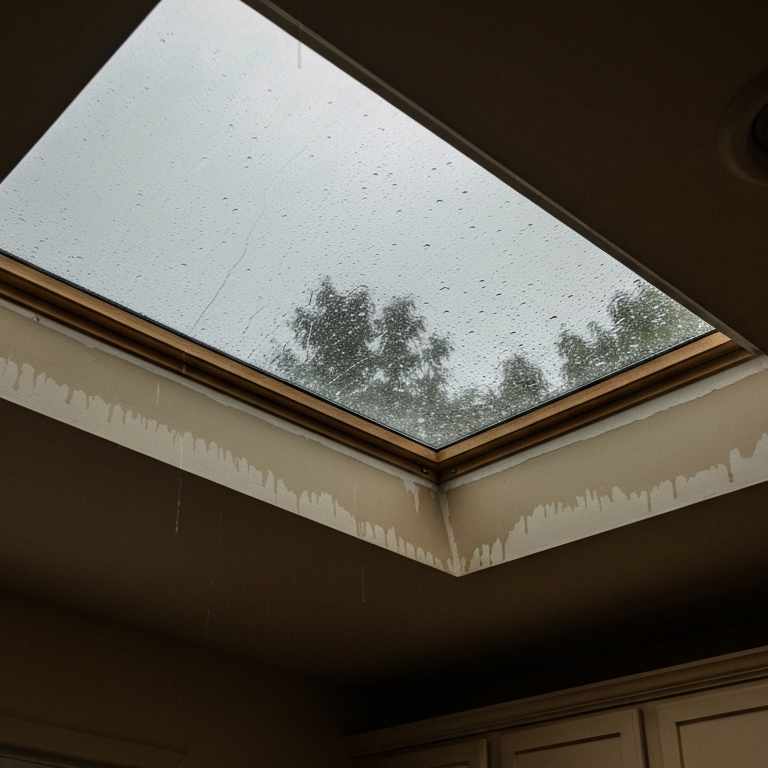
Rainwater leaking around residential skylight causes ceiling stains, moisture damage, and interior water intrusion during Louisiana storm conditions.
First Question: Is It Actually a Leak, or Condensation?
Louisiana humidity makes condensation the most common false alarm in skylight diagnostics. Warm humid interior air contacting cold glass creates water droplets that drip down and mimic a leak — particularly common in bathrooms, kitchens, and any room with high moisture from cooking, showering, or laundry.
Signs the water is condensation
Water appears on the inside surface of the glass or on the interior frame. Pattern repeats during cold mornings or evenings when the temperature differential is highest. Worse during humid weather, especially after showers or cooking. No correlation with rainfall — the water shows up regardless of whether it's raining outside. Affects only the area immediately around the skylight, not areas of the ceiling several feet away.
Signs the water is a real leak
Water appears on the exterior or above the glass — coming from outside through the unit or the surrounding flashing. Pattern correlates strongly with rainfall. Drips during or immediately after a storm; stops within hours of the rain ending. Stains may extend several feet from the skylight along the ceiling, indicating water tracking along rafters. Visible water entry around the skylight frame, in the corners, or at the flashing-to-shingle joint.
Quick test: dry the skylight, then watch
Wipe the interior surface of the skylight glass and frame completely dry on a humid day. Wait 24-48 hours without any rain. If water reappears on the interior glass without rain, it's condensation. If it doesn't reappear until the next rain, it's a leak.
Older acrylic dome skylights (common on pre-2000 Louisiana homes) lack a thermal break between the exterior dome and interior frame. They produce significantly more condensation than modern double-pane glass units. If the skylight in question is a single-dome acrylic model 20+ years old, condensation is the most likely culprit before chasing leak causes. Replacing with a modern thermally broken unit eliminates condensation and any leak risk.
The 5 Skylight Failure Modes
Once condensation is ruled out, skylight leaks fall into five categories. Knowing which one is in play determines the repair approach and the cost range.
1. Failed flashing around the skylight
The metal flashing pieces sealing the skylight to the surrounding roof have lifted, pulled away, or developed cracks at the corners. Usually shows up as a water entry at the top or sides of the skylight, especially after wind events. The most common skylight failure mode by a wide margin. Repair: flashing replacement, $400-$900 typical.
2. Failed seals or gaskets
The rubber gaskets between the glass and the frame have aged out and cracked. Common on skylights 10+ years old in the Gulf Coast UV. Water entry at the bottom of the glass, where it meets the frame. Repair: gasket replacement on operable units; sealant replacement on fixed units, $200-$600 typical.
3. Insulated Glass Unit (IGU) failure
The seal around the dual-pane glass has failed, allowing moisture to enter between the panes. Visible as fogging, cloudiness, or moisture trapped between the glass layers. The unit has lost its insulating properties, and the seal can't be repaired — the IGU itself must be replaced. Often, warranty-covered if the unit is under 10 years old. Repair: glass replacement, $400-$1,200 typical.
4. Compromised dome (acrylic skylights)
Older acrylic dome skylights crack from UV degradation, hail impact, or debris strike. Visible as cracks, crazing (web-like surface fractures), or punctures. The dome is the primary water barrier; any compromise lets water directly into the home. Repair: dome replacement if the model is still manufactured, $300-$800; full unit replacement otherwise, $1,200-$3,500.
5. Improper installation (the underlying cause behind many of the above)
Skylights installed without manufacturer-specified flashing kits, with inadequate sealing to the curb (for curb-mounted units), with missing roofing felt or insulation around the rough opening, or with site-fabricated flashing that relies on caulk rather than overlapping metal geometry. Improper installation is widely cited as the #1 root cause of skylight leaks. The skylight unit may be fine; the install is what's failing. Repair: removal, proper flashing kit installation, reset, $800-$2,000 typical.
Where Skylight Leaks Actually Originate (the 50/50 problem)
Roughly half of the leaks that appear at the skylight don't actually start at the skylight. Water tracking along the underside of roof decking from a problem several feet away — damaged shingles, compromised flashing on a vent, chimney issues, or roof valleys — finds the lowest point at the skylight opening and exits into the home there. The visible drip is at the skylight; the leak source is elsewhere.
Three patterns suggest the leak isn't actually the skylight:
Water enters at the top side of the skylight, especially during heavy rain
Water flowing down the roof from above the skylight gets directed by the upper flashing in good installations. Persistent water entry at the top edge of the skylight often means the upper flashing is intact but receiving more water than designed for — usually because of a problem higher up the roof (damaged shingles, valley issue, vent failure).
Stain pattern extends well beyond the skylight frame
A stain that runs 3-5 feet along the ceiling away from the skylight indicates water traveled along the rafters before exiting at the skylight. Tracing the stain back up the rafter usually finds the actual entry point.
The leak appears only during specific wind directions or storm intensities
Skylight units themselves leak in any rain heavy enough to overwhelm the failed seal. Wind-direction-dependent leaks usually mean the water is coming from a specific roof feature (a chimney, a valley, a vent stack) where wind drives water sideways under compromised flashing.
Replacing a skylight that isn't actually the source of the leak doesn't stop the leak. The water finds the next available exit point — often a few feet away in the same room — within months. The $1,500-$3,500 replacement cost goes to the wrong fix; the actual problem still needs identification and repair. Insist on diagnostic work that explicitly rules out roof issues above the skylight before any skylight replacement is quoted.
The Hose Test — Diagnostic Method That Settles It
The hose test is the standard professional diagnostic for ambiguous skylight leaks. The method requires two people and 30-45 minutes. The result definitively identifies whether the leak originates at the skylight or elsewhere.
Setup: One person on the roof with a garden hose. One person inside with a flashlight watching the skylight area for water entry. Two-way phone or radio communication.
Sequence: Spray water in 5-minute sections, working from BELOW the skylight up. Spray the shingles below the skylight first for 5 minutes; check inside for water. No water? Move to spraying the lower edge of the skylight itself for 5 minutes. Then the sides of the skylight. Then the top edge. Then the shingles above the skylight. Then up the roof toward the ridge in 5-minute sections. The first section that produces water entry inside is the leak source.
Why bottom-up matters: starting below the skylight rules out the skylight unit itself before testing higher areas. If water appears when spraying below or at the skylight's bottom edge, it's the unit or the lower flashing. If water appears only when spraying above the skylight, the leak is elsewhere on the roof, and the skylight is just the exit point.
Hose testing is a roof-walking activity. OSHA requires fall protection for any work above 6 feet. Standard residential roofs are 12-15 feet at the eave. Steep pitches, wet shingles during the test, and Louisiana sun heat all add risk. Either hire a professional roofer for the diagnostic test or skip the rooftop hose work entirely and start with a free professional inspection.
| Repair Scenario | DIY Approach | Pro Approach |
|---|---|---|
| Small sealant crack at counter flashing | Reseal: $20-$40, ~1 hour, 3-5 yr life | $200-$400 reseal w/ inspection |
| Lifted counter flashing edge | Not recommended | $400-$800 partial reset |
| Missing step flashing piece | Not recommended | $500-$1,000 selective replacement |
| Full flashing replacement | Not recommended | $800-$1,500 complete reflash |
| Mortar joint deterioration + flashing | Not recommended | $1,000-$2,500 (tuckpoint + flash) |
| Missing cricket on wide chimney | Not recommended (code work) | $800-$2,000 cricket install |
OSHA fall protection requirements apply to any work above 6 feet. Chimney work typically happens at 12-25+ feet on a residential roof. Personal Fall Arrest Systems run $200-$500 and require training to use safely. A homeowner attempting DIY chimney flashing work without fall protection is taking on a risk that the project's $200-$400 savings do not justify. Falls from chimney work cause some of the most serious DIY home repair injuries annually.
Curb-Mounted vs Deck-Mounted — Different Failure Profiles
Two skylight installation styles are common in Louisiana residential. They have meaningfully different leak-vulnerability profiles.
| Feature | Curb-Mounted | Deck-Mounted |
|---|---|---|
| Installation | Sits on raised wood curb on the roof | Mounted directly to roof deck (flush) |
| Visual profile | More prominent on roof exterior | Lower-profile, sleeker |
| Flashing complexity | Simpler — flashes to the curb | Integrated — more components |
| Wind-driven rain risk | Lower (curb lifts unit above water) | Higher (water can pool against unit) |
| Replacement difficulty | Easier — curb stays in place | More involved — full flashing system |
| Typical install in LA | Older homes (pre-1995) | Modern homes (post-2000) |
Curb-mounted skylights are generally less leak-prone in Louisiana because the curb lifts the unit above the immediate roof plane, reducing the likelihood that water-driven rain will find horizontal entry paths. Deck-mounted units have a sleeker appearance but require more precise flashing to remain watertight during hurricane-force winds.
The replacement implications matter for cost. A failed curb-mounted unit can often be replaced for $1,200-$2,500 because the curb itself stays — only the unit drops out and the new one drops in. A failed deck-mounted unit typically runs $1,800-$3,500 because the flashing system has to be removed and rebuilt with the new unit.
Repair vs Replace — Which Decision Makes Sense
The repair-vs-replace decision for skylights involves age, damage extent, and whether the roof itself is being replaced. Several factors push toward replacement that don't apply to other roof component decisions.
Replacement makes sense when
The skylight is 15+ years old. Materials have degraded; further repairs typically last 1-3 years before the next failure. A replacement modern unit lasts 25-30 years.
The insulated glass unit has failed (visible fogging between panes). The seal can't be repaired; the IGU must be replaced. Replacing the whole unit while the work is open often costs little more than IGU-only replacement.
The frame is warped or no longer sits flush on the curb or roof deck. Flashing repair on a warped unit doesn't restore watertight integrity. Replacement is the only durable answer.
The roof is being replaced. Almost always cost-effective to replace skylights during a re-roof rather than as a standalone project later. Resetting an old skylight during re-roofing often breaks brittle seals and creates new leaks. Manufacturers commonly recommend replacing skylights 10+ years old when the roof is replaced.
Multiple repairs in 3-5 years. Recurring leaks despite repair attempts indicate the underlying unit is failing. Continued patching wastes money on a unit that needs replacement.
Repair makes sense when
The unit is under 10 years old and otherwise in good condition. Most failures at this age are flashing or seal issues that are legitimately repairable.
Damage is isolated to a single component (flashing, gasket, seal). Targeted repair addresses the specific failure without replacing functional parts.
Manufacturer warranty still active. VELUX provides a 10-year No Leak warranty on professionally installed skylights; other manufacturers have similar coverage. Warranty claims often cover full repair or replacement at no homeowner cost.
The roof has 5+ years of remaining useful life. Skylight repair on an aging roof is reasonable if the roof itself isn't due for replacement soon. Both should be replaced together when the roof reaches the end of its life.
Real Louisiana 2026 Cost Ranges
Skylight repair and replacement pricing in Louisiana runs ~10-20% below national averages due to lower regional labor rates. The numbers below reflect typical 2026 Northshore and Greater New Orleans pricing from licensed Louisiana roofers.
| Repair Type | Louisiana 2026 Cost |
|---|---|
| Sealant/gasket replacement (small leak) | $200-$500 |
| Flashing repair around skylight | $400-$900 |
| Full flashing replacement with proper kit | $700-$1,400 |
| IGU (glass unit) replacement | $400-$1,200 |
| Acrylic dome replacement (if available) | $300-$800 |
| Full skylight replacement (curb-mounted) | $1,200-$2,500 |
| Full skylight replacement (deck-mounted) | $1,800-$3,500 |
| Skylight replacement during re-roof (incremental) | +$500-$1,500 per skylight |
| Tubular skylight (sun tunnel) install/replace | $800-$1,800 |
Three factors push pricing above the table ranges. Multi-story access adds 20-30%. Custom or oversized skylights with non-standard glass require special-order materials and longer lead times. Storm-season emergency response (active hurricane window, after-hours) adds 30-50% to standard rates.
Most skylight repairs fall under the Louisiana State Licensing Board for Contractors (LSLBC) $7,500 licensing threshold. Full skylight replacement projects approach or exceed that threshold, especially on multi-story homes or when several skylights are involved. LSLBC-licensed contractors carry insurance documentation that protects the homeowner if the work fails or causes secondary damage.
Insurance Coverage for Skylight Damage in Louisiana
Whether a skylight leak is covered by Louisiana homeowners’ insurance depends on the cause of damage — exactly the same rule that applies to any roof leak claim.
Storm-related damage (hurricane wind, hail, falling tree limb, lightning) is typically covered minus the deductible. Document the damage with date-stamped photos before any temporary repair, file the claim within the policy notice window, and follow the standard Louisiana storm damage documentation discipline (covered in detail in a companion article in this collection).
Wear-and-tear damage (aged seals, gasket failure, IGU seal degradation, UV-cracked acrylic domes) is excluded from every Louisiana homeowners policy. Filing a claim for these wastes time and goes on the claims history without paying anything.
Hail damage to skylight domes is a special category. Older acrylic skylight domes crack at smaller hail diameters than asphalt shingles do — about 1.0" hail can split a 10+ year old acrylic dome, where shingles need 1.25"+ to show damage. A hailstorm severe enough to damage shingles will almost always damage acrylic skylight domes. Document any cracks or fractures in the dome immediately after a hail event — these are typically covered under the same dwelling claim as any roof damage from the same storm. A separate companion article walks through hail damage assessment in detail.
Skylights count as "openings" under International Residential Code wind loading calculations, particularly important for Louisiana coastal parishes. Replacement skylights in coastal zones may need to meet impact-rated glazing standards similar to hurricane shutters. Confirm with the contractor before signing — non-impact-rated glazing in a coastal zone may not meet code and may not be insurable on the wind portion of the policy.
Common DIY Skylight Repair Mistakes
Skylight work is generally not a reasonable DIY project — fall risk above one story, specialized flashing components, and the cost of wrong-fix consequences put it firmly in professional territory. When DIY is attempted, four mistake patterns recur.
1. Caulking over a structurally failed flashing or frame: Same pattern as chimney flashing DIY — sealant covers the visible damage temporarily without restoring the flashing geometry. The leak returns within 12 months as the underlying issue progresses.
2. Site-fabricated flashing instead of a manufacturer’s kit: VELUX, Wasco, Sun-Tek, and other manufacturers sell skylight-specific flashing kits engineered to match their units. DIY flashing made from generic sheet metal and caulk routinely fails within 5-10 years vs the 25+ year service life of properly installed manufacturer kits.
3. Replacing a skylight without addressing roof issues that contributed to the original leak: A new unit in the same compromised roof environment leaks within months for the same reasons. Diagnostic work to identify all contributing factors should precede any replacement.
4. Ignoring weep holes and drainage channels: Most modern skylights have small drainage openings designed to let condensation and any small water entry escape. When clogged with dirt or debris, water backs up and overflows. Basic cleaning of the weep holes is sometimes the entire fix for a recurring "leak" — and it costs nothing.
Prevention — Extending Skylight Life in Louisiana Conditions
Several practices meaningfully extend skylight life in the Louisiana climate.
Annual visual inspection. Walk around the property and look at each skylight from different angles with binoculars. Check for visible debris on the dome or in the frame channel, signs of seal degradation, or staining that suggests water entry.
Clear debris from the skylight frame and weep holes. Pine needles, oak leaves, and Spanish moss accumulate in the frame channel and block drainage. A few minutes of cleaning twice a year (spring and fall) prevents most drainage-related issues.
Inspect after storm events. Hurricane wind, severe thunderstorms, and hail all stress skylight components. A post-storm inspection within 30 days catches developing problems before they produce interior leaks — and stays within the insurance claim window if any damage is found.
Replace older skylights when the roof is being replaced. The $500-$1,500 incremental cost of replacing a skylight during re-roofing is far less than dealing with leaks from an aging unit on a new roof. Most manufacturers explicitly recommend this approach.
Improve attic ventilation if condensation is a recurring issue. Adequate ridge vent and soffit vent capacity reduces the temperature differential that produces condensation on skylight glass. Particularly important in the Louisiana humidity.
Frequently Asked Questions
Condensation appears on the inside surface of the glass or interior frame, doesn't correlate with rainfall, and is worse during humid weather or after activities like showering and cooking. Real leaks correlate strongly with rainfall, often appearing at the frame or flashing rather than the glass center, and may produce stains extending several feet from the skylight. The dry-and-watch test (wipe everything dry, wait 24-48 hours without rain) settles ambiguous cases.
Modern double-pane glass skylights have been professionally installed for the last 20-30 years in the Louisiana climate. Older acrylic dome skylights typically last 15-20 years before UV degradation produces cracks or seal failures. VELUX provides a 10-year No Leak warranty on professionally installed units; other manufacturers have similar coverage.
Most repairs fall in the $300-$1,400 range, depending on what's failing. Sealant or gasket replacement is the cheapest at $200-$500. Flashing replacement runs $400-$900. Full skylight replacement runs $1,200-$3,500, depending on type and complexity. Louisiana pricing runs 10-20% below national averages.
Often, yes, for units under 10 years old with isolated damage to flashing, gaskets, or seals. Replacement becomes the better answer when the unit is 15+ years old, when the IGU has failed (visible fogging between panes), when the frame is warped, or when multiple repairs in 3-5 years indicate the underlying unit is failing.
Storm-related damage (hurricane wind, hail, lightning, falling tree) is typically covered minus the deductible. Wear-and-tear failures (aged seals, IGU seal degradation, UV-cracked acrylic domes) are excluded from every Louisiana homeowners’ policy. The cause determines coverage. Document any storm-related damage with photos before any repair work begins.
Almost always yes for skylights 10+ years old. The incremental cost of replacing during re-roofing is $500-$1,500 per skylight — far less than a standalone replacement project later. Resetting old skylights during re-roofing often breaks brittle seals and creates new leaks. Most manufacturers explicitly recommend replacement during re-roofing for skylights at this age.
Curb-mounted skylights sit on a raised wood frame (the curb) on the roof deck. The curb lifts the unit above the immediate roof plane, providing better protection against wind-driven rain. Deck-mounted skylights install directly to the roof deck for a sleeker, low-profile look but require more precise flashing integration to stay watertight. Most older Louisiana homes have curb-mounted; most modern installations are deck-mounted.
Generally not recommended. Fall risk above one story, specialized flashing components, and the high cost of a wrong fix put most skylight work in professional territory. Basic cleaning of weep holes and visible debris is a reasonable DIY; anything involving flashing, seals, or unit replacement is professional work.
Diagnose Twice, Repair Once
The most expensive skylight mistake in Louisiana is replacing a unit that wasn't actually the source of the leak. Roughly half of "skylight leaks" come from condensation, from roof problems above the skylight that drain to it, or from elsewhere entirely — and the $1,500-$3,500 replacement cost goes to the wrong fix. The diagnostic discipline is the differentiator. Condensation vs leak first. Origin point second. Repair vs replace third. Skipping any of those three steps usually means paying for the same leak twice.
