
What Causes Roof Flashing to Leak — and Where It Starts
Quick Answer: Roof flashing is the metal that seals the transitions and penetrations in a roof, where it meets a chimney or wall, where two slopes form a valley, and around skylights, vents, and plumbing pipes. Most roof leaks begin at these spots rather than in the open field of shingles, because the flat expanse of a shingle roof sheds water well while the joints and openings are where water has a chance to sneak in. Flashing leaks come from a handful of predictable failures: rust and corrosion that eat through galvanized metal, sealant or caulk that dries out and pulls away, flashing that was installed wrong or reused when it should have been replaced, pieces that lifted or backed out of the wall or mortar, missing or too-short flashing that leaves a gap, and a cracked rubber collar on a plumbing pipe boot. Caulk over a failed joint is a temporary patch; the lasting repair is re-flashing the transition so metal, not sealant, is doing the sealing.
Trace a roof leak back far enough, and you almost never end up in the middle of a shingle field. You end up at an edge, the base of a chimney, the line where the roof runs into a wall, the mouth of a valley, or the collar around a plumbing pipe. Those are the spots flashing is supposed to protect, and they are where leaks actually begin. Understanding what causes flashing to fail tells you why a ceiling stain shows up where it does and why the fix is usually more than just a tube of caulk.
Why Leaks Start at the Flashing, Not the Shingles
A shingle roof is built to shed water off a continuous slope, and across the open field, it does that job well. The trouble is that a real roof is not one clean plane. It has a chimney punching through it, walls butting into it, valleys where two slopes collide, and a scattering of vents and pipes poking up. Every one of those interruptions is a seam, and every seam is a place water can find. Flashing is the metal that bridges the seams and directs water back onto the shingles rather than behind them. When roofers say most leaks start at flashing, this is why: the shingles are rarely the weak link; the transitions are the ones that fail. So when you see a stain, the question is not usually "which shingle failed" but "which transition stopped shedding water."
Corrosion and Rust Eating Through the Metal
Flashing spends its whole life wet and drying, wet and drying, and that cycle is hard on metal. Older roofs and cheaper installations often use galvanized steel, which has a zinc coating. As long as the coating holds, it protects the steel underneath. Once the zinc wears thin (at a scratch, a cut edge, or simply from age), the steel starts to rust, and rust does not stop. It works through the metal until there is a pinhole or a rusted-through low spot, and water goes straight in. This is why valley flashing and the base flashing at a chimney are common culprits on an aging roof: they carry the most water and rust the fastest. Aluminum does not rust the way steel does, and copper can last for decades, but many roofs were flashed with the cheapest option, and it eventually gives out.
Dried-Out Sealant and the Limits of Caulk
Many flashing details rely on a bead of sealant somewhere, along the top edge of counterflashing, at a joint, or around a fastener. Sealant is not a permanent material. Sun and heat drive the oils out of it; it hardens, shrinks, and cracks, and then it pulls away from the metal or the masonry it was supposed to bond to. Once that bead opens up, water follows the gap. In hot climates, where roofs bake and then take on heavy rain again and again, that breakdown happens faster than people expect. The trap is treating caulk as the repair. Squeezing fresh sealant over a failing joint buys a season, maybe two, but it is covering a symptom. If the flashing itself is corroded, lifted, or missing, no amount of caulk fixes that. The metal has to be made right.
Flashing That Was Installed Wrong, Reused, or Worked Loose
A surprising share of flashing leaks were built into the roof from day one. The most common example is at a wall: done right, the joint gets step flashing, small L-shaped pieces of metal, one woven in behind each course of shingles so every piece overlaps the one below like scales, so it sheds water no matter where it hits. Done wrong, an installer skips the step pieces and runs a single long strip of metal down the wall with a heavy bead of roofing cement, or relies on caulk alone. It looks sealed on day one and leaks within a few years as the cement cracks. A related mistake occurs during a re-roof: the crew tears off the old shingles but leaves the old flashing in place, with shingles over it. Flashing is cheap relative to the roof, and old, work-hardened, partly corroded metal reused under new shingles is a leak waiting to surface, which is why good practice is to replace flashing when the roof is replaced.
Flashing can be installed correctly and still fail if it moves. A roof expands in heat and contracts as it cools, and that constant flexing works fasteners loose and pries pieces up over time; wind can catch an edge and bend it back. On a chimney, the counterflashing is the upper piece that tucks into a cut groove in the mortar joint and laps down over the base flashing; when the mortar erodes or the chimney shifts even slightly, that top edge can back out of its slot, leaving the joint open. Sometimes the problem is simpler: a piece is short, so it does not extend far enough up the wall or under the shingles, leaving a gap that water finds in hard, wind-driven rain. Lifted, backed-out, or missing flashing is one of the easier failures to see, because you can often spot the daylight gap or the loose metal from a ladder.
The Cracked Pipe-Boot Collar
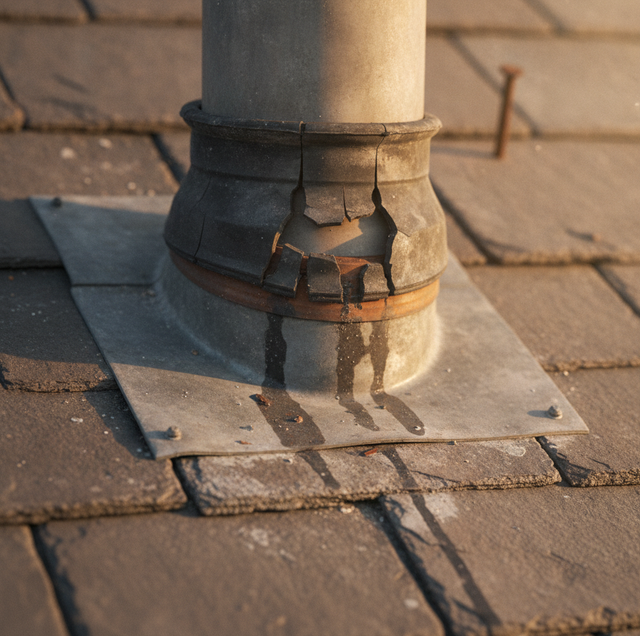
One of the most common leaks on any roof is also one of the cheapest to fix, and it hides in plain sight. Every plumbing vent that pokes through the roof is sealed with a boot, a metal or plastic flange that lies flat under the shingles, with a rubber collar (a gasket) that hugs the pipe where it exits. That rubber is the weak point. Sun and heat make it brittle, and eventually it splits, cracks, or crumbles around the pipe. Once it opens, water runs down the outside of the pipe and straight into the attic. You can often spot a failing boot from a ladder or with binoculars: look for a rubber collar that is cracked, dry-rotted, curled at the edge, or has a visible split. Replacing the boot, or slipping a rubber-and-metal collar over the old one, is a small repair, but left alone, it stains ceilings just like any major flashing failure.
How a Ceiling Stain Points Back to the Flashing
Water rarely drips straight down from where it enters. It runs along the underside of the decking, down a rafter, and across the ceiling before it finds a low spot to soak through, so the stain can land feet away from the real leak. Even so, the location tells a story. A stain that keeps reappearing near an interior chimney chase, or high on a wall where an upstairs room meets the roofline, points at chimney or step flashing far more often than at the shingles above it. A brown ring around a ceiling fixture in a bathroom or laundry (rooms with plumbing vents overhead) points at a pipe boot. Reading the stain's position and whether it only shows up in heavy or wind-driven rain is the first clue a roofer uses before ever getting on the roof.
What a Real Flashing Repair Involves
Fixing a flashing leak well means finding it first, and a good roofer does not just eyeball it. A common method is a controlled water test: one person runs a hose over the roof in stages, starting low and working up, one section at a time, while another watches inside for the moment water appears, which isolates the leak instead of guessing. On the roof, the roofer lifts the surrounding shingles to see what the flashing looks like underneath, since the failure is usually hidden below the courses. The repair itself depends on what is wrong. A cracked pipe boot gets a new boot. Corroded or reused flashing gets torn out and replaced with new metal, properly integrated, step flashing woven back in course by course at a wall, counter-flashing reset into a fresh groove in the mortar at a chimney. Where a joint really needs sealant, it is a finishing touch on sound metal, not the whole repair. The goal is always the same: get the metal doing the sealing so the detail sheds water on its own.
Frequently Asked Questions
Drip edge is the metal strip along the eaves and rakes that directs runoff into the gutter rather than letting it curl back under the shingles onto the fascia. Kick-out flashing, sometimes called a diverter, sits at the bottom of a roof-to-wall intersection and directs water running down that wall into the gutter rather than behind the siding. Both are small, inexpensive pieces that get skipped on some installs, and a missing kick-out, especially, is a notorious cause of hidden wall rot, because the water runs straight into the wall cavity where nobody sees it until the damage is done.
The chimney is usually first, because it is the largest and most complex penetration on the roof: it breaks the slope on several sides and depends on base, step, and counterflashing, all working together, so it has the most joints to go wrong. After the chimney comes roof-to-wall and dormer intersections, where step flashing must be woven correctly, course by course, then skylights and valleys, which funnel a lot of concentrated water. That order tells you where to look first: if you have a chimney and a leak, start there.
Usually not. A flashing leak is often a localized repair; re-flash the one chimney, wall, or pipe that failed, as long as the decking and framing underneath have not rotted from water sitting there, which is why catching it early keeps it small. It argues for more only on an older roof with widespread corroded flashing near the end of the shingles' life, where replacing the flashing during a re-roof beats patching one spot at a time. A roofer can tell you which case you are in after looking under the flashing.
Usually not. Flashing that has been on a roof for years is work-hardened, may be partly corroded, and often has old fastener holes and bends from the previous installation. Shingling over it saves a little money up front but leaves aged metal under a brand-new roof, and it commonly starts leaking while the new shingles still have most of their life left. Replacing flashing during a re-roof (especially valley, step, and chimney flashing) is standard good practice, so ask whether new flashing is included rather than assuming it is.
Two tools do most of the work. First is reading the interior stain and when it appears: its position, and whether it only leaks in wind-driven rain, narrows down the transition involved. Second is a staged water test: a hose is run over the roof low to high, one area at a time, while someone inside watches for the moment water shows, which pins the leak to a specific spot instead of a whole region. On the roof, the roofer lifts the shingles around the suspect flashing to inspect what is underneath, because the failure, a rusted low spot, a backed-out counter-flashing edge, a short piece, is almost always hidden below the surface.
Yes, and it explains why some roofs leak at the flashing sooner than others. Galvanized steel is steel with a zinc coating; once that coating wears through at an edge or scratch, the steel rusts and eventually perforates, so galvanized flashing tends to be the first to give out on an older roof. Aluminum does not rust the way steel does and holds up better in wet, humid conditions, which is why it is a common choice in hot climates. Copper is the longest-lived of the common options and can outlast the shingles by decades, though it costs more. Knowing which metal is on your roof hints at whether corrosion is a likely cause of the leak.
Putting the Clues Together
A roof leak that seems to come from nowhere almost always traces back to flashing, the metal that seals every place the roof is interrupted. Corrosion, dried-out sealant, a lifted or missing piece, a cracked pipe-boot collar, or flashing that was never installed right are the usual causes, and each one lets water in at a seam while the shingle field sheds rain just fine. Because the failure hides beneath the surface, the fix is rarely a dab of caulk; it is new metal properly integrated at the trouble spot. Catch it while the leak is small, and it stays a targeted repair rather than rotted decking.
Have a stain near a chimney, wall, or vent? Get the flashing inspected before the leak spreads. Epic Roofing LLC serves Mandeville, Covington, Baton Rouge. Call (225) 819-3742.
