
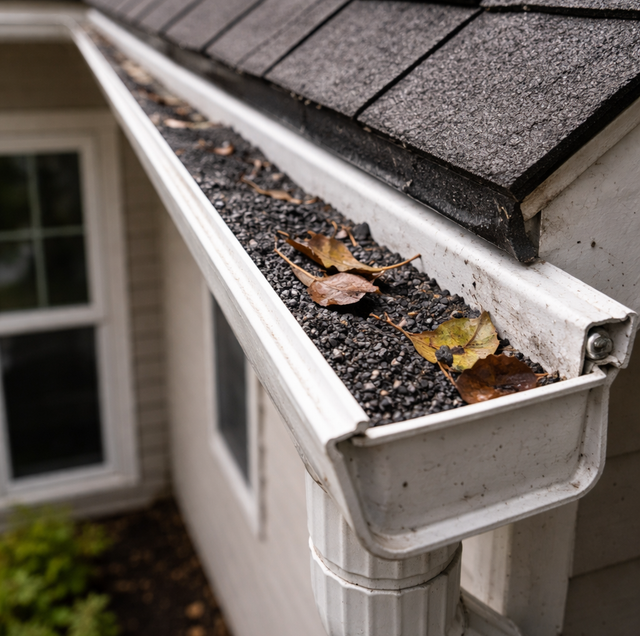
You clean the gutters, scoop out a handful of what looks like coarse black sand, and wonder where it came from. That grit is not dirt blown in from the yard. It is the mineral surface of your shingles, and once it starts collecting in the gutter in any quantity, the roof is telling you something about its condition.
Quick Answer: Those granules are the ceramic-coated mineral layer that shields the asphalt in your shingles from sunlight. A light sprinkle from a brand-new roof is normal factory shedding. A steady stream of granules off an older roof, especially with bare or shiny asphalt spots showing on the shingles, means the surface is wearing thin, and the roof is aging toward the end of its service life.
What the Granules Actually Are and Why They Matter
An asphalt shingle is built in layers. At its core is a fiberglass mat saturated in asphalt, and asphalt on its own is soft, sticky, and highly vulnerable to sunlight. To protect it, the manufacturer presses a dense layer of small mineral granules into the top surface while the asphalt is still hot. These granules are crushed rock coated in a hard ceramic finish, and they do several jobs at once.
They block ultraviolet light: UV radiation is the single biggest enemy of asphalt. It breaks down the oils that keep the asphalt flexible, causing it to dry out, harden, and crack. The granule layer acts as a shield, taking the sun's punishment so the asphalt underneath stays intact.
They add fire resistance: The mineral surface is non-combustible and helps a shingle earn its fire rating. A roof that has lost its granules has lost part of that protective quality.
They give the roof its color: The tint you see, whether weathered gray, driftwood, or charcoal, comes from the ceramic coating on the granules, not from the asphalt. That is why a worn shingle looks patchy and faded rather than uniformly colored.
Strip that mineral layer away and the asphalt is exposed directly to the elements. From that point, the shingle ages far faster, because the material doing the actual protecting is gone.
Normal Shedding Versus a Warning Sign
Not every granule in the gutter is bad news. The trick is knowing which kind of loss you are looking at.
A newly installed roof will shed a small amount of loose granules for the first months. These are excess granules that never bonded tightly during manufacturing, knocked free by rain and settling. A modest sprinkle after the first few storms on a new roof is expected and harmless.
The concern is a roof several years into its life that suddenly starts giving up granules in volume. On an aging shingle, the asphalt has grown brittle, and its grip on the mineral surface has weakened, so the granules let go in sheets rather than a few at a time. When an older roof is shedding heavily, that is wear, not break-in.
Think of the granule layer as the tread on a tire. A new tire sheds a little rubber dust as it beds in, but a tire worn down to the smooth casing has run out of the material that was doing the work. A roof reaching bare asphalt is at the same point.
What Causes Granules to Come Loose
Granule loss rarely has a single cause. A roofer reads it as one clue among several, then looks at the roof's age, the pattern of loss, and what else is happening up there.
Normal aging and end of life: The most common cause is simple time. Sun, heat, and thermal cycling gradually loosen the granule bond over years. As a roof approaches the end of its rated lifespan, granule loss accelerates on its own, and this is often the clearest sign that a roof is wearing out rather than suffering a specific injury.
Impact from hail: Hail strikes knock granules loose at the point of impact, leaving small dark bruises or dimples where the mineral surface has been driven off. Wind-driven rain does a milder version of the same thing over time, scouring granules from exposed faces and edges. Storms of any season can do this, so heavy granule loss right after a hailstorm often points to fresh impact damage rather than age.
Foot traffic. Walking on shingles grinds granules loose, especially in hot weather when the asphalt is soft, and the granules embed and dislodge easily. This is one reason roof-surface inspection is a job for a professional with fall protection, not a homeowner. Every unnecessary trip across the shingles shortens their life.
Blistering: Trapped moisture or gases can form small blisters in the asphalt. When a blister pops, it takes the granules above it with it, leaving a tiny bare crater. Clusters of these craters are a manufacturing or ventilation clue, not storm damage.
Lower-quality or aging shingles: Thinner, budget shingles carry a less durable granule bond and shed sooner than premium products. Two roofs of the same age can be in very different condition depending on what was installed.
The Bald Spot Red Flag
Granules in the gutter tell you loss is happening. Bare patches on the shingles tell you how far it has gone. When you can see the roof from a window or from the ground with binoculars, look for spots where the surface has turned smooth, dark, and shiny rather than textured and matte. Those shiny areas are exposed asphalt, the mineral shield gone and the soft core baking in the open.
A shiny asphalt spot is a more serious signal than loose granules alone. Once the asphalt is bare, that area has no UV protection left, and it will dry, crack, and fail well ahead of the rest of the roof. A scattering of small bald spots across a roof suggests widespread wear. A concentrated patch may point to a localized problem such as a blister cluster or a spot that took repeated impact.
How Granule Loss Speeds the Rest of the Failure
Losing granules is not a cosmetic problem, because it sets off a chain reaction. Bare asphalt absorbs far more heat than a granule-covered surface, so the exposed shingle runs hotter, and its oils cook off faster. As the asphalt dries, it loses flexibility and begins to crack. Cracks open paths for water, and a shingle that can no longer flex with temperature swings starts to curl and lift at the edges.
Each stage feeds the next. Granule loss leads to a hotter, drier shingle, which cracks and curls, which lets in water, which rots the decking below. That is why a roofer treats heavy granule loss as an early warning: it is often the first visible step in a sequence that ends with leaks and deck damage if nothing changes.
Checking Your Downspout Outlets After Storms
You do not need to get on the roof to track granule loss, and you should not try to. The safest place to read the evidence is at ground level.
You can track granule loss without getting on the roof. After a storm, check the splash area where each downspout empties. A light seasonal accumulation of grit is ordinary, but a fresh mound after a single storm, particularly a hailstorm, is worth a call.
Do the same quick check when you clean the gutters from a ladder or have them cleaned. A thin layer of sediment is normal. A heavy bed of granules packed along the gutter bottom, enough to feel like you are scooping wet sand, tells you the roof is shedding faster than a healthy surface should.
When It Means Repair and When It Means Replacement
Granule loss by itself does not automatically mean a new roof. The right response depends on how much is happening, where, and what else the roof shows.
Points toward repair: Loss concentrated in one area, on an otherwise sound roof still within its service life, often traces to a specific cause such as fresh hail impact or a small blister cluster. Replacing the affected shingles or a section can restore protection without redoing the whole roof.
Points toward replacement: Heavy loss spread across the entire roof, widespread shiny asphalt spots, and a roof already near the end of its rated life together say the surface is worn out as a whole. Patching a roof that is failing everywhere at once buys little time, because the areas you did not touch are close behind.
No single sign decides it. A roofer weighs granule loss alongside the roof's age, the condition of the flashing, whether shingles are curling or cracking, and what the decking looks like from inside. Granules in the gutter open the conversation. A full assessment closes it.
Frequently Asked Questions
No. The mineral layer is pressed into the asphalt once during manufacturing and cannot regenerate. Some sealant and coating products marketed for asphalt shingles claim to slow further loss by re-binding the surface, but these are maintenance measures, not a repair, and no product restores the original factory granule bond once it is gone.
A useful rule of thumb roofers use is the point where bare asphalt becomes visible across multiple shingles rather than a single spot. A gutter with a light dusting is fine, but if you can see the fiberglass mat or the shiny black asphalt itself on more than a few shingles, the surface has moved from maintenance territory into assessment.
Matching is harder than people expect. Because the color comes from the granule coating and that coating weathers over years, a new shingle rarely matches an aged one exactly, even in the identical product line. Roofers often pull replacement shingles from a less visible slope to blend a repair, or recommend replacing a full plane so the color reads uniform.
It can. Fine mesh guards catch granules before they reach the gutter trough, so the grit collects on top of the guard or washes over it instead of pooling where you would normally see it. If you have guards, check the downspout splash area and the top surface of the mesh rather than expecting a pile inside the gutter.
They are separate issues, though both show up on aging roofs. The dark streaks are a type of airborne algae feeding on the limestone filler in some shingles, not lost granules. Certain shingles include copper-coated granules that resist algae, which is one reason a streaked roof and a granule-shedding roof are not always the same problem.
Many roofing contractors provide a no-charge inspection and written assessment, especially when storm or hail damage may be involved, and an insurance claim could apply. During that visit, a roofer checks the granule loss against the flashing, valleys, ventilation, and attic side of the deck to judge whether the roof needs a targeted repair or has reached replacement.
Book a free roof check before small granule loss turns into a leak — a quick assessment tells you exactly where your roof stands. Epic Roofing LLC serves Mandeville, Covington, and Baton Rouge. Call (225) 819-3742.
